How to Prevent Construction Budget Overruns: They're Not Estimate Failures. They're Timing Failures.
How to Prevent Construction Budget Overruns (Before It's Too Late to Fix Them)
A general contractor in Nashville finishes a $2.3M commercial fit-out. The crew worked hard. The schedule held. The client signed off. Then the job-cost report arrives six weeks later — and the margin is gone. Not trimmed. Gone.
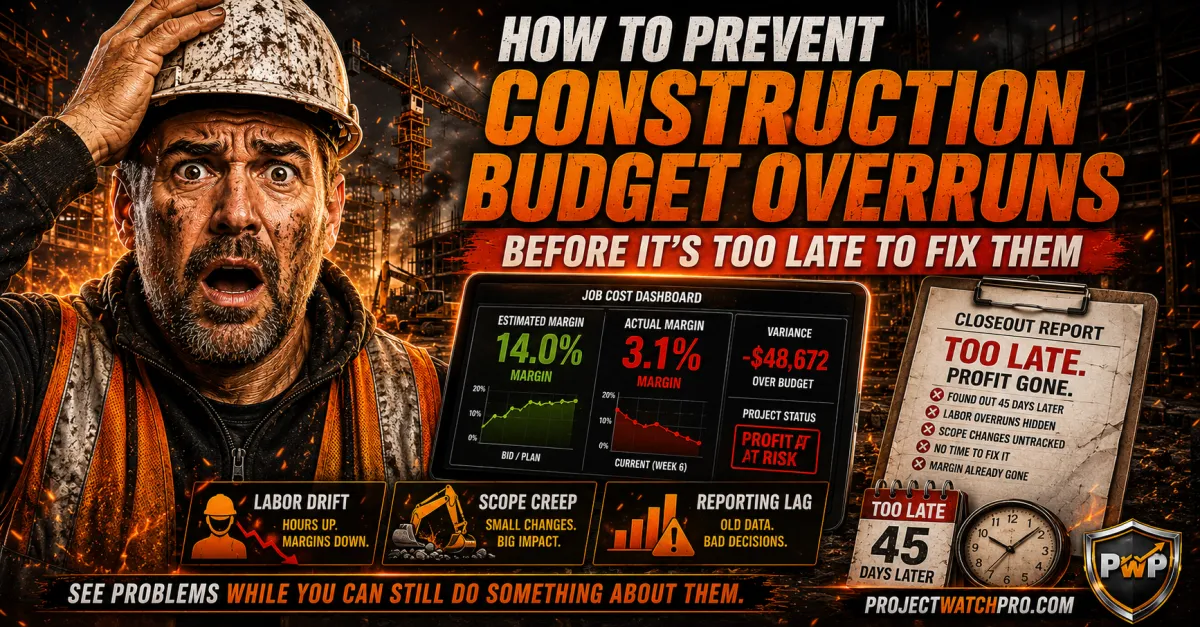
The job didn't lose money at the end. It lost money in week three, when one trade ran 40 hours over on rough-in and nobody flagged it. By the time the report showed the damage, the crew was on the next job and every decision that could have saved it was already in the past.
This is how most construction budget overruns actually happen. Not from bad bids. Not from lazy crews. From a reporting system that tells you about losses after there's nothing you can do about them.
You're not the problem. The operating model is.
Effective construction budget overrun prevention isn't about better spreadsheets or tighter contingencies. It's about closing the gap between when cost starts drifting and when you find out. Here's what's actually happening — and what to do about it.
Construction budget overrun: A situation where actual project costs exceed the original estimate, reducing or eliminating planned profit. Research consistently shows that cost overruns affect the majority of construction projects — with small and mid-size contractors ($1M–$20M) often hit hardest because they carry less financial cushion when a job goes wrong.

How to Prevent Construction Budget Overruns
How to Prevent Construction Budget Overruns (Before It's Too Late to Fix Them)
Why Most Construction Budget Overruns Happen After the Damage Is Already Done
What Causes Construction Projects to Go Over Budget?
The Real Culprit — A 45-Day Gap Between When Money Leaves and When You Find Out
The Three Structural Causes You're Almost Certainly Missing
1. Your Labor Cost Estimate Was Wrong Before the Job Started
2. Task-Level Drift Is Invisible Until the Job Total Collapses
3. Your Reporting Cycle Arrives Too Late to Help
How to Actually Prevent Construction Budget Overruns — The Real-Time Approach
Step 1 — Fix the Labor Cost Number First
Step 2 — Track by Task, Not by Job Total
Step 3 — Shorten the Decision Window to Hours, Not Weeks
Step 4 — Run Weekly Cost Review While the Job Is Alive
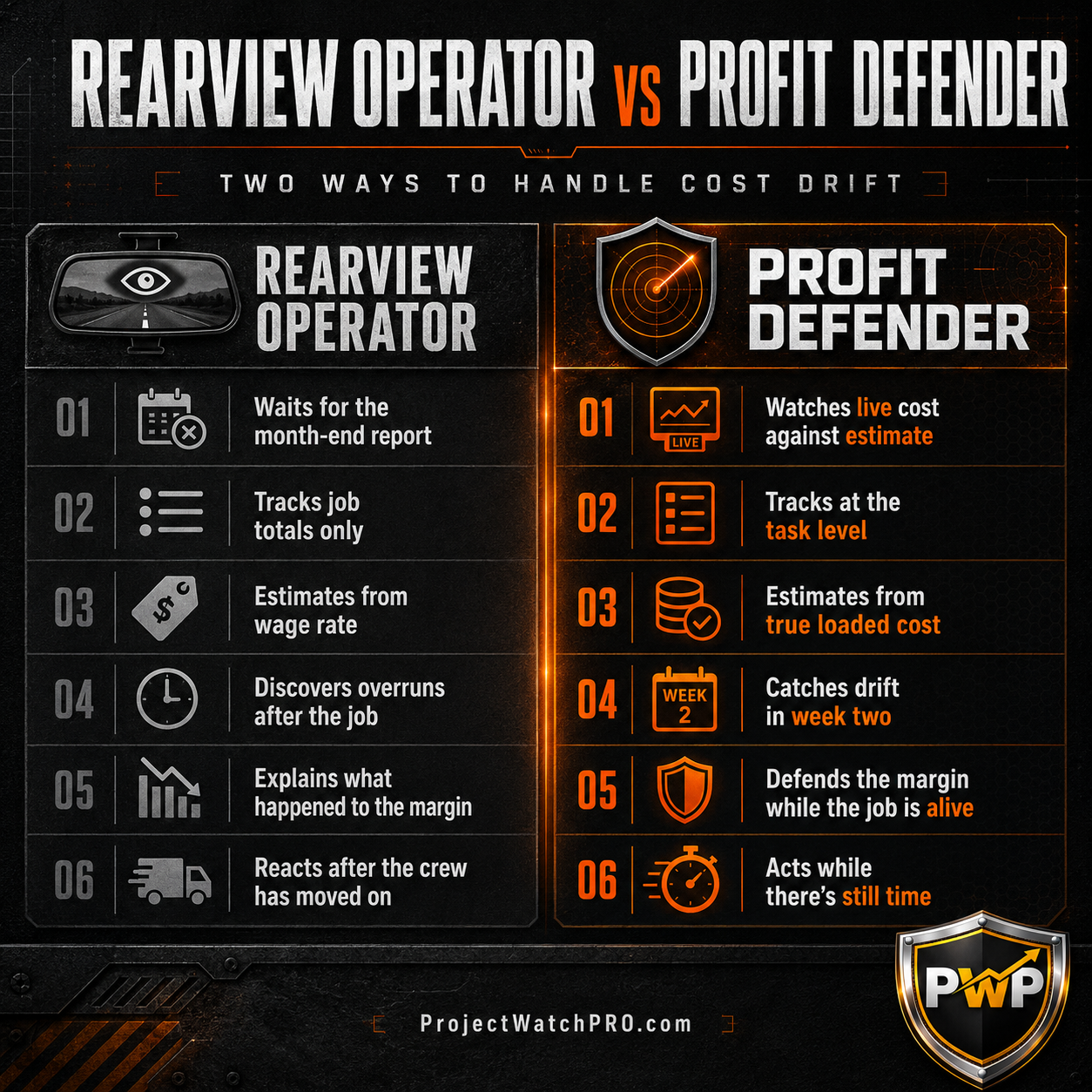
Rearview Operator vs Profit Defender — Two Ways to Handle Cost Drift
Why Most Construction Budget Overruns Happen After the Damage Is Already Done
Construction cost overruns have a reputation for being an estimating problem. Contractors bid too low. Labor rates were wrong. Material costs spiked. The fix, according to most advice: estimate better, add a bigger contingency, use more detailed specs.
That advice treats the symptom and ignores the disease.
The most dangerous budget overruns are ones you could have fixed — if you'd known in time.
A job can be bid correctly, scoped correctly, and still lose money. Not because the numbers were wrong, but because the feedback arrived too late. By the time most contractors see a cost overrun on a report, the job is closed, the crew has moved on, and corrective action is impossible.
The difference between a manageable cost drift and a catastrophic budget overrun is almost always timing.
What Causes Construction Projects to Go Over Budget?
The most common root causes — confirmed across thousands of contractor P&Ls — fall into five categories:
1. Underestimated labor cost — The bid was built on a wage rate, not a true loaded cost. The difference between the two is typically 2x–3x. (More on this below.)
2. Scope creep without cost capture — Work happens in the field that was never formally authorized or priced. The job grows; the contract doesn't.
3. Task-level drift that hides inside the job total — One phase runs 30 hours over budget, but the overall job total still "looks okay." Nobody catches it until the end of the job.
4. Change orders not processed in time — The work gets done. The paperwork lags. Cost rises before revenue catches up.
5. Reporting lag — The data exists, but it's fragmented across field logs, PM updates, and accounting — none of which sync in real time.
The first four are real problems. But the fifth one is what turns a manageable drift into a full loss.
The Real Culprit — A 45-Day Gap Between When Money Leaves and When You Find Out
In my experience working with trades businesses across two decades, I call this the 45-Day Blind Spot.
Here's how it works. A job starts. Costs begin accumulating — labor hours, materials, subcontractor invoices. The field knows things are moving. The PM feels it. But the financial picture doesn't crystallize until accounting reconciles everything, allocates overhead, and produces a job-cost report.
By the time that report arrives, it's 30, 45, sometimes 60 days after the costs occurred.
And inside that gap — between when the money started leaving and when the report showed it — every decision you could have made has expired.
This is the construction industry's most expensive operating problem. And it's not caused by bad estimating. It's caused by delay.
The Three Structural Causes You're Almost Certainly Missing
Most guides to construction budget overrun prevention focus on project management tactics: better documentation, tighter scope control, mandatory change order processes. These help at the margins. But they don't fix the three structural problems that drive the biggest losses.
1. Your Labor Cost Estimate Was Wrong Before the Job Started
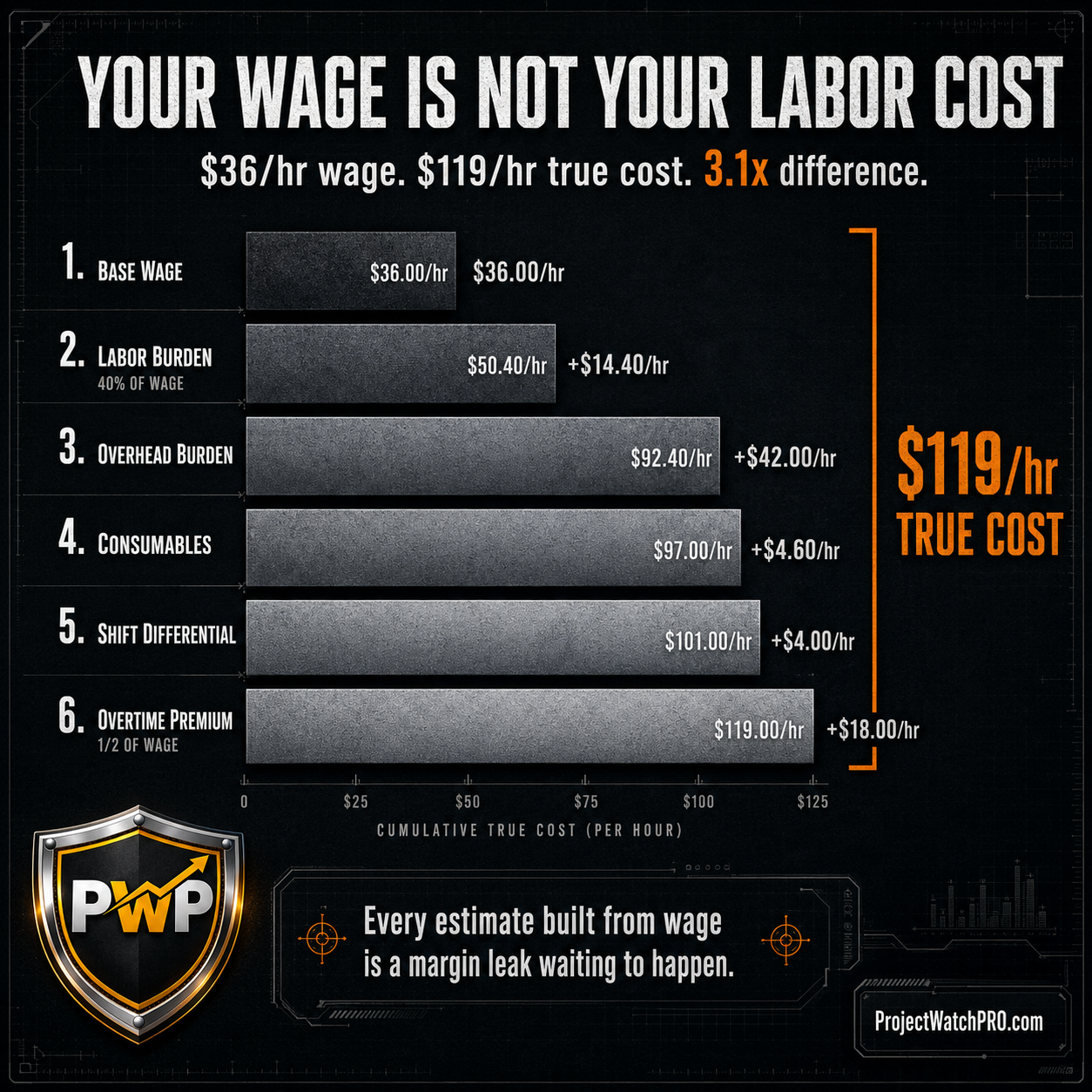
Here's a number that surprises most contractors: if your field labor earns $36/hour, the true cost to your business is closer to $119/hour.
The gap is explained by six cost layers:
1. Base wage
2. Labor burden (payroll taxes, workers' comp, benefits)
3. Overhead burden (your proportional operating cost per labor hour)
4. Task-specific consumables (materials used on the specific task)
5. Shift differential
6. Overtime premium
Most estimates are built on the wage — Layer 1 only. The business pays all six. That 3.1x multiplier is built into every job you run, whether you account for it or not.
When the estimate uses $36/hour and reality costs $119/hour, there is no version of this job where the margin survives. The budget overrun was locked in before the crew set foot on site.
2. Task-Level Drift Is Invisible Until the Job Total Collapses
Job totals are misleading. A job can look "on budget" at the total level while one task is burning through its hours at twice the estimated rate.
Here's what typically happens: rough-in runs 35 hours over. Trim-out picks up some time. The PM checks the job total — it still looks within range. Nobody flags the rough-in problem. The job rolls forward.
By the time the final number comes in, the margin is gone. And the autopsy shows it all happened in one phase, weeks ago, when there was still time to adjust the labor deployment, call a change order, or re-sequence the work.
If the task is invisible, the leak is invisible. Budget overrun prevention requires task-level tracking, not just job-level reporting.
3. Your Reporting Cycle Arrives Too Late to Help
This is the structural failure that compounds everything else.
A job-cost report can be 100% accurate and still be completely useless — if it arrives after the work is done and the crew has moved on. Accuracy isn't the problem. Timing is.
The average construction reporting cycle — field data to PM to accounting to reconciled report — runs 3 to 6 weeks behind reality. On a 6-week job, that means your financial picture is always one whole project behind. You're managing the current job with data from the last one.
Rearview mirror management. It feels like control. It isn't.
How to Actually Prevent Construction Budget Overruns — The Real-Time Approach
Construction budget overrun prevention works when it shortens the decision window — the time between when a cost problem starts and when someone in a position to act actually sees it. The goal is not to catch overruns at the end of the job. The goal is to catch drift while the job is still alive.
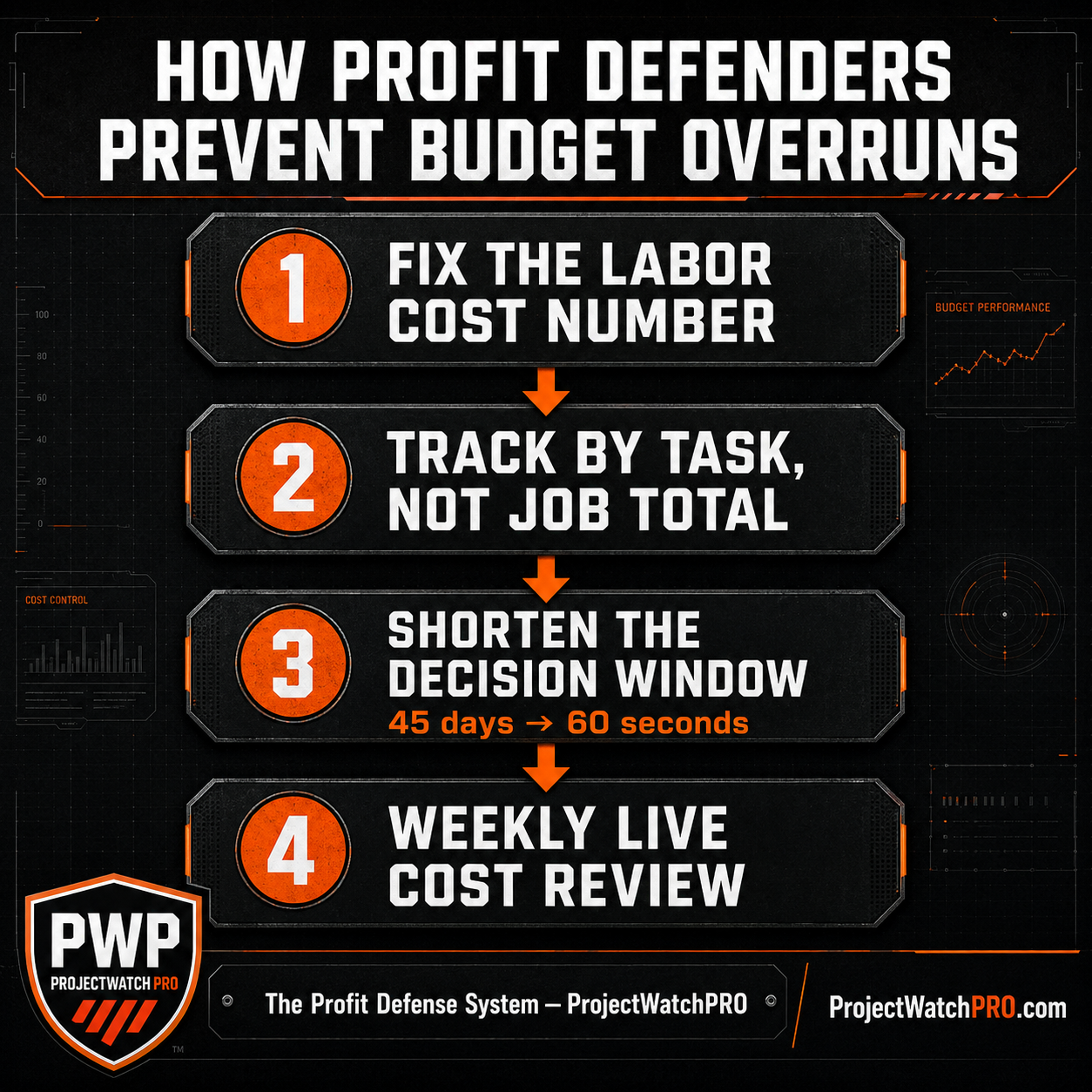
Here's the framework:
Step 1 — Fix the Labor Cost Number First
Before you can defend a budget, you need an accurate starting point. Run the true cost calculation for your top labor category:
1. Start with base wage
2. Add labor burden (typically 25–35% of base wage)
3. Add your overhead burden rate (divide total overhead by total billable labor hours)
4. Add task-specific consumables relevant to that trade
5. Factor in shift differential if applicable
6. Factor in overtime exposure on jobs with schedule compression
The result is your true loaded labor cost. Use this number in every estimate going forward. The $36 → $119 gap is not a rounding error — it's the structural reason margins collapse on jobs that look well-bid.
Use the True Labor Cost Calculator at truelaborcost.site to run this in three minutes.
Step 2 — Track by Task, Not by Job Total
Job totals create false confidence. Re-organize your job costing structure around tasks or phases, with a budget allocation and hour tracking at each level.
The specific tasks depend on your trade — rough-in vs. trim, civil vs. vertical, phase 1 vs. phase 2 — but the principle is constant: if you can't see which task is running over, you can't fix it in time.
When task-level data exists, a drifting phase becomes visible in week two — not at the end of the job. That's the difference between a recoverable problem and an explanatory post-mortem.
Step 3 — Shorten the Decision Window to Hours, Not Weeks
This is where the real leverage lives. Every day of lag in your reporting cycle is a day you can't act.
The Profit Defense System tracks labor cost against estimate in real time — updating as hours are logged, not as reports are generated. When a task starts running over, the dashboard reflects it immediately. The PM doesn't wait for accounting. The owner doesn't wait for month-end.
Systems like ProjectWatchPRO update every 60 seconds — pulling field labor data, applying true loaded cost, and comparing against task-level budget in real time. The result: margin drift is visible while the crew is still on the job, decisions can still be made, and the budget can still be defended.
That is the difference between 45 days and 60 seconds.
Step 4 — Run Weekly Cost Review While the Job Is Alive
Real-time data requires a decision rhythm to be useful. Build a weekly job review cadence — not a post-mortem review, a live review — that asks:
- Which tasks are over their hour budget right now?
- What is the current margin projection vs. the estimate?
- What decision can we make this week that protects the margin?
Profit Defenders don't review jobs after they're done. They defend them while they're running.
Rearview Operator vs Profit Defender — Two Ways to Handle Cost Drift
The construction industry has two types of operators. Both work hard. Both win jobs. Only one catches budget overruns in time to do something about them.
The tools, the data, and the math are the same for both. The only difference is timing — and timing is everything.
Key Takeaways
- Budget overruns are mostly timing failures, not estimating failures. The damage often happens weeks before the report confirms it.
- The 45-Day Blind Spot is the gap between when cost starts drifting and when you find out. Closing that gap is the core of construction budget overrun prevention.
- True labor cost is 2x–3x the wage rate. Estimating from wage alone locks in a structural loss before the job starts.
- Task-level tracking is non-negotiable. Job totals hide the leaks until it's too late to fix them.
- Real-time job costing — systems that update as hours are logged, not as reports are generated — is the only way to catch drift while the job is still recoverable.
- The decision window matters more than the accuracy of the final report. A perfect report after the job closes doesn't protect profit. It explains what happened to it.
- Weekly live job reviews — not monthly post-mortems — are what separate contractors who defend margins from contractors who explain losses.
Frequently Asked Questions
What causes construction projects to go over budget?
The most common causes are underestimated labor cost, scope creep without cost capture, task-level drift hidden inside the job total, delayed change order processing, and reporting lag. The most damaging — and most overlooked — is reporting lag: by the time a contractor sees cost overrun data, the opportunity to correct it has already passed.
How do you avoid cost overruns in construction?
The most effective approach combines three elements: accurate true labor cost in every estimate (not just wage rate), task-level budget tracking so drift is visible before the job total collapses, and a real-time reporting cadence that surfaces cost variances while the crew is still on site and corrective action is still possible.
What is job costing and how does it prevent overruns?
Job costing is the process of tracking all costs — labor, materials, subcontractors, overhead — against a specific job's budget in real time. When structured at the task level and updated continuously rather than at month-end, job costing gives project managers a live picture of where margin is being lost and when. This allows intervention while the job is still running, not after it closes.
How does poor estimating lead to cost overruns?
Poor estimating — particularly underestimating true labor cost — creates a structural deficit before the job starts. When a bid is built on wage rate rather than fully loaded labor cost (wage + burden + overhead + consumables), the gap between bid cost and actual cost is baked in from day one. No amount of field efficiency recovers it.
What tools help contractors track budget in real time?
Real-time job costing platforms like ProjectWatchPRO track labor cost against task-level budgets continuously — updating as hours are logged from the field, applying true loaded labor cost, and surfacing margin drift before the job closes. The key distinction from traditional job costing software: real-time systems show you the problem while you can still fix it, not after.
How do change orders affect construction budgets?
Change orders create budget overruns when they're not captured and priced in time. The work happens in the field before the paperwork is processed — costs accumulate against the original budget, and the job appears over budget until the change order revenue is recognized. Real-time cost tracking helps flag the timing mismatch before it compounds.
The contractors who consistently protect their margins don't have better bids than everyone else. They have better feedback — faster, more specific, and delivered while there's still time to act.
If you want to find out what your labor is actually costing you — not the wage rate, but the real number including burden, overhead, and true loaded cost — the True Labor Cost Calculator does it in about three minutes.
No signup. No pitch. Just the number you need to stop underestimating.