
Construction Overhead Rate: Why You're Leaving $30–$60/Hr on the Table
Your Overhead Rate Is Wrong — And It's Costing You More Than You Think
You finished a job last quarter that should have come in at 11% margin.
You managed it well. Scope was clean. Crew executed.
The job closed at 2.8%.
You spent two weeks looking for the mistake. Bad materials? Change order you missed? Subcontractor overrun?
It wasn't any of those things.
It was your overhead rate — the number you haven't actually calculated since you set it three years ago. A flat 15% of base wage. Felt reasonable. Still does. For most project-based businesses, that flat percentage is the single biggest error in their construction overhead rate calculation — and it compounds on every job.
But here's what 15% of base wage doesn't cover: every hour your crew is in the field, they're consuming your office, your admin, your insurance, your vehicles, your software, and your equipment. Those costs don't care how tight the job was bid. They run every month, billed or not.
If that cost isn't in your rate, it's coming out of your margin. Every hour. Every job. Right now.
Overhead burden rate is the cost of running your business — rent, insurance, admin, utilities, vehicles, software — expressed as a dollar amount per productive billable hour. It's Layer 3 of the [True Cost Baseline](/true-labor-cost-contractors) — the 6-layer framework that reveals what an employee actually costs to deploy — and for most project-based businesses it runs between $30 and $60 per hour — far higher than the 10–20% of base wage most estimates assume.
Construction Overhead Rate: Why Contractors Under-Recover
Your Overhead Rate Is Wrong — And It's Costing You More Than You Think
Why Most Project-Based Businesses Are Under-Recovering Overhead Right Now
What Overhead Actually Is (And What Doesn't Count)
Why the "10 and 10 Rule" Is Breaking Project Business Margins in 2026
How to Calculate Your True Overhead Rate Per Billable Hour
Step 1 — Total Your Annual Overhead Costs
Step 2 — Calculate Your Total Monthly Billable Hours
Step 3 — Divide to Find Your Overhead Cost Per Hour
Running the Math — How Overhead Turns $32/hr Into $87/hr
Why Most Project-Based Businesses Are Under-Recovering Overhead Right Now
The construction industry averaged 14.8% gross margin in 2024, according to CFMA benchmark data. That number applies broadly to any project-driven operation — electrical, plumbing, mechanical, fabrication, painting, sandblasting — because the cost structure is the same. Almost no room for overhead miscalculation. Yet most project-based businesses are carrying a gap on every single hour they bill — because their overhead estimate was built on a rule of thumb, not the actual math.
Here's how it usually goes.
You heard "10 and 10" — add 10% overhead, 10% profit. Or maybe you pushed it to 15% and felt conservative. That number went into your estimating template. Maybe it came from a mentor. Maybe you reverse-engineered it from a job that seemed to work.
What it didn't come from: your actual books.
The result is predictable. In 2026, with overhead costs rising across the board — insurance premiums up, admin wages up, software and equipment costs up — the gap between what you estimate for overhead and what you actually spend is widening. Every month your rate stays static and your costs climb, you're losing more on every billable hour.
Any project-based business that hasn't recalculated its overhead rate in the last 12 months is almost certainly under-recovering it. That's not a theory. It's arithmetic.
What Overhead Actually Is (And What Doesn't Count)
Before you can calculate your overhead rate, you need to be precise about what goes in the number.
Overhead includes every cost of running your business that isn't directly tied to a specific job:
- Office rent or home-office allocation
- Administrative and management salaries (including your own, if you do admin work)
- Business insurance — general liability, errors and omissions, vehicle coverage
- Utilities for your office or shop
- Company vehicles not charged directly to jobs
- Tools and equipment used across multiple jobs
- Software — accounting, estimating, project management, communication
- Phone and internet
- Professional fees — accounting, legal
- Training, certifications, industry memberships
Overhead does NOT include:
- Direct labor on a specific job
- Materials purchased for a specific job
- Subcontractor costs tied to a specific job
- Equipment rented for a specific job
- Job-specific permits and fees
The distinction matters because overhead must be recovered across all billable hours — not charged to one job. It's the cost of keeping your operation running, regardless of which job is active.
Why the "10 and 10 Rule" Is Breaking Project Business Margins in 2026
The "10 and 10 rule" — add 10% overhead and 10% profit — was a shortcut built for a different era.

It assumes your overhead runs at 10% of direct costs. For a project-based operation — electrical, plumbing, mechanical, welding and fabrication, sandblasting, painting, or any other trade running $2M–$5M — overhead typically runs 25–45% of revenue or, when expressed as a per-hour rate, often exceeds $40 per billable hour. The 10% rule misses that by a factor of three or four.
Here's what actually happens when you apply 10% overhead on a $32/hr base wage:
You estimate $3.20/hr for overhead.
But your rent, your admin, your insurance, your trucks, your software — spread across every productive hour your crew works — actually costs $38/hr.
That's a $34.80/hr gap. On every hour. For every employee.
At 1,700 billable hours per year, that's $59,160 in unrecovered overhead per employee, per year — on a rate that looked perfectly reasonable when you set it.
Scale that across three field employees and you're leaking $177,000+ in overhead every year. On jobs that estimated fine.
The "10 and 10 rule" isn't a conservative approach to overhead. In 2026, it's a structural margin drain.
How to Calculate Your True Overhead Rate Per Billable Hour
This is the calculation most project-based business owners have never done. It takes about 30 minutes the first time — and it's the most important number in your estimating process.
Step 1 — Total Your Annual Overhead Costs
Pull your last 12 months of financial statements. Add up every cost that is not directly tied to a specific job. Use the list above as your guide.
Be thorough. Many business owners forget to include:
- Their own salary for administrative time (not field time — the time spent on quotes, HR, accounting, and meetings)
- Depreciation on equipment used across jobs
- Financing costs on company vehicles or equipment
- Software subscriptions that support the whole business
Total these up. That's your annual overhead.
For a 3–5 person field-crew operation, this number typically falls between $180,000 and $480,000 per year, depending on the scale of the operation.
Step 2 — Calculate Your Total Monthly Billable Hours
Count how many hours your field employees spend on billable work in a typical month.
Not total hours on the clock. Productive billable hours — hours that can be charged to a client project.
Industry benchmarks (Deltek Clarity, CFMA, Zweig Group 2024–2026) put productive billable hours for field crew at 1,600–1,800 per employee per year, or roughly 133–150 hours per month per employee.
The gap between hours on the clock and billable hours is significant. Commute, yard time, training, safety meetings, re-work, idle time waiting for materials or access — these hours consume overhead but generate no revenue. That's exactly why the overhead rate per billable hour is higher than most project-based businesses expect.
Multiply your per-employee monthly billable hours by your number of field employees. That's your total monthly billable hours.
Example:
- 4 field employees × 140 billable hours/month = 560 billable hours/month
Step 3 — Divide to Find Your Overhead Cost Per Hour
Take your annual overhead and divide by 12 to get monthly overhead. Then divide monthly overhead by your total monthly billable hours.
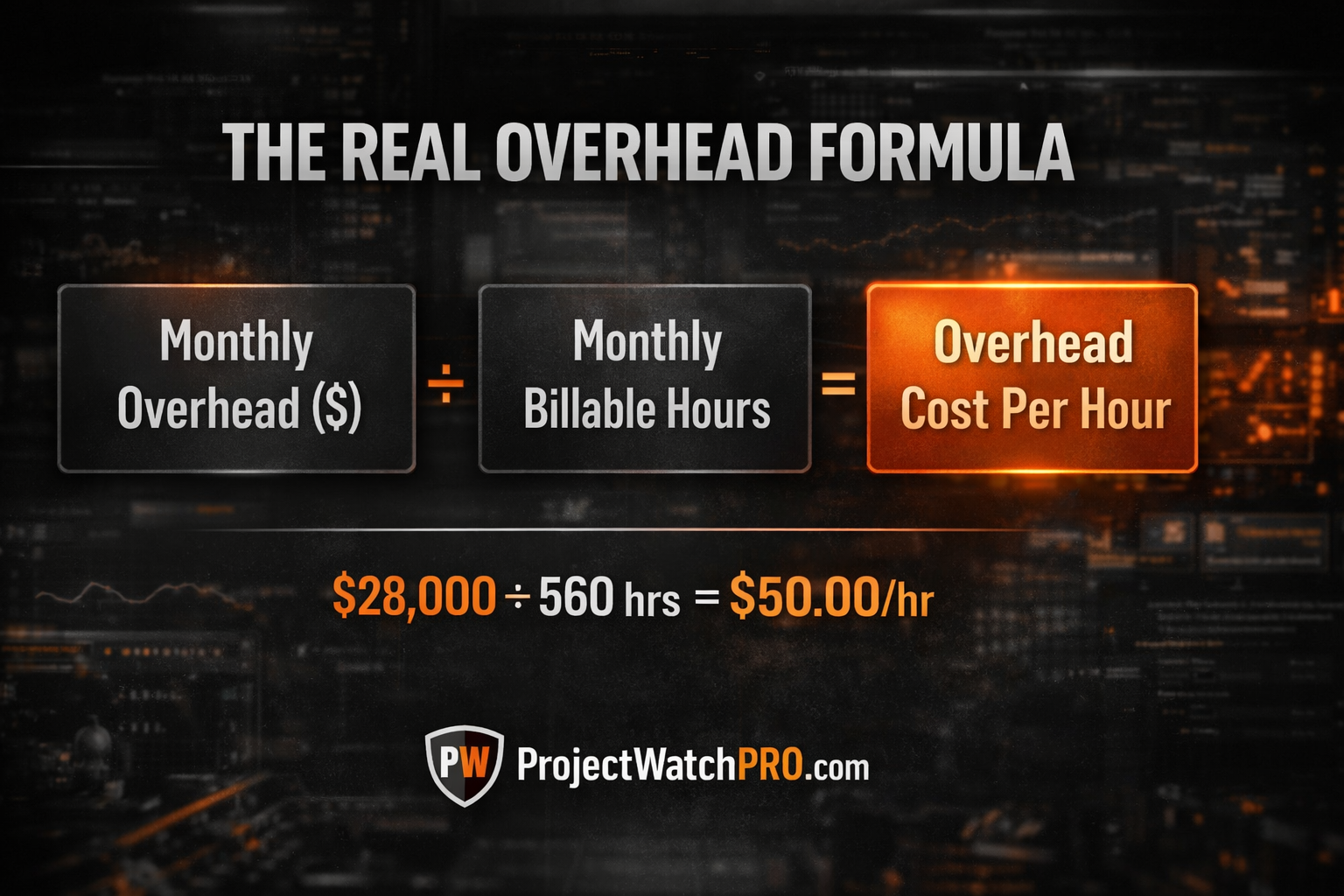
Overhead Rate Per Hour = Monthly Overhead ÷ Monthly Billable Hours
Example:
- Annual overhead: $336,000
- Monthly overhead: $28,000
- Monthly billable hours: 560
- Overhead rate: $28,000 ÷ 560 = $50.00/hr
That $50.00 is the cost of running your business for every single hour a field employee works on a client project. It rides on every hour, on every job, every month.
If your estimate only allocates $4.80 for overhead on that same hour — which is 15% of a $32 base wage — you're starting $45.20/hr in the hole before the employee touches a tool.
Running the Math — How Overhead Turns $32/hr Into $87/hr
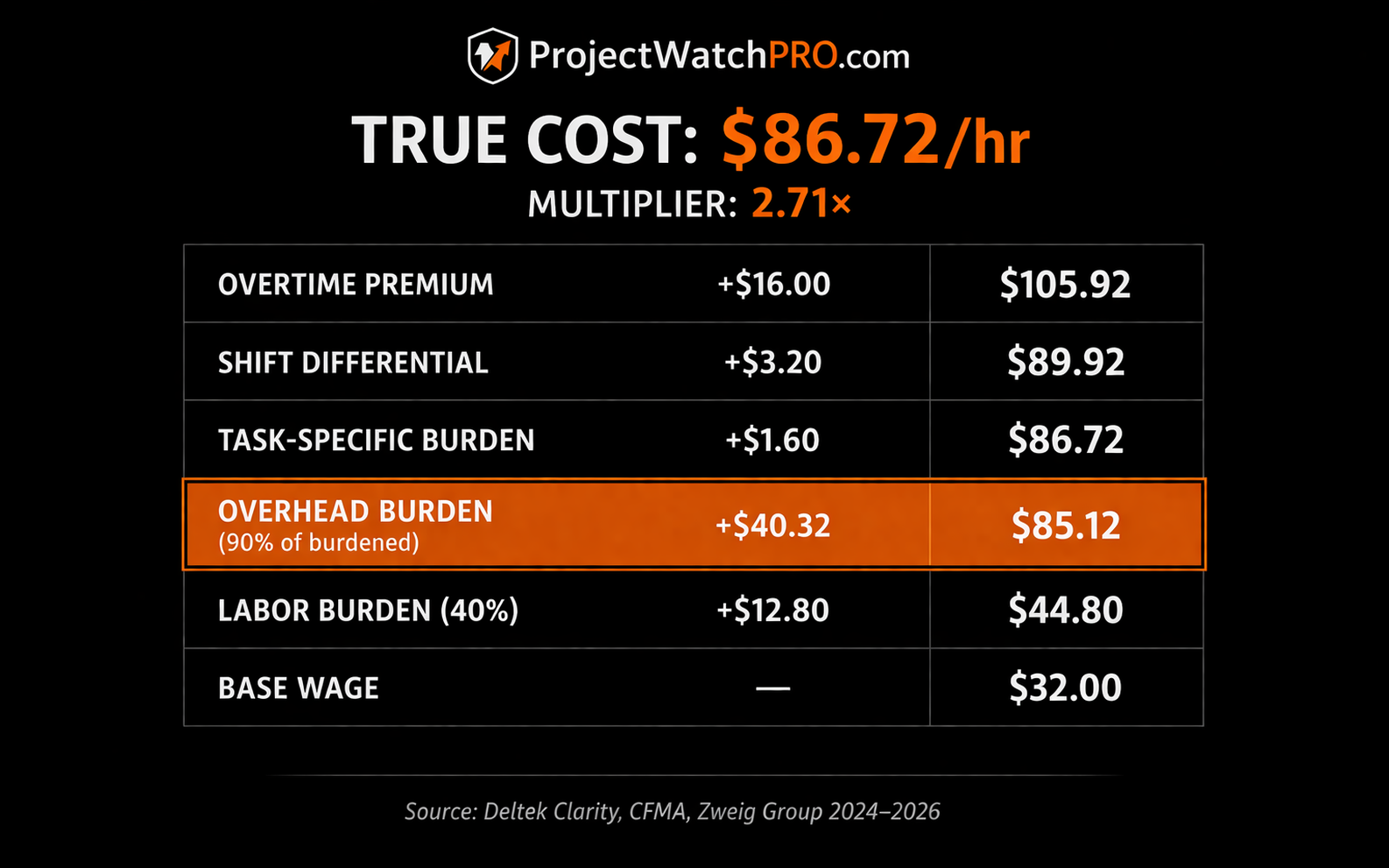
Here's what the full 6-layer True Cost Baseline looks like for a $32/hr base wage employee, using industry benchmark rates:
Without shift differential or overtime premium. Source: Deltek Clarity, CFMA, Zweig Group 2024–2026 benchmarks
Most project-based businesses price that employee at $32–$44/hr.
The true cost to deploy them — before a single shift premium or overtime hour — is $86.72.
The overhead layer alone adds $40.32/hr. That's not a rounding error. That's the largest single gap between what project-based businesses think labor costs and what it actually costs.
The Hidden Cost Multiplier for this employee: 2.71×. For every $32 you think you're spending on labor, you're actually spending $86.72.
If your current rate doesn't reflect that overhead layer — rebuilt from your actual books, not a flat percentage — every job you estimate is absorbing the gap in margin.
What Happens to Your Overhead Rate When Billable Hours Drop
This is the part most project-based businesses don't think about until it's too late.
Your overhead is mostly fixed. Rent doesn't drop because you had a slow month. Insurance doesn't get cheaper because a project pushed. Admin salaries don't flex with your job load.
But your billable hours do.
When a project delays, when a crew member is sick for a week, when a job pushes two weeks and the next one can't start — your total billable hours for the month drop. Your overhead doesn't.
That means your overhead rate per hour goes up.
If your overhead rate was $50/hr at 560 billable hours and a project delay drops you to 420 billable hours, your actual overhead rate jumps to $66.67/hr — with no change in your spending.

When you're running fewer billable hours, your overhead per hour climbs. When your rate is static, that climb comes out of margin.
This is why project-based businesses that track overhead per billable hour — and update it regularly — catch margin erosion before it becomes a job-close surprise. Static rates hide the drift. Real numbers surface it.
The old way: you set an overhead percentage once, embed it in your estimating template, and find out it was wrong six weeks after the job closes — when the damage is done and the money is gone. The new way: you calculate your overhead rate from your actual books, update it when your cost structure shifts, and know before you send the estimate that every layer is covered. Same crew. Same jobs. Different number going in — which means a completely different number coming out.
That shift starts with one calculation. The one in the next section.
Key Takeaways
- Most project-based businesses estimate overhead at 10–20% of base wage — a flat percentage that under-recovers by $30–$50/hr for typical field-crew operations.
- The correct overhead rate is calculated from your actual books: Annual overhead ÷ 12 = monthly overhead. Monthly overhead ÷ monthly billable hours = overhead cost per hour.
- Overhead is Layer 3 of the True Cost Baseline — the third number that must be in your charge-out rate. If it's not, it comes out of margin.
- For most project-based operations running 3–5 field employees — whether electrical, plumbing, fabrication, painting, or any other trade — overhead runs $35–$60/hr per productive field hour — not 10% of base wage.
- A $32/hr employee with correct overhead allocation applied costs $86.72/hr to deploy — a 2.71× multiplier on base wage.
- When billable hours drop, overhead rate per hour goes up automatically. Static rates hide this. Calculated rates surface it.
- Overhead is not a fixed percentage. It's a live number that must be recalculated at least annually — and adjusted when your cost structure or billable hour volume changes.
Frequently Asked Questions
Q: How do you calculate the overhead rate for a construction company?
Add up all annual overhead costs — rent, insurance, admin salaries, utilities, vehicles, software — and divide by 12 for monthly overhead. Then divide by your total monthly billable field hours. The result is your overhead cost per billable hour. This number should be rebuilt from your actual books at least once per year.
Q: What is a typical overhead percentage for project-based businesses?
Industry benchmarks (CFMA, Deltek Clarity) show overhead at 25–45% of revenue for most field-crew operations — electrical, plumbing, fabrication, painting, and other trades — which translates to $35–$60 per productive billable hour for a 3–5 person operation. The "10 and 10" rule significantly underestimates this, leaving most operations under-recovering overhead by 60–80%.
Q: How do project-based businesses allocate overhead costs to jobs?
The correct method: calculate total monthly overhead, divide by total monthly billable hours to get a cost per hour, then apply that rate to every billable hour worked on each project. A project consuming 200 hours of a 560-hour month absorbs 35.7% of monthly overhead — automatically, proportionally, without any separate calculation per job.
Q: What is an overhead burden rate in construction?
The overhead burden rate is your fixed business operating costs expressed as a dollar amount per productive billable hour. It's Layer 3 of the True Cost Baseline — stacked on top of base wage and labor burden (taxes, WC, benefits). When overhead burden is correctly included, the total burdened hourly cost of a field employee typically runs 2.4×–2.8× their base wage.
Q: Why do project-based businesses fail to recover their overhead costs?
The most common reason is using a flat percentage (10–20% of base wage) instead of calculating actual overhead per billable hour from their books. The flat percentage underestimates overhead by a factor of two or more, and never updates when costs rise or billable hours shift. The gap is absorbed by job margin — silently, on every project.
Q: How often should a project-based business recalculate its overhead rate?
At minimum, annually — using the previous 12 months of actual overhead costs. In practice, any time your cost structure changes significantly (new hire, lease increase, major equipment purchase) or when you notice billable hour volume shifting consistently up or down. A rate that's more than 18 months old is almost certainly wrong in 2026.
Find Out If Your Overhead Rate Is Covering Your Costs
You can run this calculation with a spreadsheet. Pull the last 12 months of overhead expenses, count the billable hours, divide. It'll take about an hour the first time.
Or you can run it in two minutes.
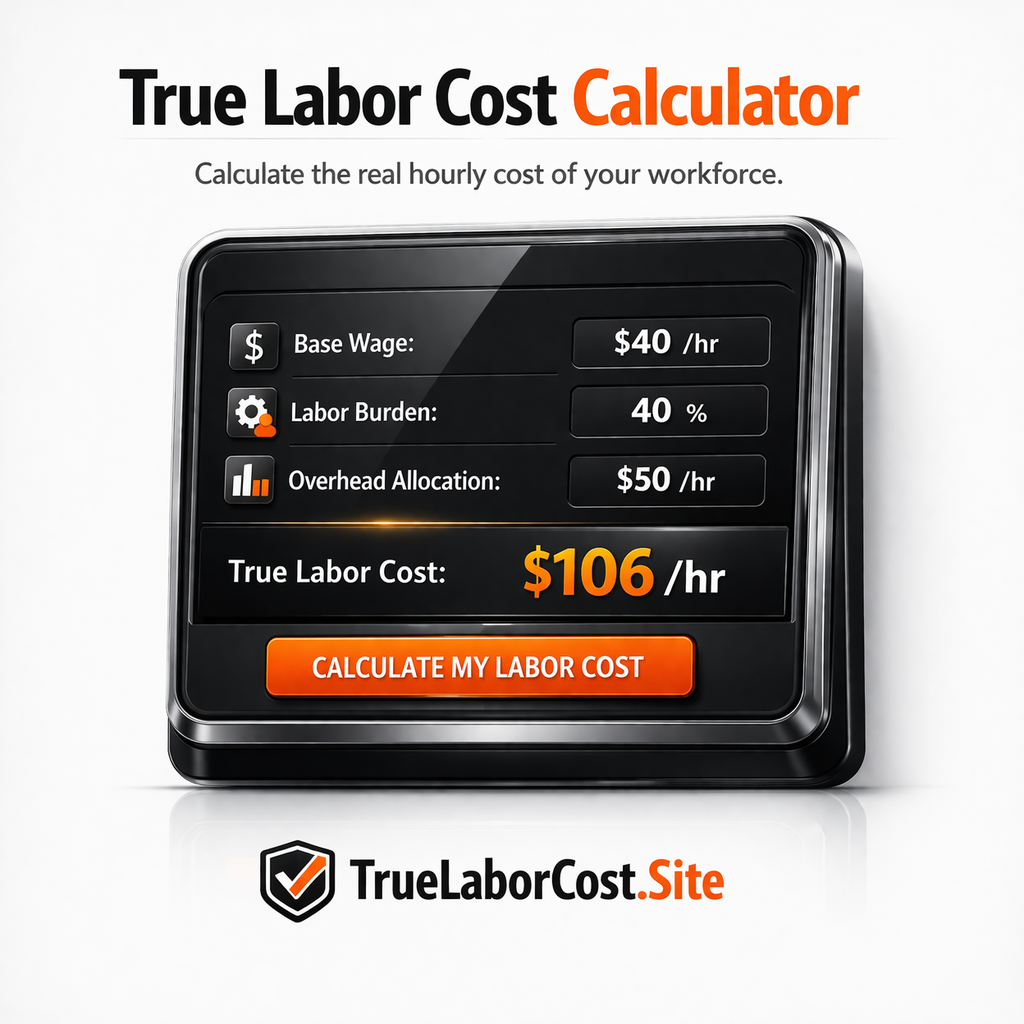
The True Labor Cost Calculator at truelaborcost.site builds the full 6-layer True Cost Baseline — including the overhead layer — using your actual inputs or industry benchmark defaults.
Enter your base wage and work rate, select your overhead allocation method, and see:
- Your overhead cost per billable hour — the real number, not a percentage guess
- Your full burdened hourly cost — all six layers stacked
- Your Hidden Cost Multiplier — the ratio between what you think labor costs and what it actually costs
- Your annual margin leak — if your current charge-out rate is built on the old method
Most project-based businesses that run it find their overhead layer is off by $20–$40/hr. On a five-person crew at 1,700 hours each, that's $170,000–$340,000 in overhead that isn't being recovered annually.
Once you have your true cost — with overhead correctly built in — the next step is making it permanent. That's Step 1 of the [Profit Defense System](/profit-defense-system): the True Cost Baseline, installed as the single pricing standard for every estimate, every job cost report, and every margin review your business runs.
→ Calculate Your True Overhead Rate at truelaborcost.site


