Where Did the Money Go? Construction Profit Fade Explained
Where Did the Money Go? Construction Profit Fade — Why Your Jobs Lose Margin Before You Ever See It
The job is done. The crew did the work. You got paid.
Then the final accounting comes in.
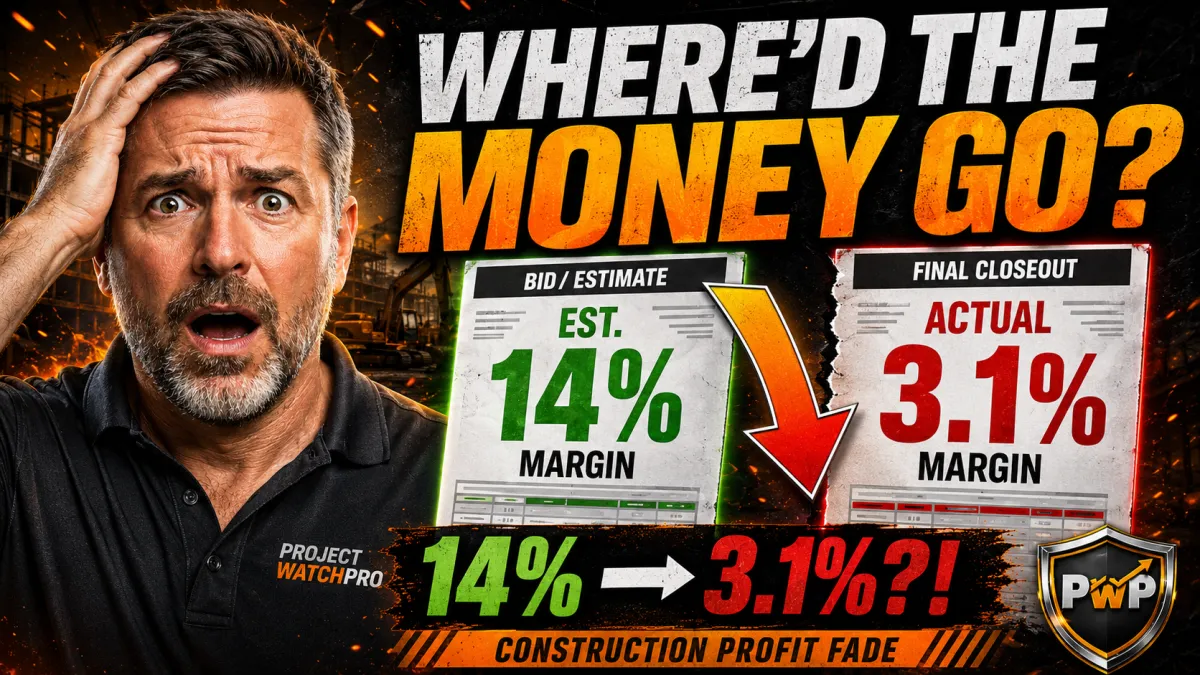
You estimated 14%. You're looking at 3.1%. On a $600,000 project, that's $65,000 in expected profit that evaporated somewhere between the bid and the closeout report — and nobody can tell you exactly where it went.
This is construction profit fade. And it happens to contractors who do everything right: they track hours, they watch their costs, they follow up on change orders. The margin still disappears. Not because they're bad at business. Because the operating model they're running was built to show them the damage after it's done — not while there's still time to stop it.
You're not the problem. The system is.
Here's what's actually happening inside a job that fades — and what Profit Defenders do differently to catch it before it becomes a loss they can't recover.
Construction profit fade is the gradual reduction in a job's gross margin from the bid estimate to the final closeout number. A job estimated at 14% net margin that closes at 3% hasn't just underperformed — it's experienced profit fade: margin that existed on paper at the start of the job and eroded, task by task, week by week, until it was gone.
What Is Construction Profit Fade — and Why It's Costing You More Than You Know
Profit fade is the quiet killer. It doesn't announce itself. There's no alarm, no red light, no email that says "margin alert." The job runs. The crew is busy. Revenue is coming in. Everything looks fine.
Until it isn't.
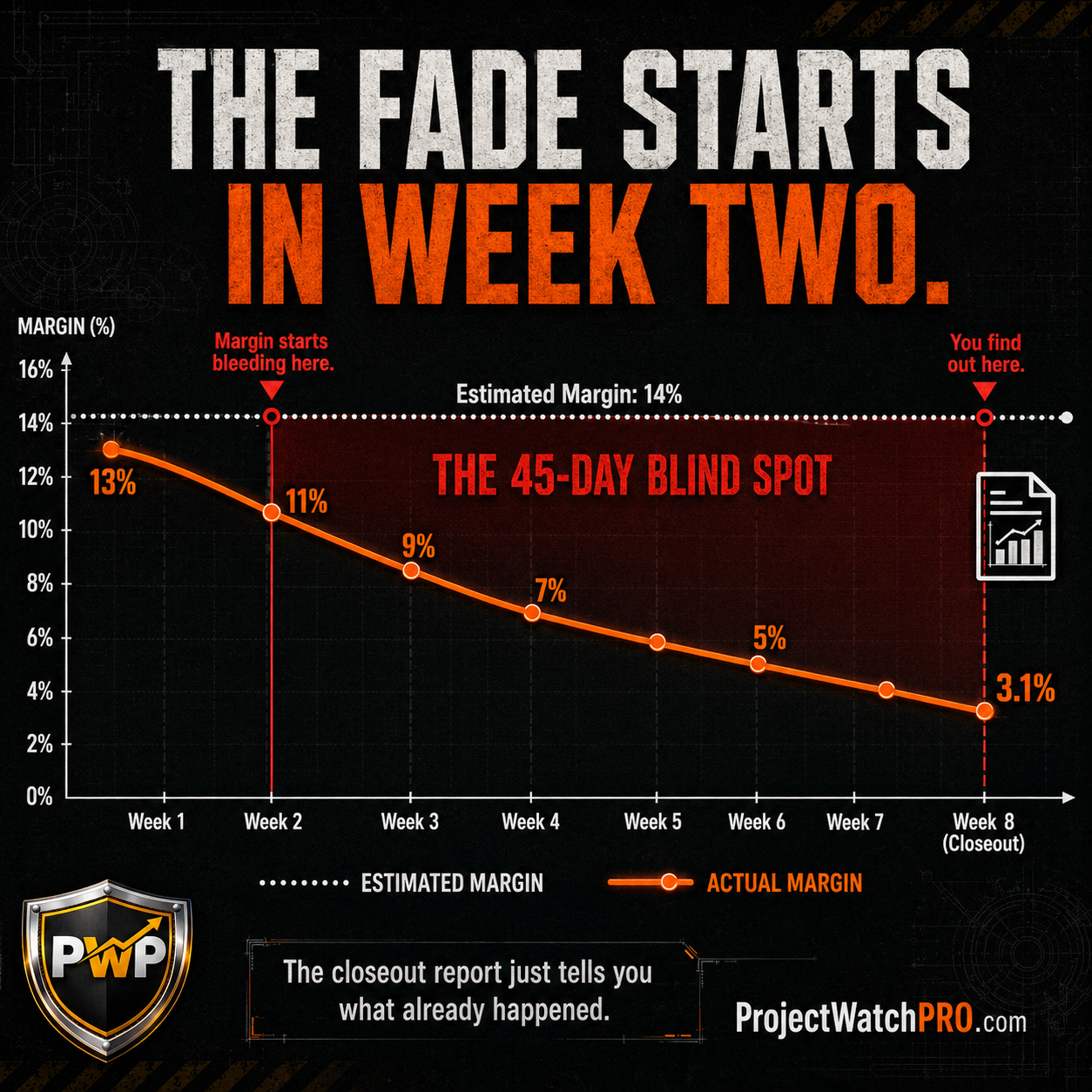
The average contractor who experiences profit fade doesn't find out until 45 days or more after the job closes — when the accountant reconciles the final numbers and the real margin surfaces. By that point, the crew has moved on. The scope is locked. The subcontractors are paid. There is nothing left to do except absorb the loss and hope the next job does better.
Profit fade is not a cost problem. It is a timing problem.
The costs that eroded the margin were knowable during the job. The variance between estimated cost and actual cost existed in week two, week three, week four. But the reporting cadence most contractors run — month-end job cost reports, or worse, closeout-only review — delivers that information 30 to 60 days after the damage happened.
That's the 45-Day Blind Spot. And profit fade is what it costs you.
Why Profit Fade Feels Like a Betrayal After a Busy Job
Here's what makes it so gut-punching: the job felt like it was going well.
The crew was productive. You hit your milestones. The client was happy. You sent the invoice, you got paid, you moved on to the next job.
And then the report comes in and tells you that you made almost nothing.
That's the trap. A busy job is not proof you're winning. Revenue is not margin. Hours logged are not margin. Getting paid on time is not margin. Margin is what's left after every dollar it cost you to do the work is subtracted from what you were paid — and that calculation only becomes visible when someone does the math. In most contractor operations, that math happens once. At the end. When there's nothing left to protect.
Why Construction Jobs Look Profitable Right Up Until They Aren't
Profit fade doesn't happen all at once. It's not one catastrophic event. It's a series of small bleeds — each one survivable on its own, all of them fatal together.
The Three Places Margin Dies on a Construction Job
1. Labor cost is underestimated from the start.
Most contractors build their bids using base wage or a standard charge-out rate. A tech at $38 per hour. A foreman at $52. That's the number that goes into the estimate.
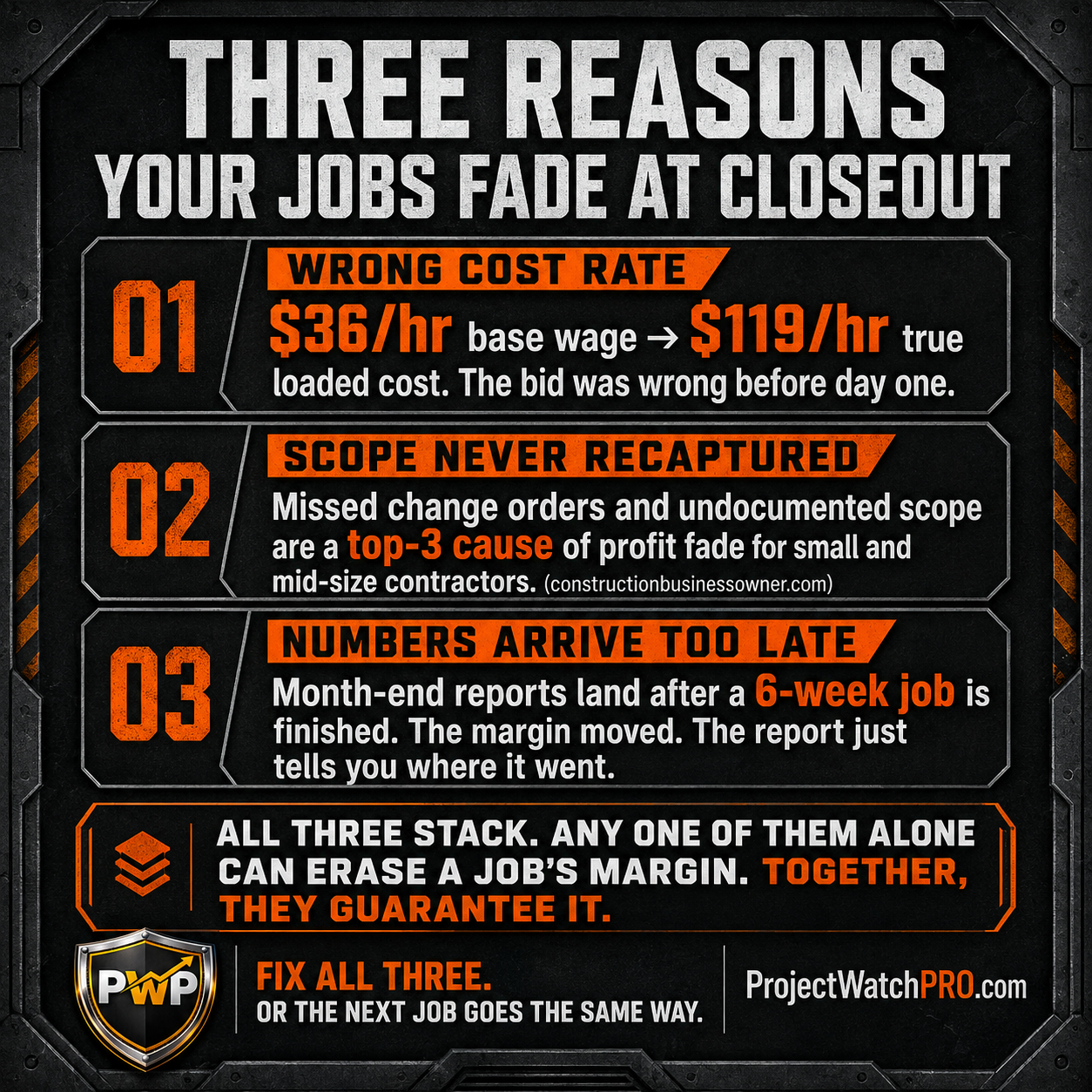
But the actual cost of that labor — when you add payroll taxes, workers' comp, benefits, overhead allocation, task-specific consumables, and overtime risk — is dramatically higher. In most contractor operations, a $36-per-hour base wage carries a true loaded cost of $97 to $119 per hour. That's a 2.7 to 3.1x multiplier.
If your estimate was built on $38 per hour and your actual cost is $119 per hour, your margin calculation was wrong before the first person clocked in.
2. The job scope moves — and the cost doesn't get recaptured.
Scope creep is the silent margin killer on fixed-price work. The client asks for one additional thing. The foreman makes a field call to avoid a conflict. A task takes three days instead of two because site conditions changed.
Each one of these is a cost that wasn't in the estimate. Some get documented and billed. Many don't. According to constructionbusinessowner.com, missed change orders and undocumented scope additions are among the top three causes of profit fade for small and mid-size contractors.
A job can track perfectly at the task level and still bleed 4 to 6 margin points from scope that never made it to a change order.
3. Nobody looks at the numbers until the job is over.
This is the one that compounds everything else.
If you knew labor was running 15% over estimated cost on the rough-in phase in week three — while the finish phase was still ahead — you could act. Adjust crew mix. Tighten the sequence. Have the change order conversation while the client still needs you on site.
But if you only look at the numbers at month-end or closeout, you get a detailed explanation of margin that's already gone. The analysis is perfect. The outcome is unchanged.
Why Month-End Reports Show You the Crash After It Already Happened
Month-end reporting was built for a different era. Jobs ran for a year or more. Cost movements were gradual. A 30-day feedback lag was acceptable because there was still time to course-correct.
The average commercial trade job in the $500K–$2M range today runs four to eight weeks. When month-end reporting arrives, the job is half done — or finished. The margin moved weeks ago. The report tells you where it went, but not in time to change anything.
This is not a reporting problem. This is a structural timing failure baked into the standard operating model most contractors inherited from their accountants.
The Real Root Cause — Wrong Numbers, Wrong Time, Zero Margin Left to Defend
Construction profit fade is a two-factor problem. Fix one without the other and the margin still disappears.
Factor 1: The cost rate in the estimate is wrong. If your bid uses $38/hr and your true loaded cost is $119/hr, the job was underbid before it started. Every hour tracked confirms a number that isn't real.
Factor 2: The comparison between actual cost and estimated cost runs too late. Even if you fix the cost rate, month-end or closeout reporting delivers the news after the window to act has closed.
Stack these two failures — wrong rate, wrong timing — and you get a job that tracks perfectly, reports cleanly, and still closes at 3% when you estimated 14%.
The 45-Day Blind Spot is the name for this gap: the space between when the margin starts bleeding and when the contractor finds out. On a six-week job, that can be the entire job.
How Profit Defenders Stop Fade Before It Becomes a Closeout Loss
The contractors who consistently protect margin on their jobs aren't running better software or estimating more carefully. They've fixed two things: the cost rate they're using, and when they look at the comparison.
Step 1 — Build the True Cost Baseline Before the Bid Goes Out
Profit defense starts before the job. Not at closeout. Before the bid.
The true loaded cost of field labor — not base wage, not charge-out rate, but every layer — is the number your estimate should be built on. When that number is right, your bid is right. When it's wrong, no amount of cost control during the job can recover the margin you gave away on day one.
The six-layer True Cost Model applies:
1. Base Wage — what you pay the worker
2. Labor Burden — payroll taxes, workers' comp, benefits, FICA
3. Overhead Burden — your operating cost per field hour (office, admin, vehicles, insurance)
4. Task-Specific Consumables — materials and consumables per hour by trade
5. Shift Differential — premium time patterns built into the schedule
6. Overtime Premium — actualized overtime risk across the crew
When all six layers are applied to a $36 base wage, the true loaded cost comes out between $97 and $119 per hour. For most contractors who run this calculation for the first time, it's the moment the profit fade problem finally has a name.
Step 2 — Compare True Cost to Estimated Cost at the Task Level During the Job
With the right rate in place, the next fix is when and where you make the comparison.
Not at the job level. Not at month-end. At the task level — by task, by week, while the task is still running.
A job is not one unit of work. It's framing, rough-in, finish, punch list — each with its own labor hours, estimated cost, and actual cost. A job can track fine at the overall level while bleeding on a single task that went sideways in week two.
The comparison that surfaces fade before it becomes permanent:
True labor cost × actual hours on this task vs. estimated cost for this task.
When that runs at the task level during the job, you see which tasks are running clean and which are drifting. When it runs at the job level at month-end, you get the full story of margin that's already gone.
Step 3 — Flag Variance Fast Enough to Act on It
The comparison alone doesn't protect margin. The flag does.
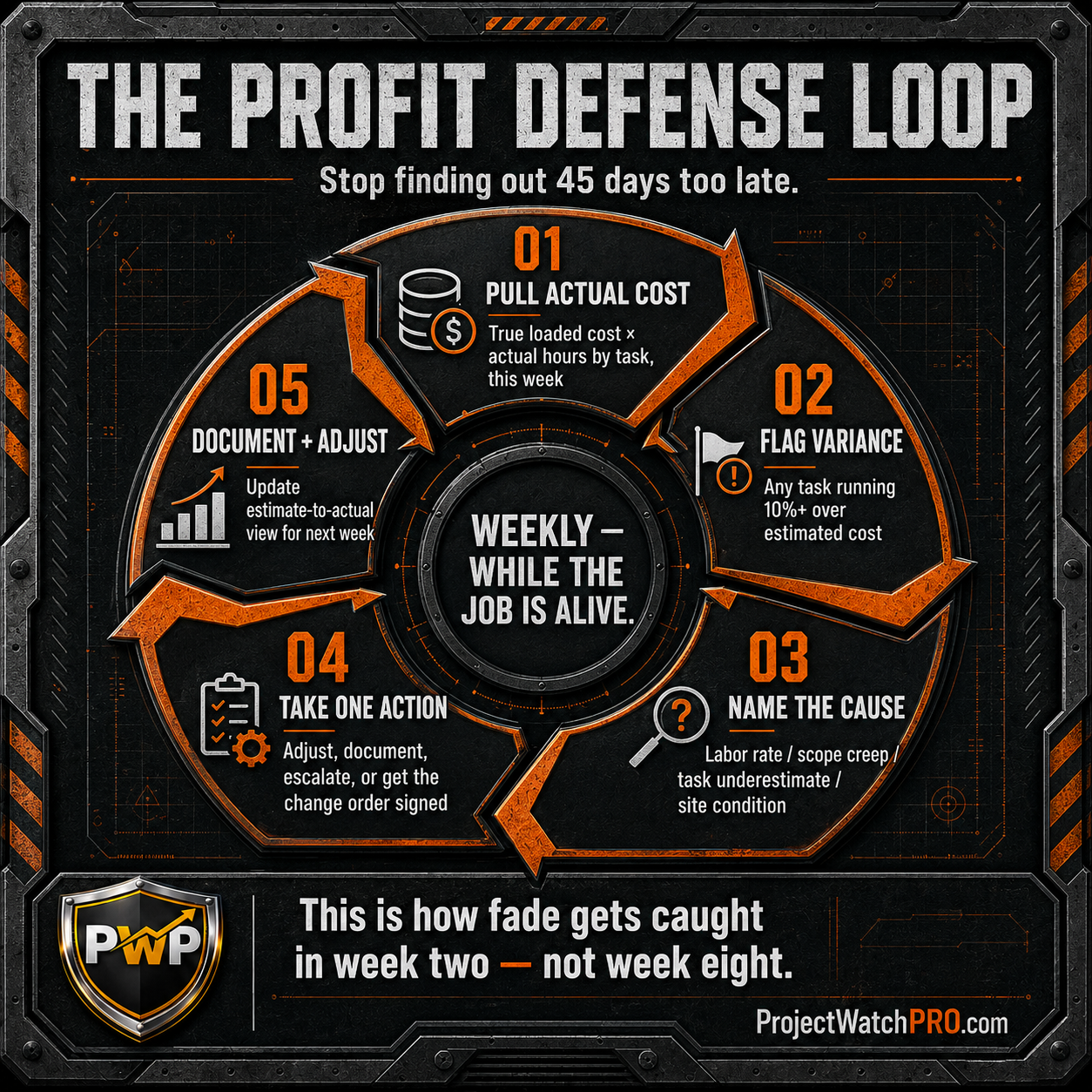
In the Profit Defense System, any task running more than 10% over estimated cost triggers a review — not an emergency, a review. What caused the drift? Labor rate variance. Scope creep. Task underestimate. Site condition.
Name the cause. Take one action:
- Adjust the task sequence before more labor gets applied
- Address the crew mix or productivity issue
- Document the scope change and get the change order signed while the client is still engaged
- Update the estimate-to-actual view for next week's comparison
That's the Profit Defense Loop. Five steps. Run weekly on active jobs. It does not require reviewing every job every week — only the ones showing signal.
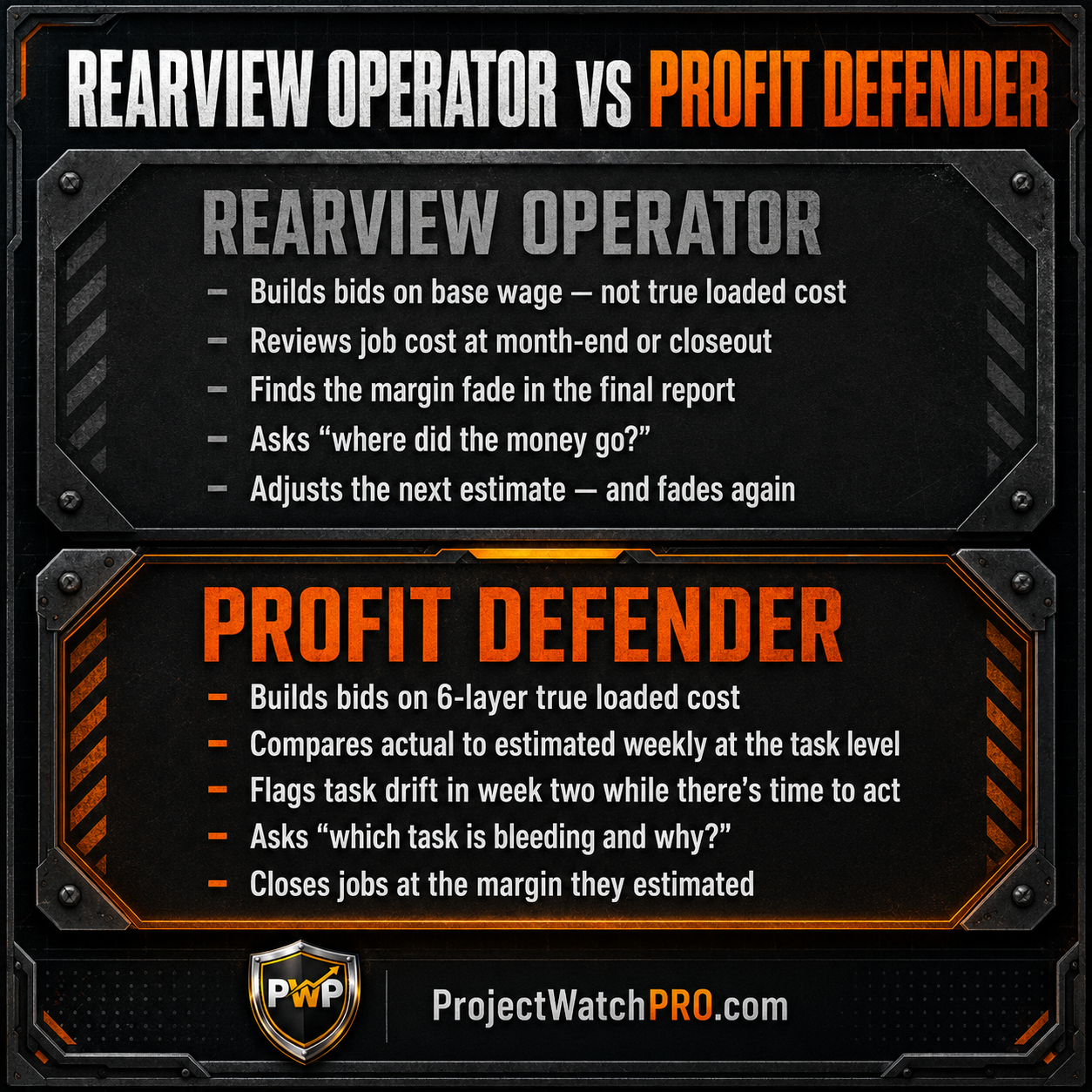
A Rearview Operator reviews the timesheet data at closeout. The hours are all there. The margin is not.
A Profit Defender compares true labor cost to estimated cost by task in week two — and acts while $400,000 in labor budget is still ahead of them.
Same job. Completely different outcome.
Key Takeaways
- Construction profit fade is a timing problem, not a cost problem. The margin didn't disappear — it drifted, task by task, while you were running the job. You just found out too late to stop it.
- The first root cause is the wrong cost rate. If your bid uses base wage or charge-out rate instead of true loaded cost, the job is underbid before day one. A $36 base wage often carries a $97–$119 true loaded cost — a 2.7 to 3.1x multiplier.
- The second root cause is the wrong timing. Month-end or closeout reporting delivers the margin story after the job is done. On a 6-week job, that's the whole job.
- Fix both, and the fade stops. True cost baseline in the bid + weekly task-level comparison during the job = the system that catches drift while there's still time to act.
- Task-level comparison is what changes the game. A job can look fine at the top level while a single task is bleeding margin. Weekly task-level review surfaces the problem in week two — when there are still options.
- The Profit Defense Loop is the mechanism. Pull actual cost → flag variance → name the cause → take one action → document. Weekly. Active jobs only.
- Contractors running real-time task-level comparison against a true cost baseline protect 15–25% more relative margin than those who wait until closeout, according to CFMA research. On a $600,000 job, that's the difference between 3% margin and 14%.
Frequently Asked Questions
What is construction profit fade?
Construction profit fade is the gradual reduction in a job's gross margin from the estimate to the final closeout number. A project estimated at 14% that closes at 3% has experienced profit fade — margin that was real on paper at the start of the job eroded through the work due to wrong cost rates, scope creep, and delayed visibility into actual vs. estimated cost.
Why do construction jobs lose money at closeout?
Most construction jobs lose margin for two compounding reasons: the cost rate used in the estimate is lower than the true loaded labor cost (often by 2–3x), and the comparison between actual cost and estimated cost only runs at month-end or closeout — after the opportunity to correct it has passed. Both failures have to be fixed for margin to hold.
How do contractors prevent profit fade on jobs?
The most effective approach is three steps: (1) build the bid on true loaded labor cost — not base wage — using all six cost layers including burden, overhead, and overtime risk; (2) compare actual cost to estimated cost at the task level during the job, not at month-end; and (3) flag any task running 10% or more over estimated cost for immediate review while there's still labor budget ahead.
What is a gain-fade analysis in construction?
A gain-fade analysis compares the estimated gross profit on a job at the time of bid to the actual gross profit at closeout — and maps when and where the variance occurred during the project. For Rearview Operators, it's a postmortem. For Profit Defenders, the same logic is applied weekly during the job, so variance is caught and addressed while the project is still running.
How do I know if my jobs are experiencing profit fade?
The clearest signals: jobs that close at significantly lower margin than estimated, jobs that look fine at month-end but surprise you at closeout, and a pattern of "busy and broke" — high revenue, low or inconsistent net. If you can't tell which specific tasks lost the margin or when the fade started, you're running a Rearview Operator model. The fix is task-level visibility during the job.
What is the true loaded cost of labor and why does it matter for profit fade?
True loaded labor cost is every dollar it costs to put a worker on site — base wage plus payroll taxes, workers' comp, benefits, overhead allocation, task consumables, shift differential, and overtime risk. For a $36 base wage, true loaded cost typically runs $97–$119 per hour. If your bids are using base wage or a standard charge-out rate instead of true loaded cost, the gap between your estimated cost and actual cost is baked into the bid — and will show up as profit fade at closeout.
Profit fade doesn't announce itself. It builds quietly across six weeks while you're busy running the job, and it surfaces in a report that lands 45 days after there's anything left to do about it.
The margin you estimated was real. The job just ran on a model that couldn't see the bleed until it was over.
If you want to know what your labor is actually costing you — not the base rate, but the real number including burden, overhead allocation, and overtime risk — the True Labor Cost Calculator runs through all six layers in about two minutes. For most contractors, the number is two to three times what they've been building bids on.