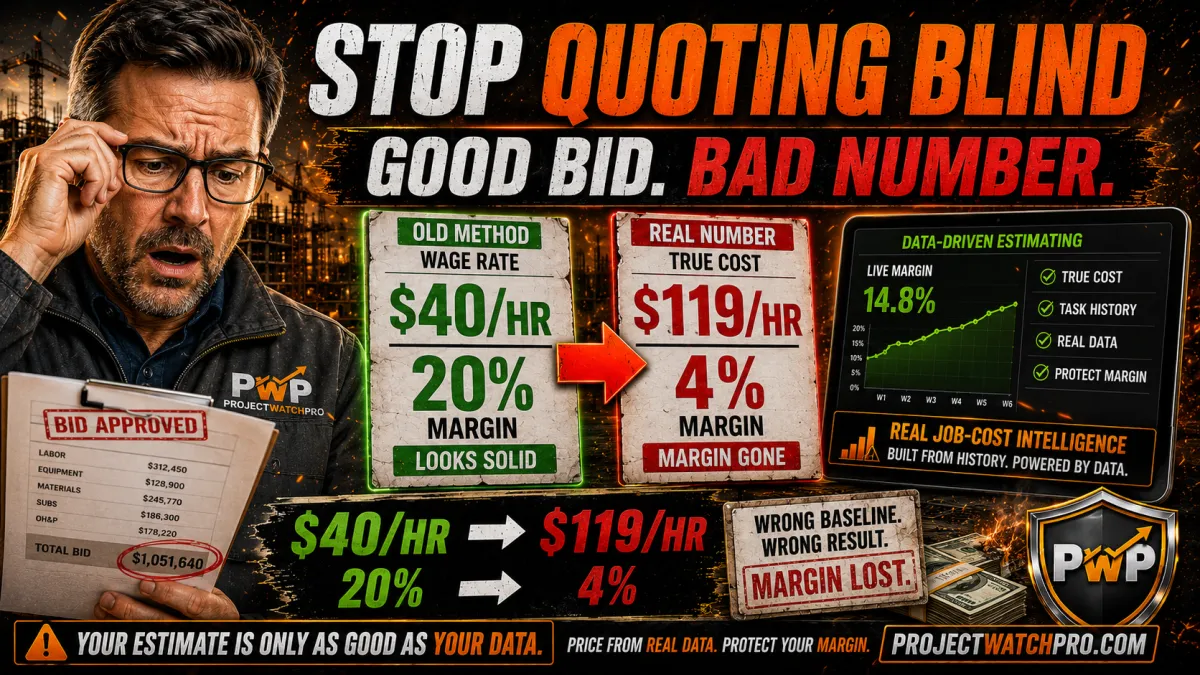
Stop Quoting Blind: Data-Driven Construction Estimating
Stop Quoting Blind: Why Data-Driven Estimating Is the Only Way to Protect Your Margin
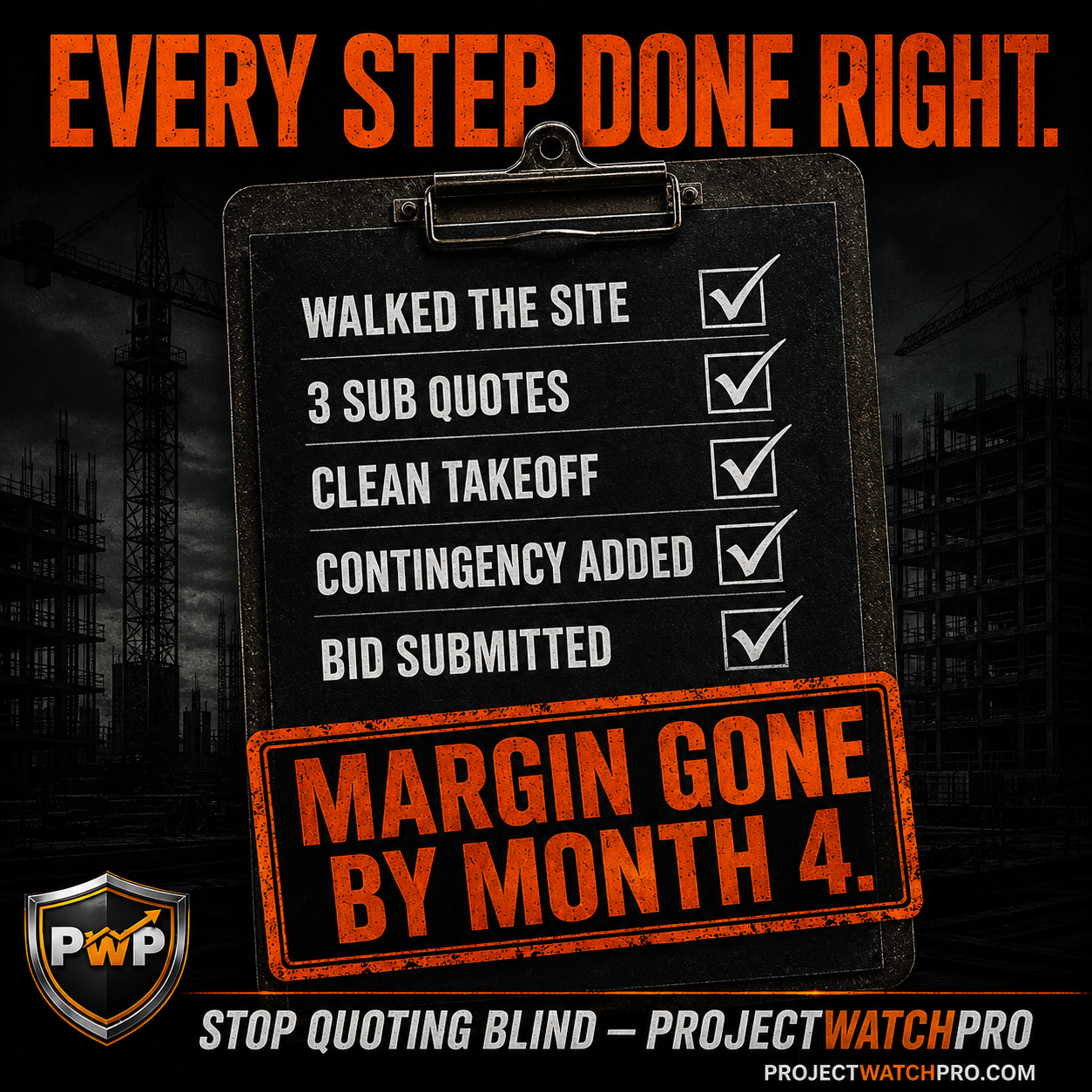
Here's a pattern I've watched play out the same way more times than I can count, across twenty years of consulting contractors: an estimator does everything right. Walks the site. Gets three sub quotes per trade. Builds a clean takeoff. Adds a contingency line.
The bid wins. Four months in, the margin is gone.
Nobody made a dramatic mistake. There's no single moment you can point to. The estimate was careful — and it was still wrong, because it was built on the same number every estimate at that company gets built on: last year's wage rate, with a buffer tacked on for good measure. You're not the problem. The operating model you're estimating from is.
Here's what's actually happening — and what to do about it.
Data-driven construction estimating means building every bid from your own historical job cost data and fully burdened labor rates, instead of base wages, gut-feel buffers, and last year's number rolled forward. It replaces "this feels about right" with "this is what it actually cost us, every time we've run this task before."
Stop Quoting Blind: Data-Driven Construction Estimating
Stop Quoting Blind: Why Data-Driven Estimating Is the Only Way to Protect Your Margin
Why Careful Estimating Still Produces Bad Bids
What Is Data-Driven Construction Estimating?
The Real Reason Estimates Fail (It's Not the Process — It's the Number)
What Are the Most Common Construction Estimating Mistakes?
How Historical Cost Data Fixes the Guessing Problem
How Does Historical Cost Data Improve Construction Estimates?
Why Do Construction Projects Go Over Budget Even With a "Good" Estimate?
Why Careful Estimating Still Produces Bad Bids
Most contractors assume a bad bid means a careless one. That's not what's happening on the jobs that quietly lose money.
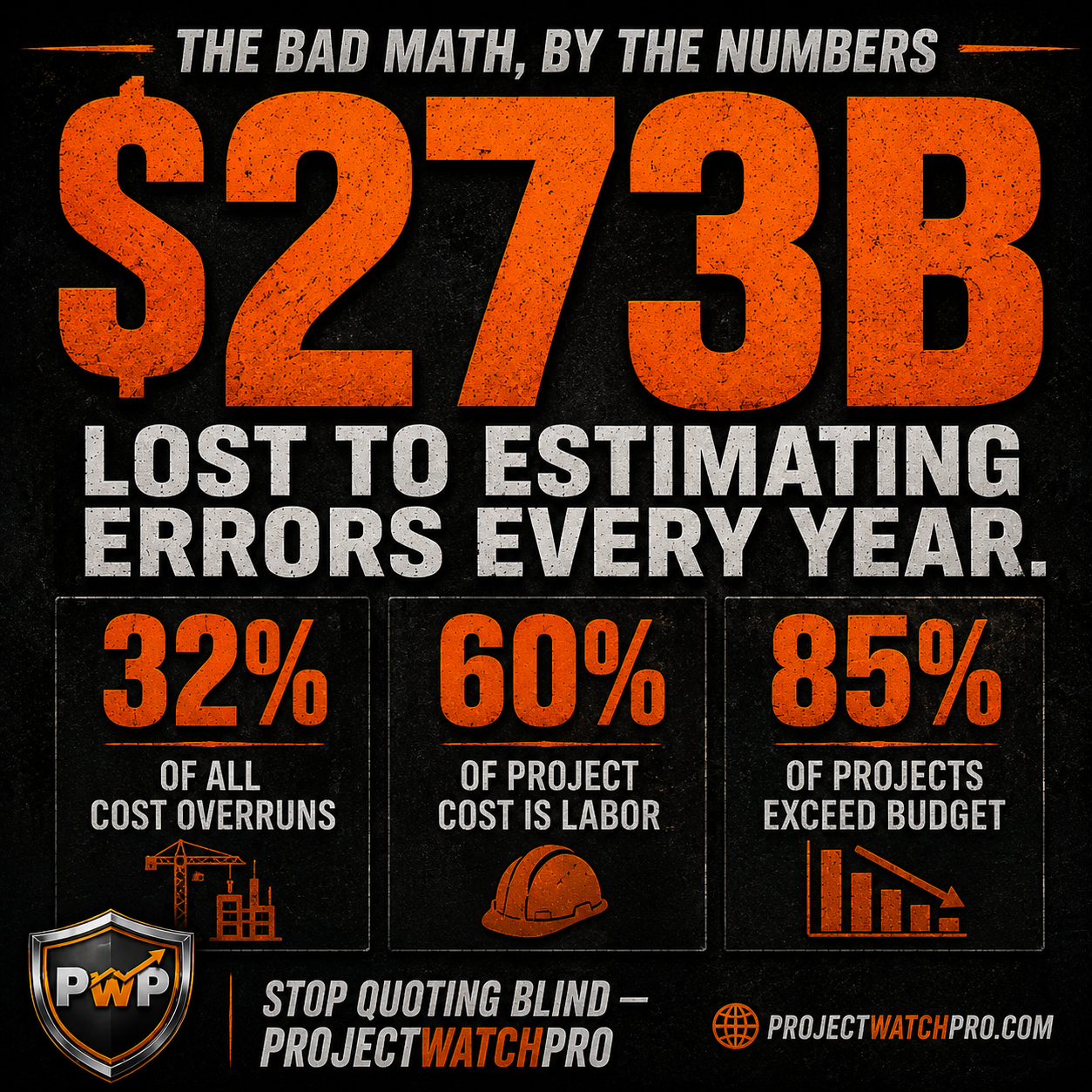
Construction estimating errors cost U.S. contractors an estimated $273 billion a year — and estimating mistakes alone account for 32% of all construction cost overruns. That's not sloppy estimators. That's careful estimators, working from the wrong baseline number, every single time.
Labor is the reason the damage is so large. Labor accounts for roughly 60% of total project cost on most jobs. If your estimate prices that labor at base wage instead of true cost — wage, burden, overhead allocation, task-specific consumables, the whole stack — you've under-priced the single biggest line item in the budget before the job even starts. The takeoff was accurate. The pricing wasn't.
The Bad Math doesn't show up as a mistake. It shows up as a margin that disappears for no visible reason — because the estimate was never tested against what the work actually costs to run.
What Is Data-Driven Construction Estimating?
Data-driven construction estimating is the practice of pricing a job from your company's own historical cost data — actual labor burden, actual task-level production rates, actual overhead per billable hour — instead of base wages and assumptions. It treats every completed job as a data point that makes the next bid more accurate, not just a closed file.
The Real Reason Estimates Fail (It's Not the Process — It's the Number)
You can run the best process in the industry and still lose the job at the pricing stage. That's the part most estimating advice skips. Walk the site, get three quotes, build a clean takeoff — every textbook step, done right — and the bid still loses money if the labor number underneath it was wrong on day one.
That's the same mechanism every time: the contractor isn't bad at estimating. The operating model hands them an incomplete number and asks them to build an accurate bid on top of it. No process fixes a bad input.
What Are the Most Common Construction Estimating Mistakes?
The most common construction estimating mistakes are: pricing labor from base wage instead of fully burdened true cost, reusing last year's numbers without checking whether vendor pricing or burden rates changed, overlooking indirect and overhead costs, skipping contingency for known risk, and relying on sub quotes without an internal cost baseline to check them against. Each one is invisible at bid time and shows up as margin loss mid-job.
Eighty-five percent of construction projects exceed their original budget — by an average of 16%. Most of that gap traces back to one of these five mistakes, repeated on every estimate, because nothing in the process forced a check against real cost data.
Then/Now: you used to find out your estimate was wrong when the job was 60% complete and the budget was already blown. Now, the question is whether your estimating process checks every bid against your own historical true cost before you submit it — or still relies on the same wage-plus-buffer math it always has.
How Historical Cost Data Fixes the Guessing Problem
Here's what most contractors miss: the data to fix this already exists. It's sitting in last year's completed jobs — if anyone captured it correctly.
The Profit Pulse System treats this as a deliberate, sequenced fix rather than a one-time cleanup. Step 1, the Overhead Guru, locks down your true hourly overhead rate. Step 2, the Labor Analyst, builds your true labor burden rate across all six cost layers — wage, payroll burden, overhead allocation, shift differential, task-specific burden, and overtime premium. Step 4, the Task Architect, turns every recurring task into a priced line item with a real, historical cost attached to it — not a guess.
How Does Historical Cost Data Improve Construction Estimates?
Historical cost data improves estimates by replacing assumptions with actuals: what a task really costs your crew to run, not what it was supposed to cost on paper. Once you have a true cost baseline and a task library priced from real job history, every new bid gets built from numbers your business has already proven — not a number copied forward and hoped on.
The transformation is concrete, not theoretical. Jobs quoted at 20% margin that land at 4% actual — the gap nearly every contractor we diagnose is carrying — close dramatically once the estimate is rebuilt on true cost and task-level history instead of wage-plus-buffer guessing. Recovering 3% net margin in 90 days is the standard outcome once a contractor stops estimating blind.
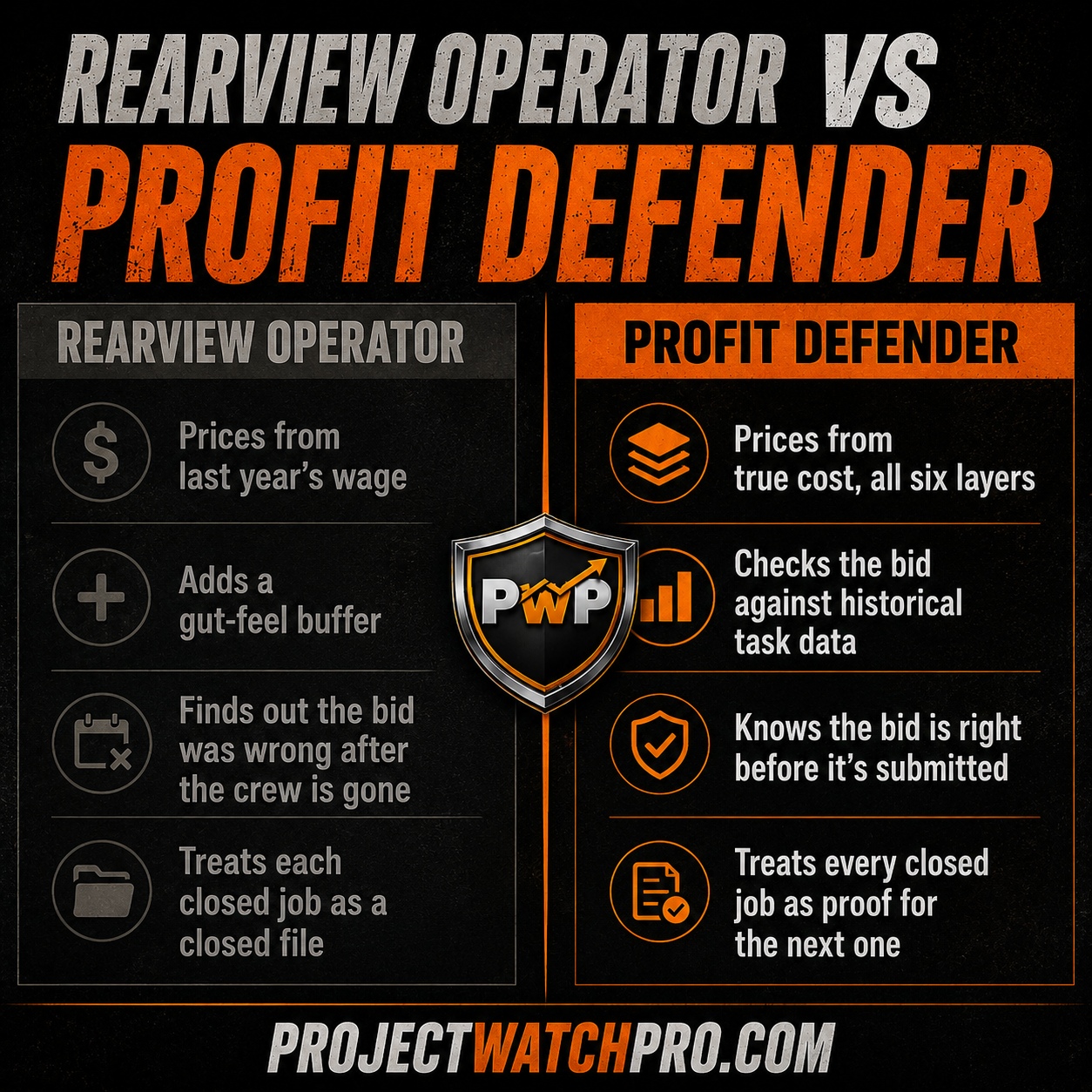
Rearview Operator vs. Profit Defender, at the estimating stage: The Rearview Operator prices from last year's wage and finds out it was wrong after the crew is gone. The Profit Defender prices from this year's true cost and historical task data — and finds out the bid was right before they ever submit it.
What To Do on Your Next Bid
You don't need to rebuild your entire estimating system before your next bid goes out. Start here.
1. Pull your true labor cost — not the wage on the pay stub, the fully burdened number across all six layers.
2. Check your last five completed jobs in the category you're bidding now. What did the labor actually cost to run, task by task?
3. Price the new bid from that number — not from last year's rate rolled forward with a buffer.
4. Flag the gap between what you would have quoted on the old method and what the real number says. That gap is the margin you've been leaving on the table.

Why Do Construction Projects Go Over Budget Even With a "Good" Estimate?
A "good" estimate can still go over budget because careful process doesn't fix an inaccurate baseline number. If the labor rate underneath the estimate is wage-plus-buffer instead of fully burdened true cost, every calculation built on top of it inherits the same error — no matter how thorough the takeoff or how many sub quotes were collected.
How Can Contractors Estimate Jobs More Accurately?
Contractors estimate more accurately by building bids from their own historical job cost data and true labor cost — not base wage — and by tracking actual task-level production rates from completed jobs to price the next one. The fix isn't a better checklist. It's a better baseline number, built once and reused on every bid going forward.
Key Takeaways
- Construction estimating errors cost U.S. contractors $273 billion a year and drive 32% of all cost overruns — and most of it comes from careful estimators working off an incomplete number.
- Labor is 60% of total project cost on most jobs. Pricing it at base wage instead of true cost under-prices the single biggest line in the budget.
- 85% of construction projects exceed budget — by an average of 16% — and most of that traces back to a handful of repeatable estimating mistakes.
- A careful process cannot fix an inaccurate baseline number. The fix is the number, not the checklist.
- Historical cost data — true labor cost, true overhead rate, task-level history — turns every completed job into proof for the next bid instead of a closed file.
- Jobs quoted at 20% margin routinely land at 4% actual when priced from wage instead of true cost. Fixing the baseline is how contractors recover 3% net margin in 90 days.
Frequently Asked Questions
Q: What is data-driven construction estimating?
Data-driven construction estimating means pricing every bid from your company's own historical job cost data — actual true labor cost, actual overhead rate, actual task-level production history — instead of base wages and assumptions carried forward from last year. It turns every completed job into a data point that improves the accuracy of the next bid.
Q: What are the most common construction estimating mistakes?
The most common mistakes are pricing labor from base wage instead of fully burdened true cost, reusing last year's numbers without checking for changes, overlooking indirect and overhead costs, skipping contingency for known risks, and relying on sub quotes without an internal cost baseline to verify them. Each one is invisible at bid time and surfaces as lost margin mid-job.
Q: How does historical cost data improve construction estimates?
Historical cost data replaces assumptions with actuals. Instead of guessing what a task should cost, you price it from what it has actually cost your crew to run on past jobs. Once you have a true cost baseline and a priced task library, every new bid is built from numbers your business has already proven.
Q: Why do construction projects go over budget even with a "good" estimate?
A careful estimating process doesn't fix an inaccurate baseline number. If the labor rate underneath the estimate is wage-plus-buffer instead of fully burdened true cost, every downstream calculation inherits that same error — regardless of how thorough the takeoff was.
Q: How can contractors estimate jobs more accurately?
Contractors improve estimating accuracy by building every bid from their own true labor cost and historical task-level production data instead of base wage and gut-feel buffers. The fix is a better baseline number, built once and reused on every future bid — not a longer checklist.
If this thinking resonates and you want the full framework behind it, Profit Defended lays out the complete system for pricing every job on real numbers and defending the margin before it disappears — including the exact six-layer true cost stack and the task-level pricing approach behind Step 4 of the Profit Pulse System.
→ Get Profit Defended https://profitdefended.com