
The $340K Fab Job That Made $12,000: A Profit Autopsy
The $340K Fabrication Job That Made $12,000: A Profit Autopsy
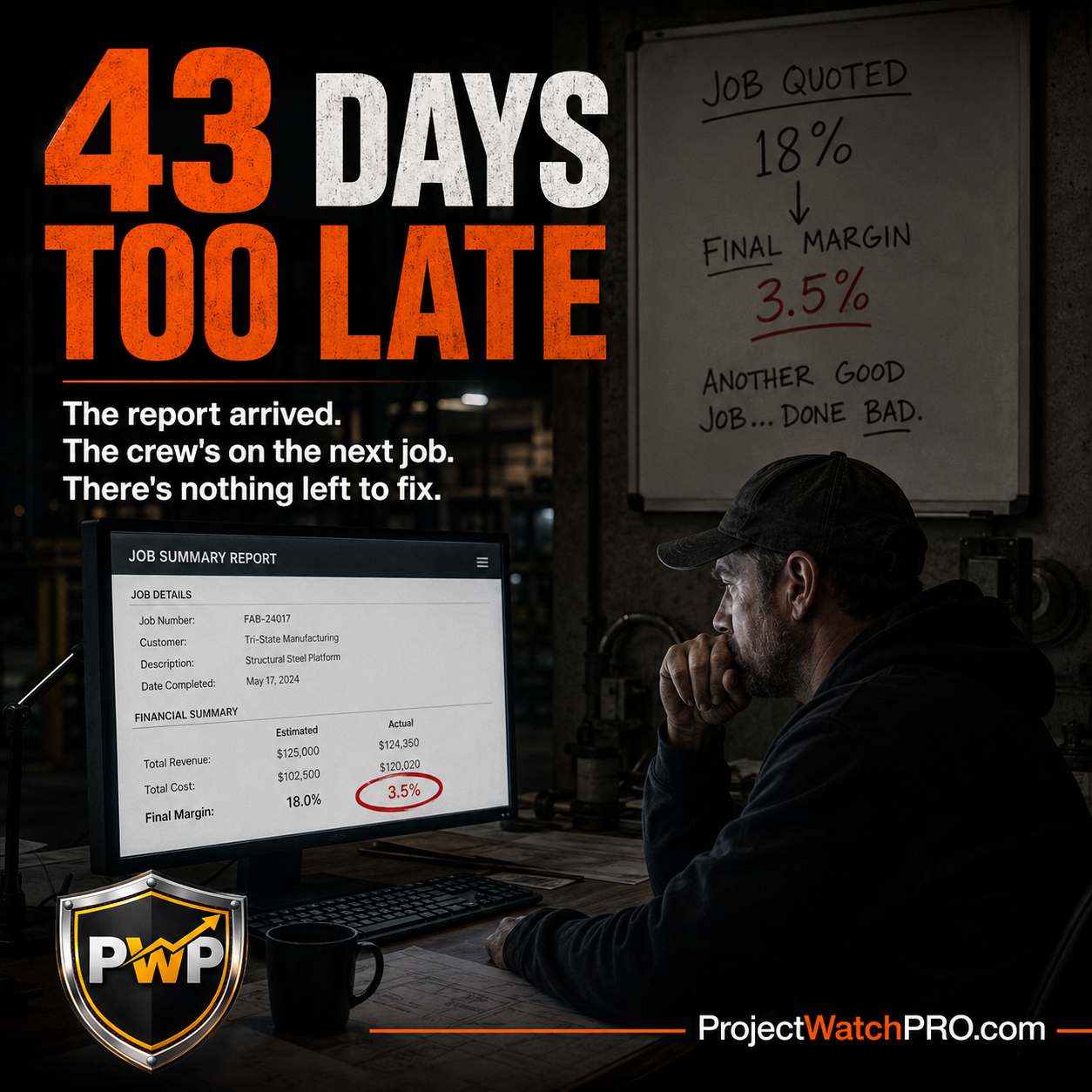
The invoice went out on a Friday. $340,000 job. Six weeks of work. The crew hit the delivery date.
Forty-three days later, the number came back: $12,000 net. 3.5% margin. The shop quoted 18%.
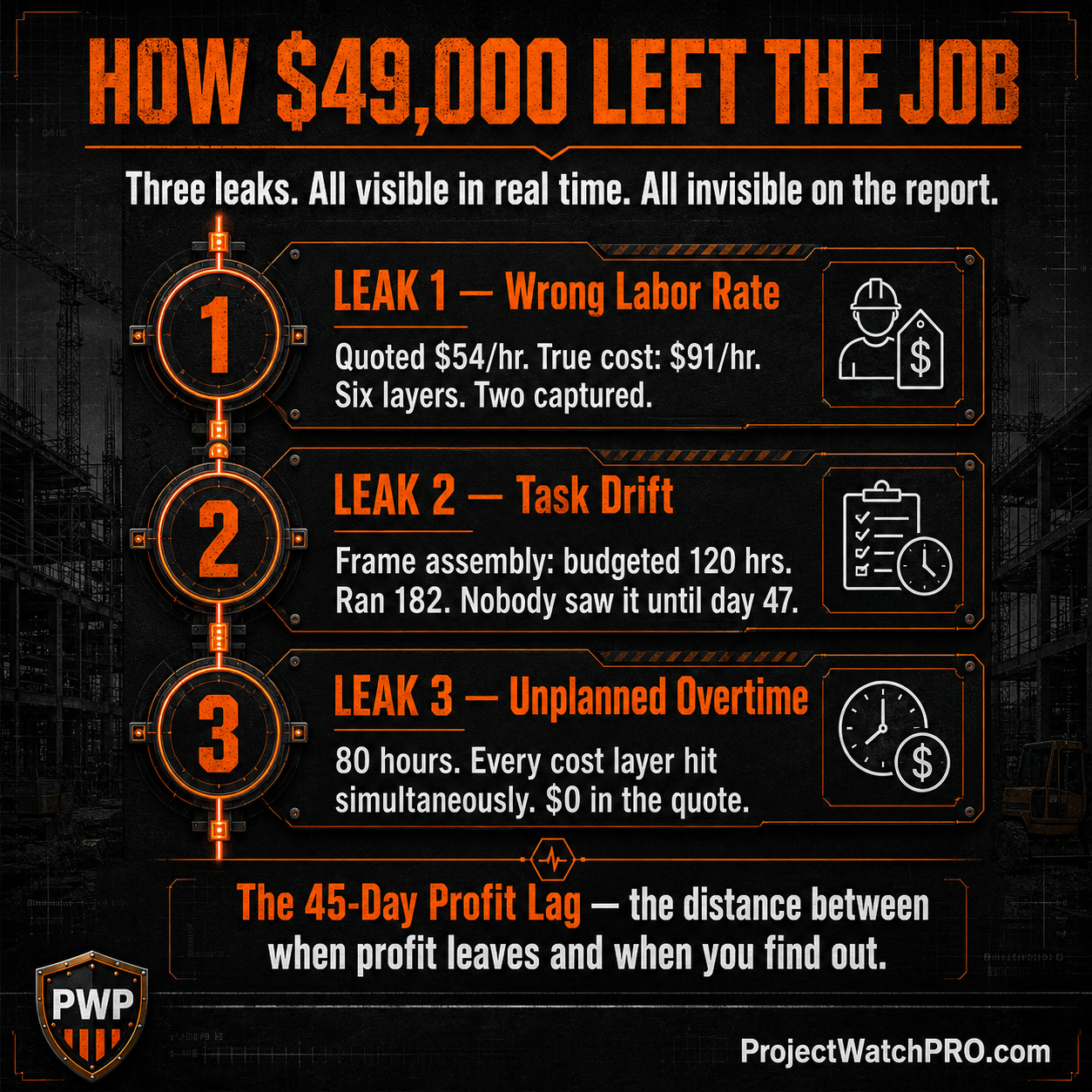
It shouldn't surprise you — industry research shows fabrication shops lose money on 20 to 30% of their jobs without realizing it. And in 2026, with construction and fabrication wages running 6 to 8% higher than last year, the math is getting harder to hide. The $49,000 didn't disappear at closeout. It left in three specific places while the crew was still on site and there was still time to catch it.
Nobody saw it until it was gone.
You're not the problem. The operating model is.
Here's exactly where the $49,000 went.
Fabrication shop job costing is the process of tracking every dollar of labor, material, and overhead against a specific job — in real time, at the task level — so you know whether the job is making money while there's still time to act on it. Fabrication shops, welding operations, machine shops, and powder coaters running $500K–$20M face this same problem on nearly every job they run. The difference between shops that survive it and shops that don't isn't effort. It's what they can see while the job is still alive.
The $340K Fab Job That Made $12,000: A Profit Autopsy
The $340K Fabrication Job That Made $12,000: A Profit Autopsy
The Quote That Won the Job — and Already Had a Problem
What the Estimate Was Built On
The First Leak — Labor Costed on the Wrong Number
What the Shop Quoted vs. What the Job Actually Cost Per Hour
How a $3/hr Wage Increase Becomes a Much Bigger Problem
The Second Leak — A Task Running Over With Nobody Watching
What Task-Level Drift Looks Like When There's No Real-Time Signal
The Decision That Could Have Saved the Margin — and When It Had to Happen
The Third Leak — Overtime Nobody Priced In
How Overtime Hits All 6 Cost Layers at Once
Why This One Always Shows Up Last
What a Profit Defender Knew While the Job Was Still Running
Rearview Operator vs. Profit Defender — the Same Job, Two Outcomes
The Quote That Won the Job — and Already Had a Problem
The estimate looked solid. $340K contract. Materials costed carefully. Labor priced at the shop's standard rate. Overhead loaded in. An 18% margin felt like room to breathe.
It wasn't.
The problem wasn't the estimate. It was what the estimate was built from. The labor rate — the number running through every line of every quote — captured the wage and a rough burden number. Two of six cost layers. The other four were invisible.
Job costing tells you what happened. Cost intelligence tells you what's happening right now. This quote was built on the first kind of math. And by the time the crew hit the floor, the number was already wrong.
What the Estimate Was Built On
The shop's standard labor rate: $54/hr. Felt reasonable. Covered the wage, covered basic burden. It was the number they'd used for three years — adjusted once when minimum wage moved.
But $54/hr was never the true cost of that employee on the floor.
It was the wage and a partial burden number. One of six cost layers. Overhead absorption, task-level burden, shift differential, overtime premium — none of those were in the rate.
The actual all-in cost? Closer to $91/hr.
Why 18% Felt Safe
At 18%, the quote built in $61,200 of profit on a $340K job. That felt like buffer.
But the buffer was calculated against a labor rate that was $37/hr short of reality. The margin wasn't 18%. It was already gone before the first piece of steel was cut.
The First Leak — Labor Costed on the Wrong Number
The most common profit leak in fabrication shops isn't bad estimating. It's estimating from the wrong cost.
Most shops quote from wage plus burden. That number is, on average, 30 to 40% of what an employee actually costs per hour. The remaining 60 to 70% — overhead absorption, labor burden rates, task-level burden, shift differential, overtime premium — gets buried in month-end reports or never captured at all.
A shop bidding 880 hours at $54/hr is building every number in that quote on a foundation that's missing $37/hr of real cost. Nothing flags it wrong. The quote wins. The job runs. The report arrives 45 days later.
What the Shop Quoted vs. What the Job Actually Cost Per Hour
There are six layers to true labor cost. This shop quoted from two:
1. Wage — the base hourly rate
2. Labor Burden — payroll taxes, WCB, benefits
3. Overhead — the shop's true hourly overhead rate absorbed per labor hour
4. Task Burden — consumables, tooling, and setup costs tied to specific tasks
5. Shift Differential — premium for evening or weekend work
6. Overtime Premium — the multiplier when hours run long
Three are constant — they're on every job, every hour. Three are contingent — they show up depending on the work, the schedule, and the crew.
This shop captured layers 1 and 2. Layers 3 through 6: invisible.
The real number, with all six layers included, was $91/hr. Running your shop's true labor cost takes under 10 minutes — it calculates exactly what each employee costs per hour and what your charge-out rate needs to be to actually protect your margin.
How a $3/hr Wage Increase Becomes a Much Bigger Problem
In 2026, construction and fabrication wages are up 6 to 8% year over year. Some specialized trades are seeing 9 to 11%.
Here's what most shop owners miss: a $3/hr wage increase doesn't add $3/hr to your true labor cost. It triggers a multiplier. Payroll taxes scale with the wage. Burden rates adjust. If you're running overtime to fill gaps in a tight labor market, the premium compounds on top.
By the time a wage increase moves through all six layers, the real cost jump is significantly higher than the raise itself.
Most owners know they should update their rates when wages change. But manually recalculating every labor burden rate, every task cost, every charge-out rate across the shop every time something shifts takes hours — so it doesn't happen. The real advantage of a system that auto-calculates is that the moment a wage changes, every true cost updates with it. You always have a clear picture of what each employee actually costs vs. what you're charging out.
Revisiting charge-out rates quarterly is the discipline that protects margin — especially when wages have moved, task burdens have shifted, or overhead operating expenses have increased. When the math auto-calculates, that quarterly review becomes a 20-minute check instead of a full-day rebuild.
If your quotes didn't update when your wages did, every job you've run since is priced at a loss you won't find for 45 days.
The Second Leak — A Task Running Over With Nobody Watching
The welded frame assembly was budgeted at 120 hours.
It ran 182.
The extra 62 hours weren't chaos. One fit-up issue in week three. A revision that came back from the client late. A junior welder on a task the estimator had priced for a senior. Each one reasonable in isolation. All of them invisible in real time.
By the time anyone reviewed the hours on that task, the job was done. At true cost, those 62 hours erased thousands of dollars in margin that the quote had already struggled to hold. Plus overhead. Plus consumables.
A task running 50% over budget while the job is alive is fixable. The same task discovered at closeout is just a line on a report.
What Task-Level Drift Looks Like When There's No Real-Time Signal
Task drift is silent. It doesn't announce itself.
The foreman knows the fit-up took longer. The welder knows the revision changed the sequence. But that knowledge lives in someone's head — and it never makes it back to the numbers until the job is closed.
This is the Disconnected Quote: the estimate that wins the job stops reflecting reality the moment the crew hits the floor. And in most fabrication shops, there's no system that reconnects them in real time. Seeing how real-time task tracking works is the difference between knowing a task is 40% over budget on day 15 — when you can still reassign crew, call the client, or adjust the schedule — and finding out on day 47, when there's nothing left to do.
The Decision That Could Have Saved the Margin — and When It Had to Happen
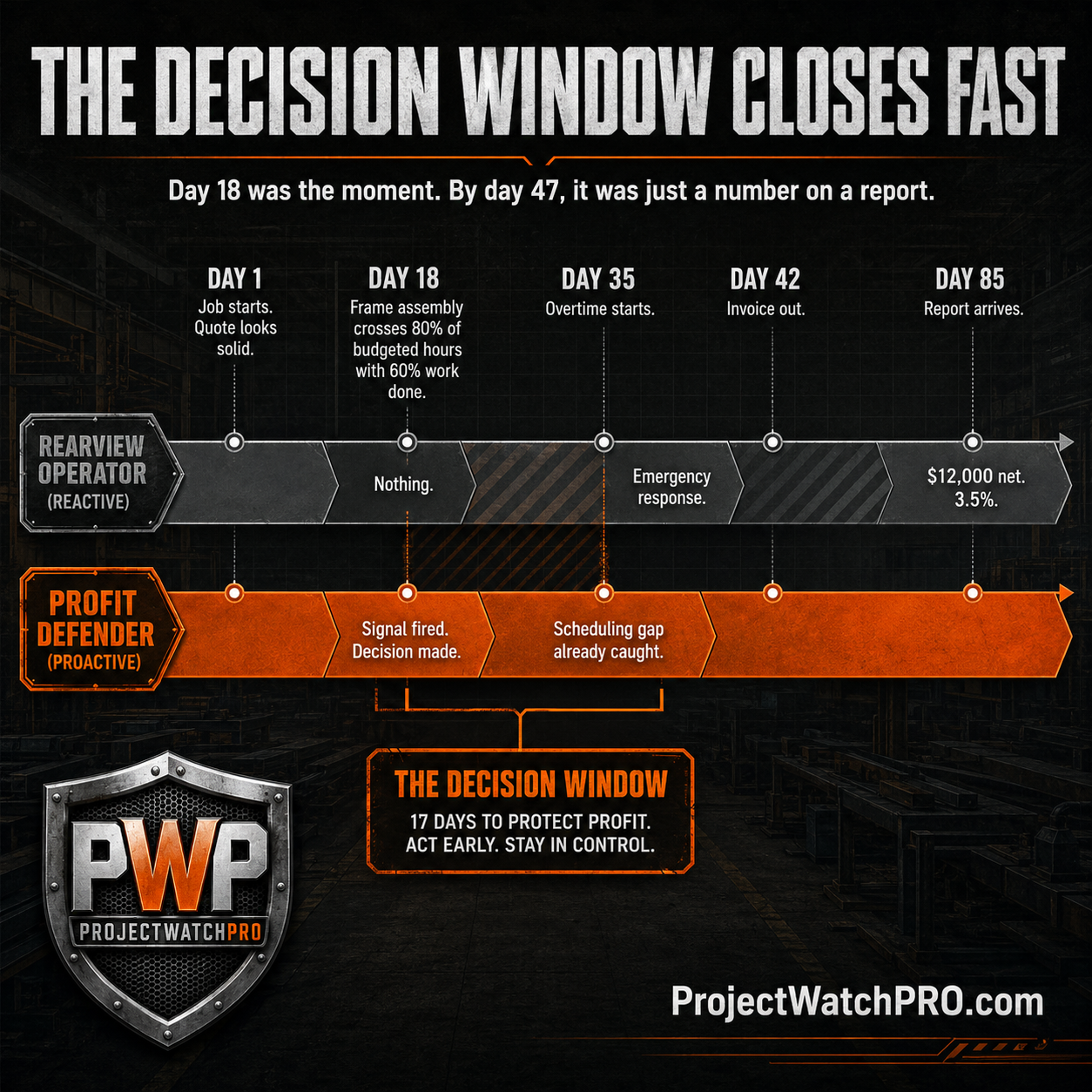
The decision window on this job closed somewhere around day 18.
That's when the frame assembly task crossed 80% of its budgeted hours with less than 60% of the work done. A shop with real-time task visibility would have had a signal. The job was still running. The client was still reachable. The crew assignment was still adjustable.
Day 47 — when the report arrived — wasn't a decision point. It was a postmortem.
The Third Leak — Overtime Nobody Priced In
Week five. One welder out with an injury. Delivery date unmovable.
The shop ran overtime for two weeks to close the gap. Four crew members. Ten overtime hours per week. Eighty hours of unplanned overtime.
At the true blended overtime cost — wage premium, burden scaled up, overhead on the extra hours — those 80 hours cost the shop $9,200.
The quote had $0 for overtime.
How Overtime Hits All 6 Cost Layers at Once
Overtime isn't just a higher wage. It runs through every cost layer simultaneously.
The wage premium increases the base. Payroll taxes scale with the higher rate. WCB premiums apply. Overhead absorbs across the additional hours. Task consumables burn at the same rate regardless of the time of day.
An hour of overtime doesn't cost 1.5x your standard rate. It costs closer to 1.7x to 1.9x your true all-in cost. On 80 hours, that gap is real money — and it's entirely invisible until the report comes back.
Why This One Always Shows Up Last
Overtime is the leak that hides behind the others.
The labor rate was wrong from the quote. The task drifted mid-job. Overtime was the emergency that covered both — and added its own premium on top. By the time the owner saw all three together, the job had closed, the client was on the next project, and there was nothing left to fix.
This is the 45-Day Profit Lag: the distance between when profit is lost and when you find out. On this job, 43 days. On the average fabrication shop without real-time cost tracking, it's 30 to 45 days on every job it runs.
What a Profit Defender Knew While the Job Was Still Running
The shop in this story found out 43 days after it was over.
A Profit Defender running ProjectWatchPRO on this job would have known three things while the job was still alive:
1. The labor rate gap — identified at Step 2 (Labor Analyst) before the quote ever went out. The $91/hr true cost would have been the number the estimate was built on — not $54.
2. The frame assembly drift — flagged at the task level when hours crossed 80% of budget with work still to complete. Not at closeout. At day 18, with the job still running and decisions still available.
3. The overtime exposure — not a surprise, because Step 6 (Schedule Master) assigns every crew member to every task before day one. A scheduling gap shows up in the system before it becomes emergency overtime.
Rearview Operator vs. Profit Defender — the Same Job, Two Outcomes
| Rearview Operator | Profit Defender |
|---|---|
| Quotes from wage + burden ($54/hr) | Quotes from all 6 cost layers ($91/hr) |
| Finds task drift at closeout | Catches task drift at day 18 |
| Learns about overtime cost on the report | Sees the scheduling gap before overtime starts |
| $12,000 profit on a $340K job | Margin defended while the job is still alive |
| Explains losses after the invoice | Prevents losses while the crew is on site |
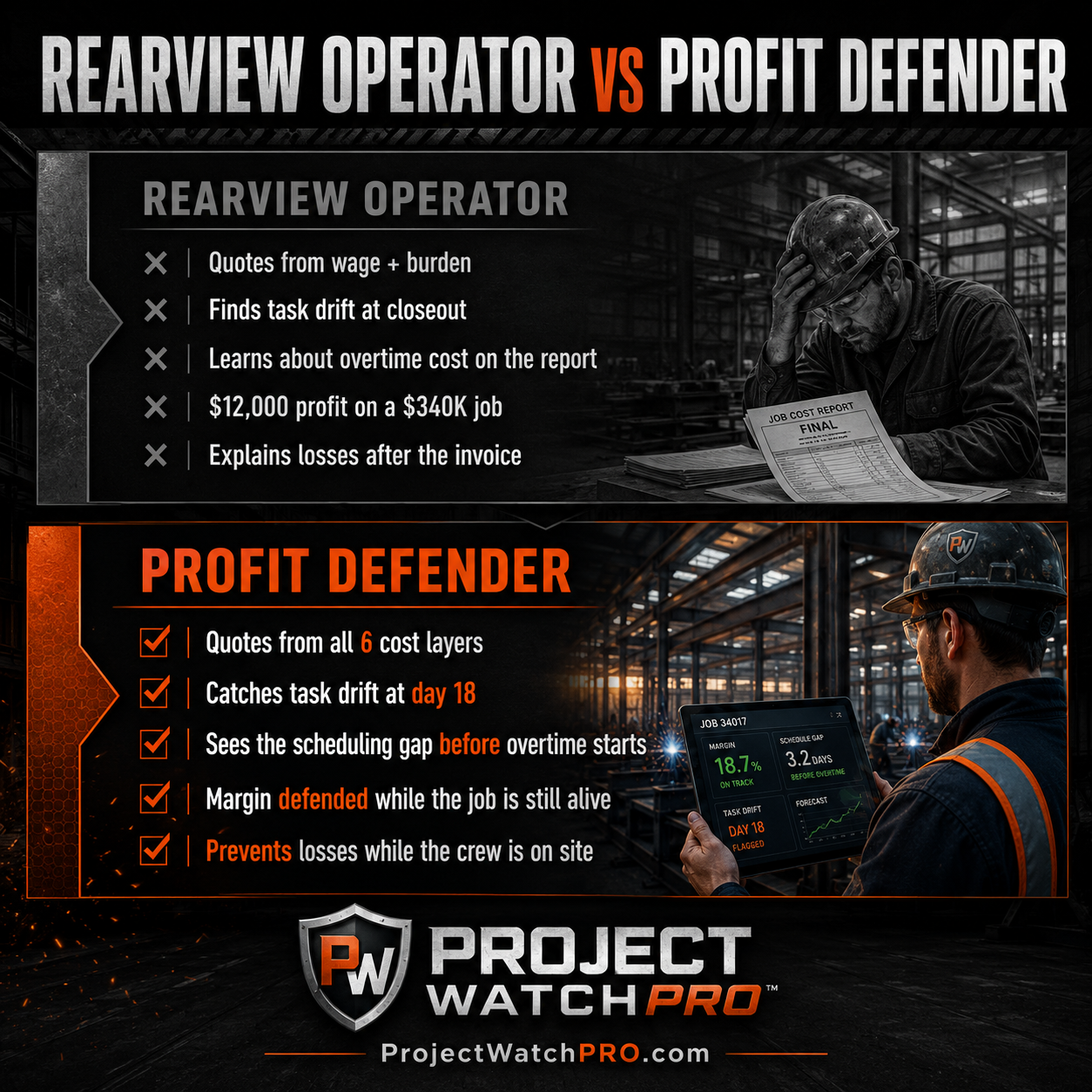
Rearview Operators explain losses. Profit Defenders prevent them.
The job didn't fail because the owner wasn't working hard enough. It failed because the operating model had no way to see what was happening while it could still be fixed. Profit Defended by John A. McCabe lays out the complete system behind why this keeps happening across fabrication shops, welding operations, and trades businesses — and how to stop it.
Key Takeaways
- Most fabrication shops quote from wage + burden — a number that captures 30 to 40% of true labor cost. The other 60 to 70% is where the margin goes.
- A wage increase doesn't just raise your labor cost by the amount of the raise. It flows through all 6 layers — burden rates, overhead, overtime premium — and the real impact is significantly higher.
- Revisiting charge-out rates quarterly is what protects margin over time. When wages move, task burdens shift, or overhead increases, the rates need to follow. A system that auto-calculates makes that review fast.
- Task-level drift is the silent leak. A task running 50% over budget mid-job is fixable. The same discovery at closeout is just damage to absorb.
- Overtime doesn't cost 1.5x your standard rate. It costs 1.7x to 1.9x your true all-in cost when it moves through all 6 layers.
- The 45-Day Profit Lag means the average fabrication shop finds out a job lost money 30 to 45 days after the damage was done — when there's nothing left to fix.
- Profit must be defended while the job is still alive. Closeout is too late.
Frequently Asked Questions
Why do fabrication shops lose money on jobs they quoted correctly?
The most common reason is an incomplete labor rate. Most shops quote from wage plus burden — only 30 to 40% of true labor cost. Overhead absorption, task burden, shift differential, and overtime premium never make it into the quote. The job wins on a number that was never real, and the margin disappears before the report arrives.
What is a good profit margin for a metal fabrication shop?
Industry data puts average metal fabrication net profit at around 4% after all costs. Top-performing shops target 8 to 12% by quoting from true cost — all 6 labor layers, full overhead absorption, and task-level pricing — rather than a simplified wage-based rate that misses most of what a job actually costs.
How do you calculate true job cost in a fabrication shop?
True job cost requires tracking six labor cost layers per employee (wage, labor burden, overhead, task burden, shift differential, overtime premium) plus materials and consumables at the task level — compared against the estimate in real time, not 45 days after closeout. Running your shop's true labor cost is the starting point before any of that tracking can work.
Why does quoted margin disappear before a fabrication job closes?
Three places account for most of the loss: labor quoted at an incomplete rate, task-level drift that nobody catches mid-job, and unplanned overtime that runs through all 6 cost layers at once. None of these are visible in traditional month-end reporting — they only show up after the damage is already done.
What is the 45-Day Profit Lag in metal fabrication?
The 45-Day Profit Lag is the gap between when profit is lost on a live job and when the shop owner finds out. In most fabrication shops, that's 30 to 45 days after the job closes — when the accounting report arrives, the crew is on the next job, and there's nothing left to act on. Understanding where your profit leaks is the first step to stopping it before it becomes a pattern.
The job above wasn't unusual. The shop wasn't careless. The owner had years in the trade, a full order book, and a crew that delivered on time. The math was built wrong from the start — and there was no signal until it was 43 days too late.
If you want to know what your labor is actually costing you — not the wage, not wage plus burden, but the real number with all six layers included — the Bulletproof Quote Calculator does it in under 10 minutes.
No pitch. Just the number you need to stop quoting on bad math.
→ Get the Bulletproof Quote Calculator (free)