Month-End Job Costing Is a Post-Mortem, Not a Strategy | ProjectWatchPRO
The Rearview Trap: Why Month-End Accounting Is a Post-Mortem, Not a Construction Management Strategy
You're booked out three months. The crews are busy. Revenue is up. You should feel good about where the business is.
Then the month-end report arrives.
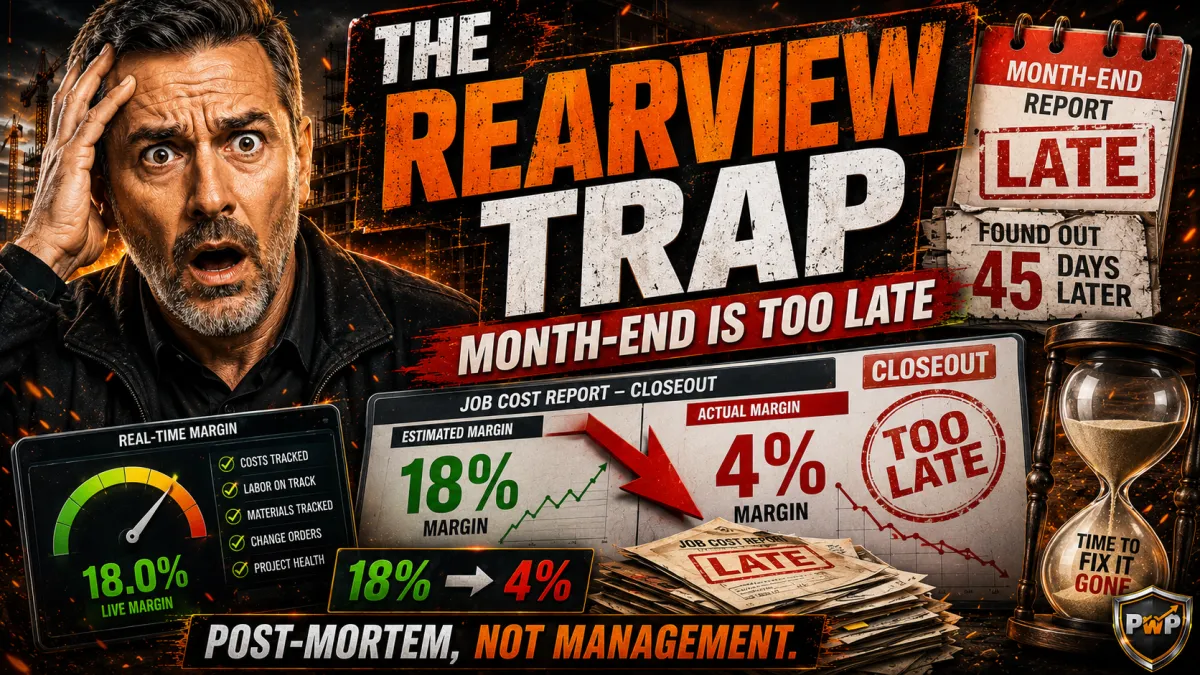
And once again — for the third time this year — a job that should have made 18% came back at 4. Or 6. Or broke even.
You go looking for what went wrong. You review the estimate. You ask the PM. You try to reconstruct where the labor hours went on a job that wrapped up five weeks ago.
You find pieces of it. Not all of it. Not enough to know for certain. And not enough to change anything.
This is the Rearview Trap. And it's not caused by bad estimating, weak project management, or a problem with your crew.
It's caused by using a compliance tool — month-end accounting — as if it were a management strategy.
You're not the problem. The operating model that tells you how the job went after the job is gone is the problem.
Here's what's actually happening every time that report blindsides you — and what a different operating model looks like.
The Rearview Trap: The operating pattern where month-end job-cost reports are used as the primary management signal for construction profitability — creating a structural delay between when margin drifts and when anyone in a position to act finds out. By the time the report confirms the loss, every corrective decision has already expired.
Month-End Job Costing Is a Post-Mortem, Not a Strategy | ProjectWatchPRO
The Rearview Trap: Why Month-End Accounting Is a Post-Mortem, Not a Construction Management Strategy
Why Busy, Booked-Out Contractors Still Get Blindsided at Month-End
The 30-to-45 Day Problem Nobody Names Out Loud
What "Getting Blindsided" Actually Means
Three Things That Are Already Happening on Your Current Jobs Right Now
Labor Hours Are Accumulating at a Cost Your Estimate Didn't Use
At Least One Task Is Running Over Its Budget and Nobody Knows It Yet
Scope Has Grown and the Change Order Paperwork Is Behind
Why Better Month-End Processes Don't Fix the Rearview Trap
What the Profit Defense System Replaces the Rearview Trap With
What Shortening the Decision Window Actually Looks Like
Why Busy, Booked-Out Contractors Still Get Blindsided at Month-End
The worst version of this trap isn't when you're slow. It's when you're killing it on volume.
When the calendar is full and the crews are moving, there's a false sense of control. Activity looks like performance. Booked revenue looks like earned profit. The operation feels like it's working.
Then the reports arrive. And they tell a different story.
Being fully booked is not proof you're winning. It's proof your pipeline is full. Those are different things.
A $5M mechanical contracting firm — consistently booked out, crews running — can be systematically losing $40,000 to $80,000 per month to profit drift that never surfaces until accounting closes the period. Not because anyone is doing anything wrong. Because the instrument being used to detect the problem is optimized for accuracy, not speed.
Month-end job costing is extremely accurate. It is also, by design, extremely late.
The 30-to-45 Day Problem Nobody Names Out Loud
Here's the sequence that plays out in most contracting businesses:
1. The job runs. Hours log. Materials arrive. Subcontractors bill.
2. Field data makes its way to project management.
3. PM data gets processed into accounting.
4. Accounting closes the period, allocates overhead, reconciles payroll.
5. The job-cost report is generated.
From Step 1 to Step 5, the average elapsed time is 30 to 45 days. On a fast-moving job, that means the report arriving on your desk today is describing events that happened in a different month — on a job your crew may have already left.
The events in that report aren't news. They're history.
And history, no matter how accurate, cannot be changed.
What "Getting Blindsided" Actually Means
When a contractor says the month-end report blindsided them, what they're describing isn't a surprise about the past. It's the realization that they had no instrument in the present.
The loss didn't happen when the report arrived. It happened in week two or week three — when one task started running long, when a scope addition went uncaptured, when the loaded labor cost outpaced the estimate by a multiplier the estimate never accounted for.
The report confirmed the loss. The loss itself was already weeks old.
That's the trap. Not the number on the report. The delay that made the number irreversible.
Three Things That Are Already Happening on Your Current Jobs Right Now
While you're reading this, you have jobs running. And on at least some of them, the following three things are happening — right now — with no instrument surfacing them to you in real time.
Labor Hours Are Accumulating at a Cost Your Estimate Didn't Use
If your field labor earns $40 per hour, the true cost to your business is typically $108 to $119 per hour.
That gap is explained by six cost layers:
1. Base wage
2. Labor burden — CPP or FICA, EI, workers' compensation, benefits
3. Overhead burden — your operating cost allocated per billable labor hour
4. Task-specific consumables
5. Shift differential (where applicable)
6. Overtime premium on compressed schedules
Most estimates are built from Layer 1 only. Every job runs on all six. When the estimate uses $40 and reality costs $119, the margin gap is baked in before a single shovel hits the ground.

This isn't a field performance problem. It's a math problem that resets on every single estimate that uses wage rate instead of true loaded cost.
At Least One Task Is Running Over Its Budget and Nobody Knows It Yet
Job totals create false confidence. A job can look "on budget" at the aggregate level while one task — rough-in, civil, equipment rigging, whatever — burns through its hours at twice the estimated rate.
The total absorbs the overrun. Nobody flags it. The job rolls forward.
By the time the total collapses, the task that caused it finished weeks ago. Identifying it in the post-mortem doesn't help. The hours are spent. The margin is gone.
If the task is invisible, the leak is invisible.
Scope Has Grown and the Change Order Paperwork Is Behind
The field moves in real time. Change order paperwork moves on business days, with signatures, approvals, and billing cycles.
The typical lag between a scope addition happening in the field and a signed change order in hand: 10 to 21 days. On a fast-moving job, that's multiple additional scope additions stacked on top of the first before the first one is even processed.
Every hour of unauthorized scope work is margin leaving the job without a corresponding billing event. By month-end, those hours are in the cost column. The revenue hasn't caught up. The report shows a margin that's lower than it should be — and there's no clean way to recover it.
Why Better Month-End Processes Don't Fix the Rearview Trap
This is the piece most advice on construction job costing misses.
Faster closes don't fix the problem. Better cost code discipline doesn't fix it. Tighter month-end processes don't fix it. They reduce friction. They don't change the structural timing failure.
The Rearview Trap isn't caused by sloppy accounting. It's caused by a fundamental mismatch between when decisions can be made and when information arrives.
By the time the month-end report is in your hands:
- The job it describes has closed or is nearly closed
- The labor hours that caused the overrun were logged 2 to 6 weeks ago
- The crew has moved to new work
- The foreman's memory of what happened in week three is approximate at best
- The change order window has passed for work that happened last month
Month-end reporting is the right tool for compliance, tax, and financial statements. It is the wrong tool for managing profit on jobs that are actively running.
Managing profit from month-end reports is like driving by looking in the rearview mirror. The road behind you is perfectly clear. The road in front is completely invisible.
What the Profit Defense System Replaces the Rearview Trap With
The Profit Defense System isn't faster reporting. It's a different operating model — one where the job is the center of all information, and that information updates as the job runs, not after it closes.

Here's the contrast:

The structural difference isn't sophistication. It's timing.
What Shortening the Decision Window Actually Looks Like
The decision window is the time between when a cost problem starts and when someone in a position to act on it actually sees it.
In a month-end operating model, that window is 30 to 45 days. And inside those 45 days, every decision available to you expires:
- You can't redeploy labor on a task the crew finished last week
- You can't call a change order on scope that was completed three weeks ago
- You can't re-sequence phases that are already done
- You can't add buffer to a schedule that's already been burned
Shortening the decision window to hours — or 60 seconds, as ProjectWatchPRO updates the margin picture — doesn't just give you faster information. It gives you information while decisions are still possible.

A margin alert that surfaces on Tuesday while the crew is still on site is actionable. A margin confirmation that arrives on the 15th of next month is a record.
The Weekly Job Review That Replaces the Monthly Post-Mortem
Real-time data without a decision rhythm is wasted. The operating cadence that makes real-time job costing work is a weekly live review — not a monthly closeout review, but a weekly standing question:
- Which tasks are over their hour budget right now?
- What is the current margin projection vs. the estimate?
- What is one decision I can make this week that protects the margin?
Profit Defenders don't hold post-mortems. They hold weekly stand-ups with live numbers. And the difference in outcomes — consistently 13–16% margins versus the industry average of 3–5% — isn't explained by better estimating or harder work.
It's explained by the decision window.
Key Takeaways
- Being fully booked is not proof you're winning. Activity and profitability are different measurements. Month-end reports often confirm they've diverged — weeks after it was still fixable.
- The Rearview Trap is the pattern of using month-end job costing as a management tool. It's accurate. It's also always too late to act on.
- The 30-to-45 day reporting lag is the gap between when margin starts drifting and when you find out. Every corrective decision expires inside that gap.
- True labor cost is 2x–3x the wage rate. Estimating from wage builds structural margin erosion into every quote before the job starts.
- Job totals hide the leak. Task-level tracking surfaces a drifting phase in week two — when there's still time to do something.
- Month-end reporting is the right tool for compliance. It is the wrong tool for managing profit on jobs that are actively running.
- The decision window is everything. Shortening it from 45 days to real time doesn't give you faster information. It gives you information while decisions are still possible.
Frequently Asked Questions
Why am I losing money on construction jobs that looked profitable?
The most common cause is reporting lag. The job was profitable in the estimate — it became unprofitable in execution, week by week, through labor overruns, scope drift, and true labor cost that exceeded the wage rate used in the estimate. None of it was visible while it was happening. By the time the month-end report confirmed the loss, every corrective decision had already expired.
Why does month-end job costing keep blindsiding me?
Because month-end job costing is designed for accounting accuracy, not operational speed. It tells you what happened — correctly — 30 to 45 days after the events it's describing. On a job that ran eight to twelve weeks, the month-end report may describe events from the first third of the job that were already irreversible before the job even closed. The instrument is working correctly. It's just the wrong instrument for the decision you're trying to make.
What is the difference between job costing and real-time job costing?
Standard job costing reconciles costs at period end — typically monthly — producing an accurate picture of what each job cost after the fact. Real-time job costing updates the cost picture continuously as hours are logged from the field, applying true loaded cost to each hour and comparing it against task-level budgets as the work happens. The data content is similar. The timing is the entire difference — and timing determines whether the information is actionable or historical.
How do I stop profit fade on construction jobs?
Three things have to work together: accurate true labor cost in every estimate (not wage rate), task-level budget tracking so drift is visible before the job total collapses, and a real-time reporting cadence that surfaces cost variances while the crew is still on site. A weekly live job review — not a monthly post-mortem — is the cadence that converts real-time data into real-time decisions.
How do I track labor productivity weekly on a construction job?
Weekly labor productivity tracking requires a system that allocates employee hours to specific tasks as they are logged — not after a period close — and compares them against the task's hour budget. When a task starts running over its budget mid-week, the variance surfaces immediately. A weekly review of that data gives the PM a decision opportunity before the task finishes and the window closes. ProjectWatchPRO does this continuously, updating every 60 seconds.
Why is month-end accounting not enough for construction companies?
Month-end accounting is the right tool for financial statements, tax compliance, and period-end reporting. It is not a management tool for active jobs because its output describes the past, not the present. Construction companies that manage profit from month-end reports are always operating on 30-to-45-day-old information — which means they're always reacting to losses they had no instrument to prevent. The fix isn't faster accounting. It's real-time job costing that runs in parallel with accounting, not downstream from it.
If this describes how your business runs right now — booked out, crews moving, but month-end keeps blindsiding you — the issue isn't the jobs. It's the instrument you're using to manage them.
The first step is finding out what your labor is actually costing you. Not the wage rate. The real number — including burden, overhead, and all six cost layers. The True Labor Cost Calculator at truelaborcost.site shows you that number in about three minutes.
No signup. No pitch. Just the number that explains the gap between what you bid and what you keep.


