
You're Paying for 8 Hours. How Many Are You Actually Billing?
You're Paying Your Crew for 8 Hours. How Many of Those Hours Land on an Invoice?
The day starts before the job starts. You're paying for all of it.
Your crew clocks in at 7am. They're on the job site at 8:15. They set up until 8:45. They break down and load at 4:00. They're back at the shop at 5:15.
You paid for 10 hours and 15 minutes. You billed for 7 hours and 15 minutes of productive work.
That gap happens every single day. On every job. For every person on your crew.
If you're pricing your jobs off the hourly wage — $38, $45, $52, whatever your number is — that price is based on 8 productive hours for every 8 paid hours. The reality is 5.5 to 6.5 productive hours for every 8 paid hours in most trades. The difference between those two numbers is profit you quoted but cannot keep.
Non-billable hours are hours you pay your crew for that cannot be billed directly to a customer or job. Drive time to and from a site, setup and breakdown, cleanup, waiting on inspections or materials, travel between jobs — all of it is on your payroll. None of it shows up on an invoice. When those hours are not priced into the quote, the gap comes out of your margin every time the crew clocks in.
The Hours You Pay For That Never Hit an Invoice
Take a service trade crew — HVAC, plumbing, electrical, painting. A typical day might look like this:
30 minutes: morning shop time, loading the truck
45 minutes: drive to the first job
20 minutes: setup at site
4 hours: productive work you can bill
30 minutes: breakdown and load
20 minutes: drive to the second job
20 minutes: setup
2.5 hours: productive work you can bill
20 minutes: breakdown and load
30 minutes: drive back to shop
15 minutes: unload and close out
That's a 10-hour paid day. You billed 6.5 hours of actual work.
The other 3.5 hours — drive time, setup, breakdown, transit — were real labor costs. Your crew was on the clock. Workers' comp was ticking. You were paying payroll taxes on every minute of it. None of it landed on a customer invoice.
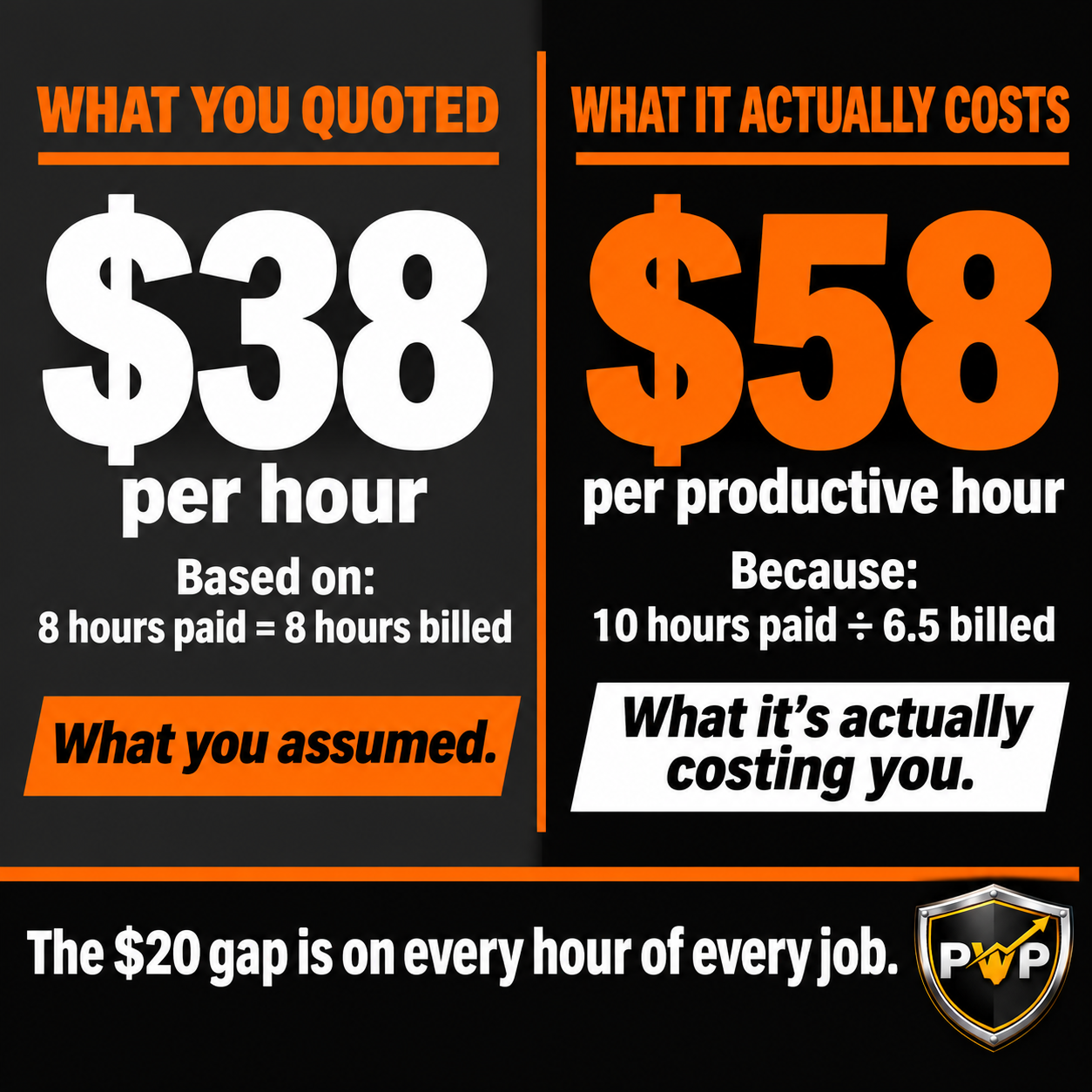
What That Gap Looks Like in Dollars
If you have one person at $38 per hour and their actual productive hours in a day average 6.5 out of 10 paid hours, here is the math:
- Paid per day: 10 hours × $38 = $380
- Productive hours billed: 6.5 hours
- Real cost per billable hour: $380 ÷ 6.5 = $58.46
You are pricing the job at $38 per hour in your quote. The actual cost of delivering that hour of work is $58.46. That is a $20.46 gap on every single billable hour — before overhead, burden, or anything else is counted.
Across five technicians running this ratio, that gap is costing contractors around $70,000 per year in labor cost that gets paid out but never recovered from customers.
Here's what most contractors get wrong: they know their wage rate and they know their billable hours, but they treat those two numbers as if they come from the same pool. They don't. Wage is what you pay. Billable hours are what customers pay for. When non-billable time sits between them and nothing covers it, profit disappears and nobody can explain why the numbers looked right on paper.
Every Trade Has a Different Non-Billable Profile
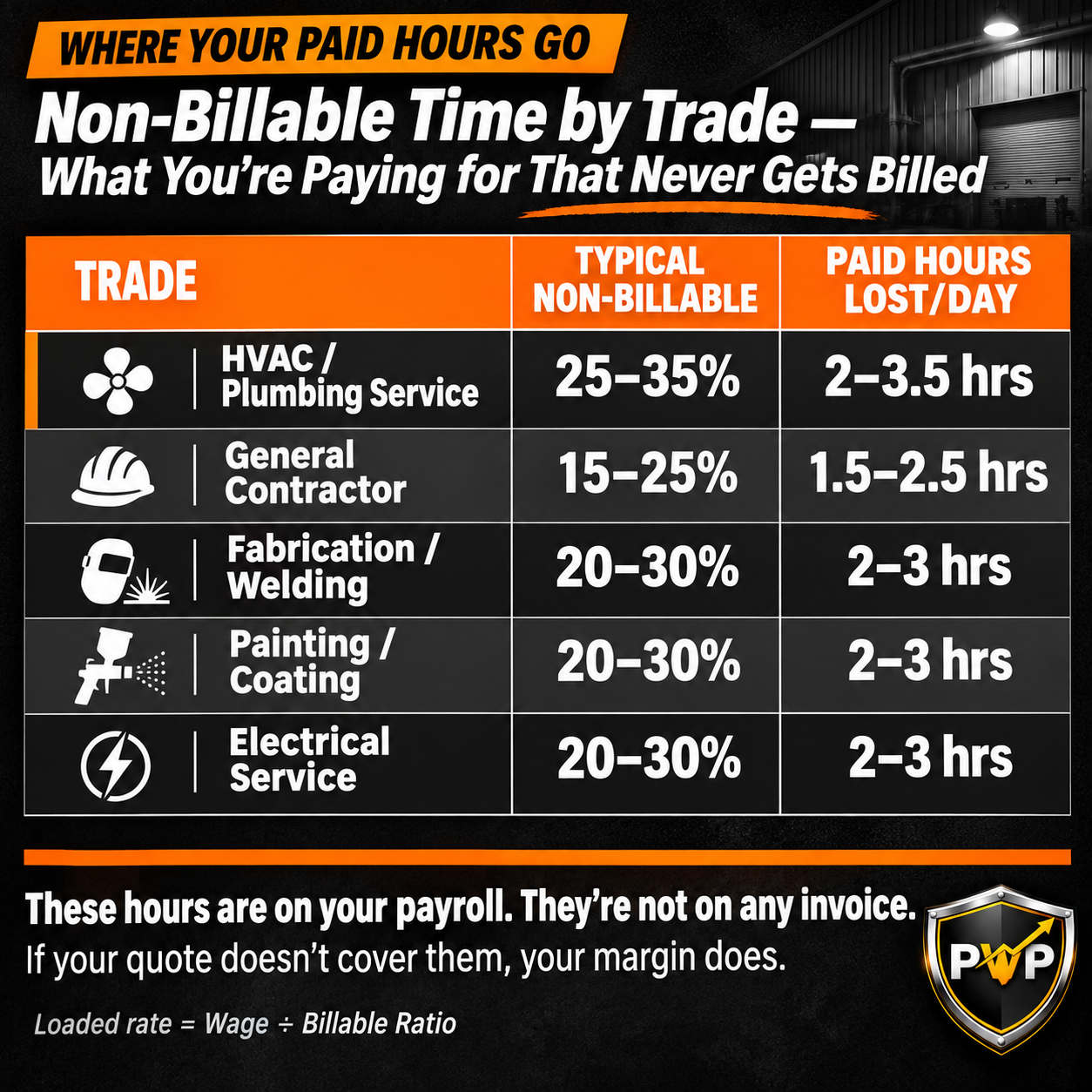
The gap is the same problem in every trade. The hours that make up the gap are different.
HVAC and plumbing service: multiple jobs per day, significant drive time between locations. Non-billable time often 25–35% of the paid day. A technician running three jobs a day has less billable time per job than one running a single all-day install.
General contractor and commercial construction: less daily transit, more setup. Equipment moves, mobilization, site safety walks, end-of-day cleanup, and sub-coordination time all sit outside billable task hours. On a large job, mobilization days are entirely non-productive from a billing standpoint — but the crew is fully on the clock.
Fabrication and welding shops: material handling, machine setup and teardown, programming time, and rework prep are rarely broken out in a quote. A machinist who spends 45 minutes setting up a part run before cutting a single piece is non-billable for those 45 minutes — but that time is on your payroll regardless.
Painting and coating: surface prep, masking, and mobilization are often quoted as one line in an estimate. When prep runs long, the productive paint time gets compressed into the same day — but the total hours paid don't shrink to match. You end up paying for 9 hours and invoicing for 7.
Swap the trade and the numbers change. The underlying problem is the same: you are paying for time that your quotes don't account for, and that time comes out of whatever margin you thought you built in.
How to Stop Pricing From the Wrong Number
The fix is not complicated. It is one additional step in how you calculate your labor cost before you set a price.
Instead of: wage × hours quoted = labor cost in the estimate
Use: wage × (total paid hours ÷ billable hours) × hours quoted = labor cost in the estimate
That second version is called a loaded labor rate — the wage adjusted for the actual ratio of paid hours to billable hours. It is the number that reflects what your crew actually costs to put on a job, not what their paycheck says.
Here is how to build it:
1. Track one week of actual crew hours — log total hours paid and total hours that land on an invoice or job ticket. Don't guess. One week of real data gives you the ratio.
2. Calculate your billable ratio — if you paid 200 hours and billed 145 hours, your ratio is 145 ÷ 200 = 72.5% billable.
3. Adjust your labor rate — if your wage is $42/hr and 72.5% of hours are billable, your loaded rate is $42 ÷ 0.725 = $57.93 per productive hour.
4. Use the loaded rate in every quote — not the wage. The loaded rate is what it costs you to deliver one hour of work to a customer.
5. Layer on burden and overhead on top of that — the labor burden (payroll taxes, workers' comp, insurance, vacation) and overhead rate go on top of the loaded rate, not on top of the base wage. This is where most cost calculations stop too early.
The True Labor Cost Blueprint walks through all of this — including the non-billable adjustment — in one sequence. It is the full calculation, not just the wage step.
John McCabe has seen this pattern in Profit Recovery Reviews across trades and revenue levels: owners who think their labor cost is $45/hr are actually running $68–$80/hr once non-billable time, burden, and overhead are properly loaded. That gap, across a full year of jobs, is not a rounding error. At $3M in revenue it is typically around $150,000 per year in margin that was earned on paper and not kept. At $5M, closer to $200,000.
This is a methodology problem, not a people problem. The crew is not the reason. The number you built the quote on is the reason. ProjectWatchPRO's approach — before the software even enters the picture — is to get the right cost number built first. The Profit Pulse System starts there: a True Cost Baseline before anything else gets quoted, scheduled, or tracked. The software makes it easier to hold that number consistent across every job. But the first step is the number, and the True Labor Cost Blueprint is how you build it.
What Changes When You Price From the Real Number
When a contractor in HVAC service runs this calculation and updates their labor rate, the jobs don't change. The crew doesn't change. The customers don't change.
The price changes — by whatever amount was needed to cover the hours that were always being paid but never billed. Some jobs go up 10%. Some go up 18%. And the margins that showed up flat year after year start coming back — not because anything in the field got better, but because the quote started from an honest number.
That is what the Rearview Operator never does: price from a real number. They price from the wage, they run the jobs, they find out the margin was wrong somewhere between 30 and 45 days after the invoice goes out. By then there's nothing left to adjust. The Profit Defender prices from the loaded rate — burden, overhead, and non-billable time all counted before the quote leaves the office.

Key Takeaways
- Non-billable hours — drive time, setup, breakdown, cleanup, transit between jobs — are paid by the employer but cannot be charged to a customer; in most trades they represent 20–35% of a paid workday
- Real cost per productive hour is wage ÷ billable ratio, not wage alone: a $38/hr employee who bills 6.5 of 10 paid hours costs $58.46 per billable hour — a gap of $20 on every hour quoted
- Five technicians running a 65% billable ratio at $38/hr cost the business approximately $70,000 per year in unrecovered non-billable labor
- Every trade has its own non-billable profile: HVAC service crews run high transit time; GC crews run mobilization and coordination time; fabrication shops run setup and programming; painting crews run prep and masking — the gap is different, the problem is the same
- The fix is a loaded labor rate: wage adjusted upward for the non-billable ratio, then labor burden and overhead loaded on top of that number — not on top of the base wage
- At $3M revenue, correcting a $20/hr non-billable gap across a 10-person crew typically recovers around $150,000 per year in margin that was always being earned and never kept
- The True Labor Cost Blueprint at truelaborcostblueprint.com walks through the full calculation — non-billable adjustment, burden, and overhead — in one sequence
Frequently Asked Questions
What are non-billable hours in construction?
Non-billable hours are time you pay your crew for that cannot be charged to a customer — drive time to and from a job site, setup and breakdown, cleanup, waiting on inspections or material deliveries, and travel between jobs. In most trades, 20–35% of a paid workday is non-billable. When those hours are not loaded into your labor rate, the cost is paid by the business and subtracted from your margin on every job.
How do I account for non-billable time in my construction quotes?
Track one week of actual hours: total hours paid versus total hours that appear on a job ticket or invoice. Divide billable hours by paid hours to get your billable ratio. Then divide your wage by that ratio to get your loaded labor rate — the real cost per hour of billable work. Use that number in your quotes, not the wage. The True Labor Cost Blueprint walks through this calculation step by step.
Why is my labor cost higher than the wage I pay?
Because wage is only the starting point. Non-billable time means each productive hour costs more than the wage alone — a $38/hr employee billing 6.5 of 10 paid hours costs $58.46 per billable hour delivered. On top of that, labor burden (payroll taxes, workers' comp, vacation) adds another 20–40%, and overhead adds more. The real cost per hour is typically 2–3 times the wage before the job produces any profit.
How much does drive time cost a contractor per year?
It depends on crew size and job type, but the math is straightforward: if you have five technicians spending 1.5 paid hours per day on non-billable time at $42/hr, that is $315/day, $1,575/week, and roughly $70,000–$80,000 per year in paid labor that is never recovered from customers. Multiply across a larger crew or more non-billable hours and the number grows proportionally.
Does non-billable time affect all trades the same way?
The gap exists in every trade, but the hours that make it up are different. HVAC and plumbing service crews have high daily transit between jobs. General contractors carry mobilization, coordination, and site safety time. Fabrication shops carry setup, programming, and material handling. Painting and coating crews carry prep and masking time. The ratio of paid-to-billable hours varies by trade and job type — which is why tracking your own data for one week is more accurate than using an industry average.
What is a loaded labor rate and how is it different from a wage?
A loaded labor rate is the cost per billable hour of work, calculated by adjusting the wage upward for the non-billable time ratio and then adding labor burden and overhead. If your wage is $42/hr and 72.5% of hours are billable, the loaded rate starts at $57.93 — before burden or overhead. That is the number that belongs in a quote. Using the wage alone underprices every job by whatever gap sits between those two figures.