Construction Profit Fade: Your Margin Didn't Disappear at Closeout — It Left on Day 14
Profit Fade in Construction: Why Your Margins Disappear Before the Job Is Done
You bid the job right.
You checked the numbers. You accounted for labor. You built in contingency. You felt good about it.
Then the job ended. And the margin was gone.
Not because you made a massive mistake. Not because the estimate was wildly off. Just — gone. Bled out somewhere between the bid and the final invoice, and you can't point to exactly where.
This is called profit fade. And according to constructionbusinessowner.com, it is the single most-named financial problem in the contracting industry.
The industry's standard explanation blames the estimate — bad pricing, missed scope, poor change order management. Those are real. But they're not the root cause.
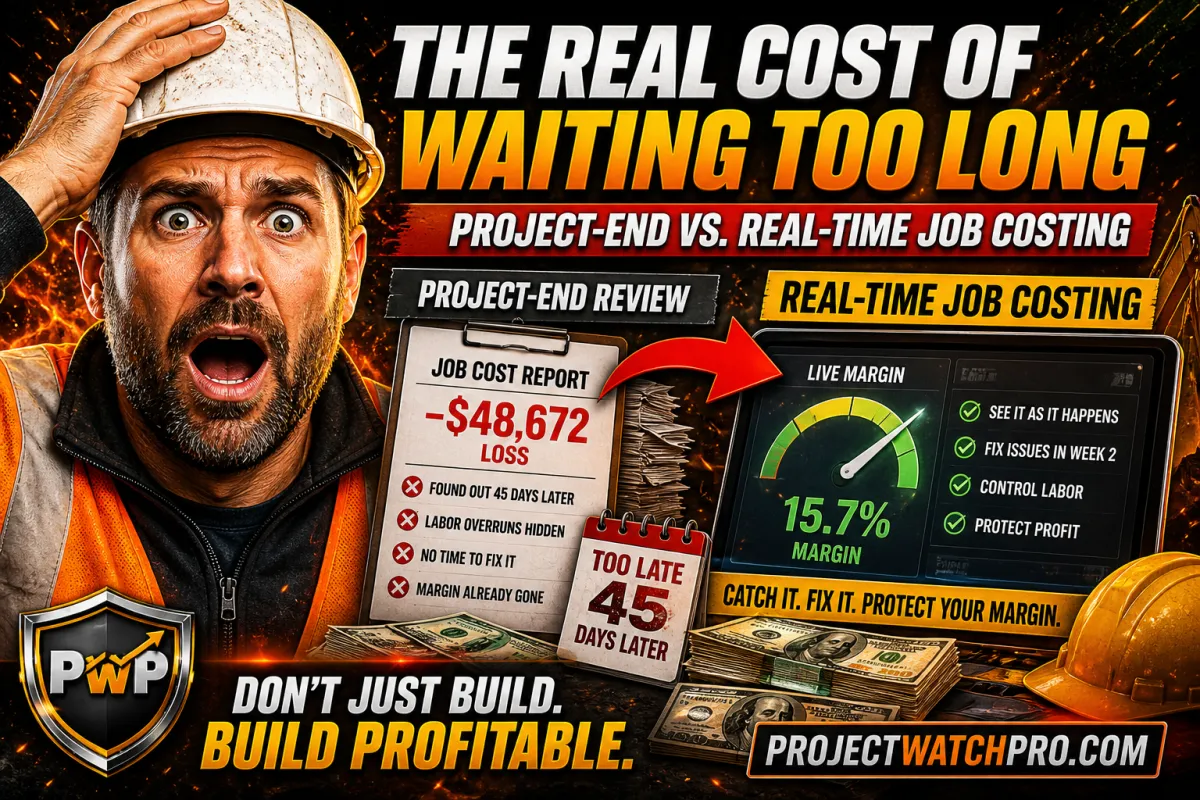
The root cause is timing. By the time you see profit fade in a report, it already happened 45 days ago. The job is done. The crew has moved on. The damage is locked in.
You're not the problem. The operating model is.
Here's what's actually happening — and what to do about it.
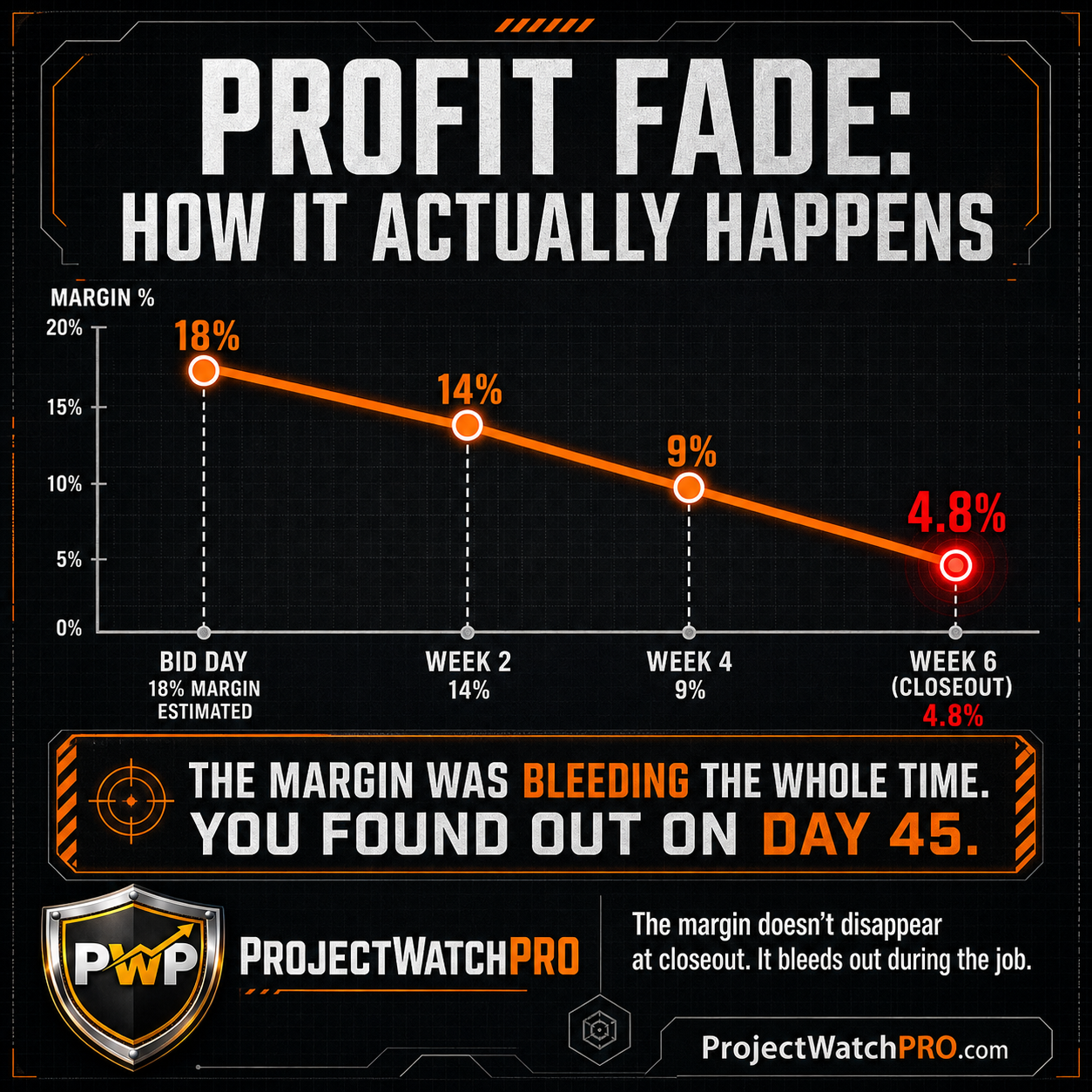
Profit fade in construction is the gradual erosion of a job's estimated gross margin between the time a contract is signed and the time the project closes out. A job estimated at 18% gross margin finishes at 6% — or less. The money was there on paper. By closeout, it had disappeared.
You Didn't Bid It Wrong — You Found Out Too Late
Profit fade is one of the most disorienting experiences in contracting.
You ran the estimate. You've done this kind of job before. The crew is experienced. Nothing catastrophic happened on site. And yet — when the job closes — the number on the report doesn't match the number you expected.
Most contractors assume the problem is in the estimate. So they go back and look for what they missed. They tighten the next bid. They try to price more carefully.
And it keeps happening.
That's because the problem isn't in the estimate. The problem is in the gap between when the margin disappears and when you find out about it.
In most contractor operations, that gap is 30 to 45 days — or longer. Month-end reporting closes the books weeks after the work is done. By the time the report shows a $22,000 labor overrun on last month's job, the crew that built it is two jobs down the road. The foreman doesn't remember why week three ran hot. There's nothing to investigate and nothing to fix.
You didn't bid it wrong. You found out too late.
What Profit Fade Actually Looks Like in Practice
Here's a scenario that plays out in thousands of contracting businesses every month.
A mechanical contractor in the $4M range takes on a commercial retrofit — $380,000 contract, 22% gross margin estimated, $84,000 in expected profit.
Six weeks in, the job closes. Final numbers:
- Labor: $14,000 over estimate
- Materials: $6,000 over due to a mid-job price adjustment
- Unbilled scope change: $9,000 of work that went through without a signed change order
Final margin: 4.8%. Final profit: $18,000.
The contractor lost $66,000 in margin on a job that felt like it ran fine. No disasters. No massive mistakes. Just slow bleed — across labor, materials, and scope — that nobody caught while it was happening.
That's profit fade. And it wasn't visible until 45 days after the damage was done.
The Timing Gap That Makes Profit Fade Inevitable
The construction industry has a structural timing problem.
Costs are live. They happen in real time — every hour logged, every material delivered, every piece of equipment on site.
Visibility is historical. Job cost reports are assembled from data that was entered days or weeks after the work happened, reconciled at month-end, and reviewed after the job closes.
The gap between when costs occur and when they become visible is where profit goes to disappear.
Contractors who catch profit fade early enough to act aren't better estimators. They've built a shorter gap — a feedback cadence that compares actual costs to the estimate while the job is still running. While there's still time to adjust.
The contractors running on month-end reports are always looking at yesterday. Usually at yesterday's job. The margin is already gone.
The Four Places Your Margin Goes Before You Know It's Gone
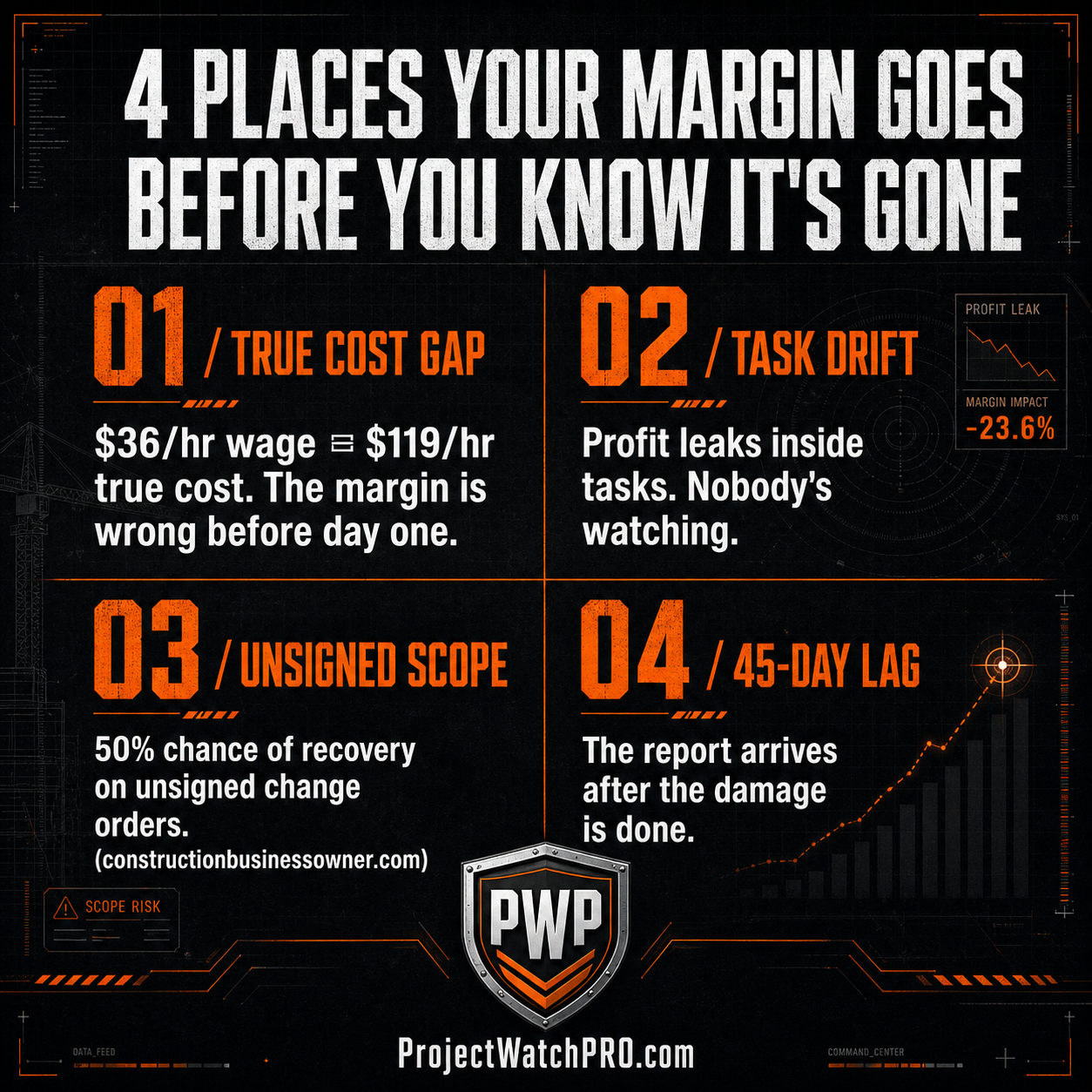
Profit fade isn't one problem. It's four problems operating in the same timing gap. Each one is manageable when caught mid-job. None of them are recoverable at closeout.
1. Labor Costed on Base Wage, Not True Cost
This is the most common and most expensive cause of profit fade in contracting — and it starts before the job begins.
Most contractors estimate labor on wage rate. A crew at $38 per hour. A foreman at $52. That's what gets entered into the bid.
The actual cost of that labor — when you add employer taxes, workers' comp, benefits, equipment allocation, and overhead burden — is typically 2.5 to 3 times the base wage.
In the Profit Defense System's six-layer True Cost Model, a $36-per-hour base wage becomes $119 per hour fully loaded.
When a job is estimated on $38 and the true cost is $97 — the margin gap is baked into the bid before the first shovel hits dirt. It's not fade. It's a structural deficit masquerading as a pricing problem.
Every hour of labor that runs over estimate costs more than you think it does — because the rate in your estimate probably isn't the real rate.
2. Task-Level Drift That Nobody Catches Mid-Job
Even when the estimate is sound, margin disappears at the task level.
A job isn't one unit of work. It's framing, rough-in, finish, punch list — each with its own labor hours, material quantities, and cost assumptions. A job can run fine on three tasks and bleed on one, and the job-level report won't show the problem until the bleeding has already happened.
The task that ran 30% over labor? It happened in week two. The foreman knew it was running long. Nobody had a system to capture that signal and route it to anyone who could act on it.
By week six — closeout — the task is a line item in a report. There's no conversation to have. There's no corrective action available. The margin is gone.
Profit doesn't fade at the job level. It fades inside tasks — where nobody is looking.
3. Scope Creep That Never Makes It Into a Change Order
Change order failure is the profit leak that contractors talk about the most — and fix the least.
The field reality: conditions change. Scope expands. Owners ask for extras. Foremen say yes because the relationship matters. The work gets done. The change order never gets signed.
According to constructionbusinessowner.com, unsigned change orders have a 50% or lower chance of full recovery at closeout. Half of the extra work your crew did last month — work that your team actually performed, on a real job, at real cost — may not get paid for.
That's not an estimating problem. That's a real-time documentation problem. The contractor who catches scope creep in week two and gets the change order signed in week two recovers it. The contractor who catches it at closeout — or doesn't catch it at all — eats it.
4. Month-End Reporting That Arrives After the Damage Is Done
This is the mechanism that makes the other three invisible.
Monthly reporting was designed for a slower world — where jobs ran for a year, costs moved predictably, and a 30-day feedback lag was acceptable.
In 2026, with labor costs up 4% year-over-year and input prices moving at 12.6% annualized, a 30-day feedback lag is a real dollar problem on every job you run.
The average construction job in the $500K–$2M range runs four to eight weeks. Monthly reporting arrives after the job is half done — or over. By the time the report shows where the margin went, the only thing left to do is the post-mortem.
Month-end reporting doesn't prevent profit fade. It documents it.
Why Every Existing Solution Misses the Point
If you've ever searched for how to fix profit fade, you've found the same three answers:
1. Better estimating
2. Stricter change order management
3. More detailed job cost reports at closeout
These are the right ideas applied at the wrong time.
Better estimating helps you start with a more accurate picture. But if you're running on a 30-day reporting lag, a better estimate just gives you a more precise number to lose.
Stricter change order management is essential — but it requires a system that surfaces scope changes in real time, not at closeout when the project manager is trying to close out ten jobs at once.
More detailed closeout reports give you a better post-mortem. They don't prevent anything.
The industry has been solving profit fade by improving the estimate and improving the autopsy. Nobody has been addressing the gap in between — the 45 days where the margin disappears while everyone is too busy working to watch it.
That's what the Profit Defense System was built for.
How Profit Defenders Stop Profit Fade While the Job Is Still Alive
The contractors who consistently protect margin aren't bidding more conservatively. They haven't eliminated risk from their work. They've built one thing that most of the industry doesn't have: a feedback cadence that closes the timing gap.
Here's what that looks like in practice.
Step 1 — Build a True Cost Baseline Before You Bid
Before you can track fade, you need a cost foundation that reflects reality.
That means knowing what one hour of your labor actually costs — not the wage rate, the true cost. Every layer:
1. Base Wage
2. Labor Burden (payroll taxes, workers' comp, benefits)
3. Overhead Burden (your operating costs allocated per field hour)
4. Task-Specific Consumables (materials consumed per hour by trade)
5. Shift Differential (premium time built in)
6. Overtime Premium (actualized risk)
When those six layers are calculated and held as your True Cost Baseline, the estimate reflects reality. You're not bidding on $38 and deploying $97. You know the real number before the job starts.
This is Step 1 of the Profit Defense System. Everything downstream depends on it.
Step 2 — Compare Actual to Estimated at the Task Level, During the Job
Once the baseline is right, the next step is catching drift before it compounds.
That means comparing actual labor hours and actual costs to estimated hours and estimated costs — at the task level — while the task is still running. Not at closeout. Not at month-end. During.
When hanging runs 18% over labor in week two of a six-week job, a Profit Defender sees it in week two. They have options:
- Adjust the task sequence for the remaining work
- Review the crew mix on that task
- Identify whether the scope changed without documentation
- Have the change order conversation with the GC while the leverage exists
At closeout, those same options cost zero dollars and produce zero results. The margin is already gone.
This is Step 7 of the Profit Defense System: Margin Drift Detection. Actual costs compared to estimated costs, surfaced fast enough to act.
Step 3 — Run the Profit Defense Loop Every Week
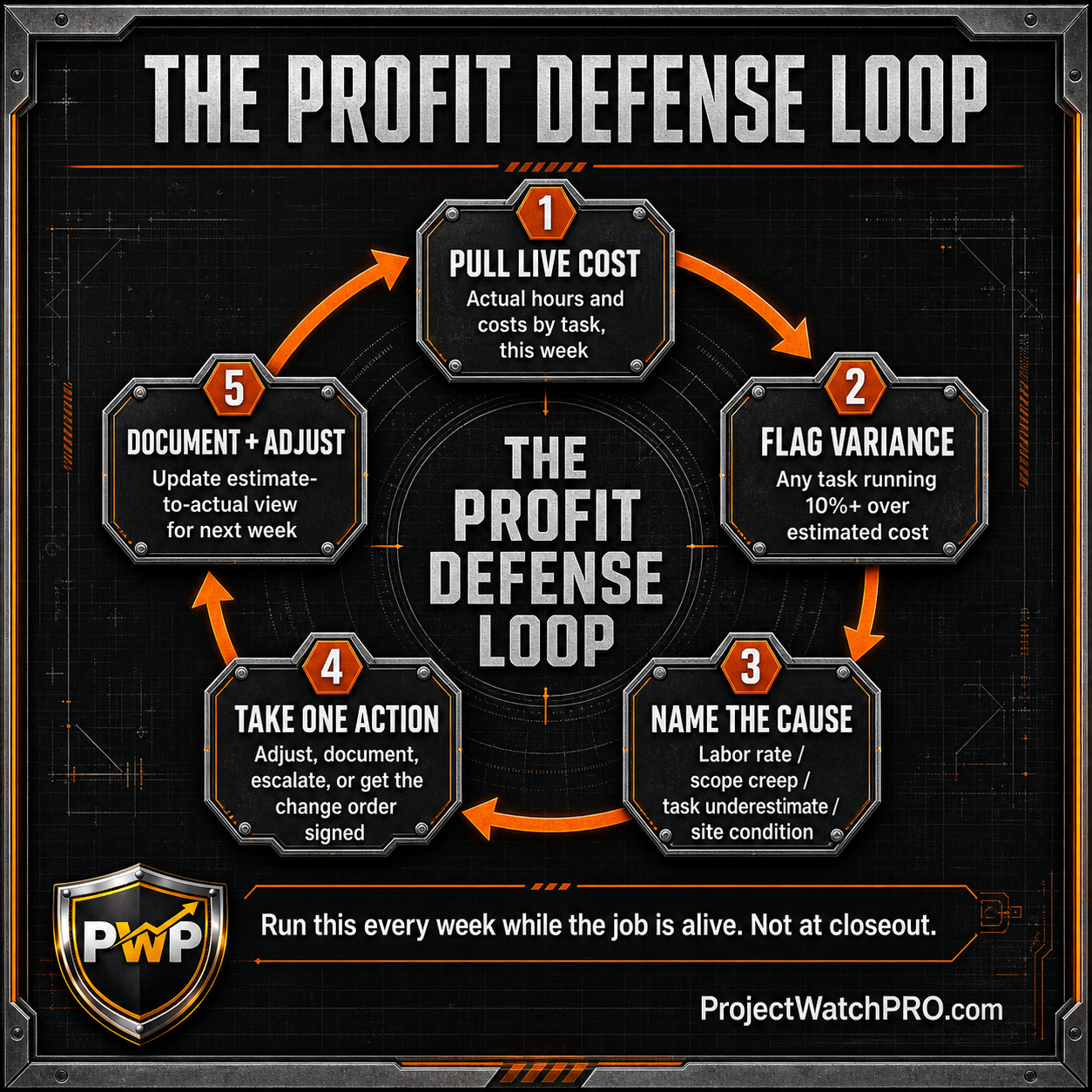
The Profit Defense Loop is the recurring practice that makes the first two steps operational.
Every week, while active jobs are running:
1. Pull live cost — actual hours and costs by task, current week
2. Flag variance — any task running more than 10% over estimated cost
3. Name the root cause — labor rate issue, scope creep, task underestimate, or site condition
4. Take one action — adjust, document, escalate, or get the change order signed
5. Document and adjust — update the estimate-to-actual view for next week
The loop doesn't require a full review of every job every week. It requires a focused look at the jobs that are drifting — while there's still time to do something about it.
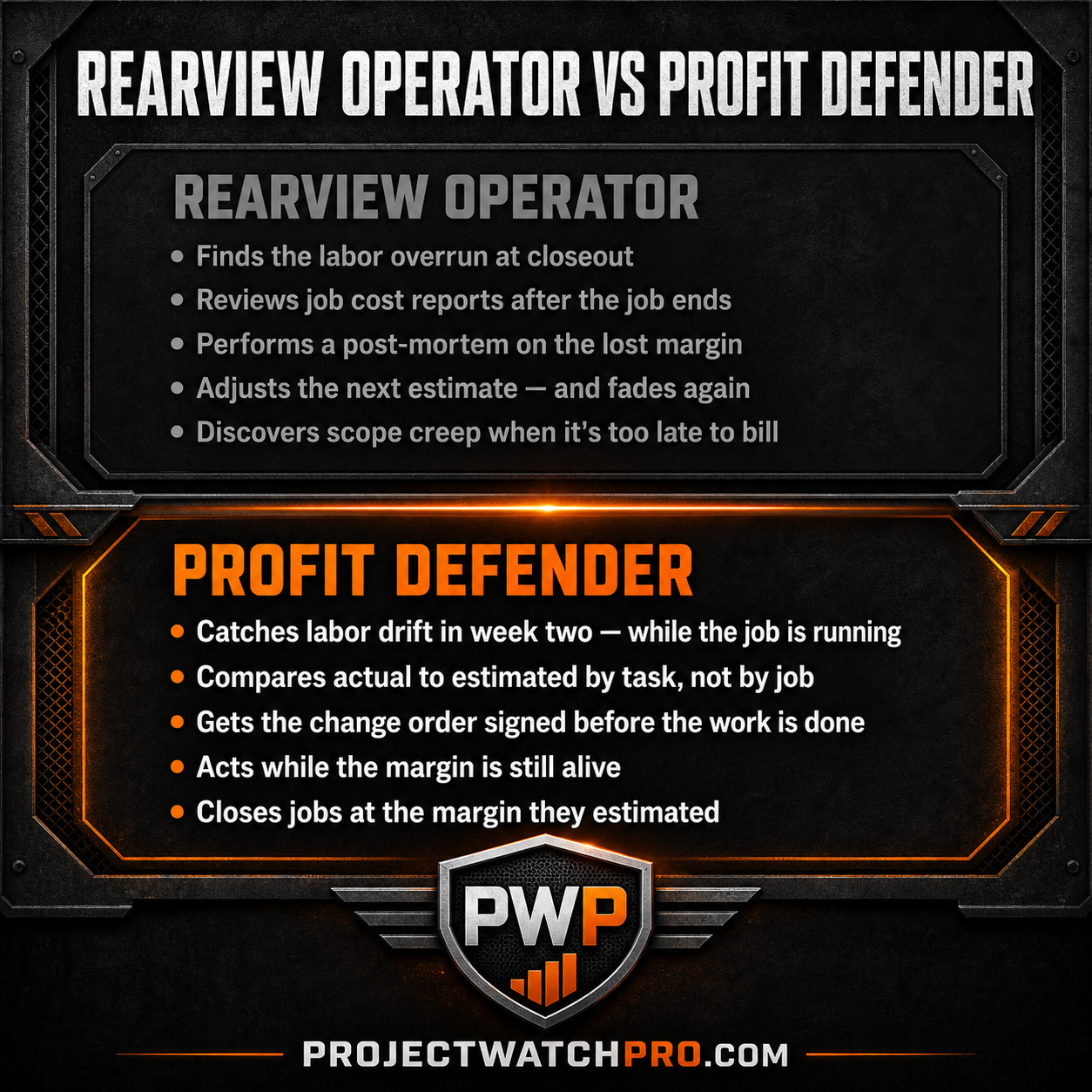
The difference between a Rearview Operator and a Profit Defender isn't discipline or effort. It's when they look.
Rearview Operators review job performance at closeout. They build detailed post-mortems explaining where the margin went. They adjust their next estimate. And the fade happens again — because the problem was never the estimate. It was the gap.
Profit Defenders compare actual to estimated during the job. They catch the drift in week two when $80,000 of a $400,000 labor budget has been spent — and $320,000 is still ahead of them. They have options. They use them.
The contractors moving from 3–5% net margins to 13–16% aren't doing anything different on the job site. They're doing something different with the numbers. They're looking at them while the job is still alive.
Key Takeaways
- Profit fade is a timing problem, not an estimating problem. The margin disappears 30–45 days before you see it in a report. By then, the options are gone.
- The four causes of profit fade — labor undercounting, task-level drift, unsigned change orders, and delayed reporting — are all manageable mid-job and unrecoverable at closeout.
- Most contractors are estimating on base wage, not true cost. A $36/hr base wage can carry a $119/hr true cost when all six layers are included. That gap starts before the job does.
- Month-end reports document profit fade. They don't prevent it. A feedback cadence that compares actual to estimated during the job is the only tool that does.
- Step 7 of the Profit Defense System — Margin Drift Detection — is the operational practice that catches fade mid-job, while corrective action is still possible.
- The Profit Defense Loop (pull cost → flag variance → name cause → take action → document) closes the timing gap that every other solution leaves open.
- Contractors who track in real time achieve 15–25% better relative margins than those who wait until closeout — according to CFMA research. On a $2M job, that's $30,000–$50,000 more profit per job.
Frequently Asked Questions
What is profit fade in construction?
Profit fade in construction is the erosion of a project's estimated gross margin between contract signing and closeout. A job estimated at 18% gross margin might close at 5–6% — not because of a catastrophic failure, but because of accumulated labor overruns, unbilled scope changes, and cost drift that went undetected until it was too late to act.
Why do contractors lose money on jobs they bid correctly?
Most profit fade isn't caused by a bad estimate — it's caused by a timing gap. The costs accumulate during the job while reporting lags 30–45 days behind. By the time the overrun shows up in the numbers, the job is done and the options are gone. The bid was right. The feedback loop was too slow to protect it.
How do you prevent profit fade on construction projects?
Preventing profit fade requires three things: a True Cost Baseline (so the estimate reflects real loaded labor cost, not just wage), task-level variance tracking during the job (not at closeout), and a weekly review cadence — the Profit Defense Loop — that flags drift while corrective action is still possible. Better estimating alone is not enough.
What causes construction profit margins to shrink mid-job?
The four primary causes are: (1) labor estimated on base wage rather than true loaded cost, (2) task-level hours running over estimate without anyone catching it mid-job, (3) scope changes absorbed by the field without signed change orders, and (4) a reporting structure that delivers data 30+ days after the costs occurred. Each one is preventable. None are recoverable at closeout.
How do I know if a job is profitable before it's done?
By comparing actual costs to estimated costs at the task level while the job is running — not at closeout. If your actual labor hours on each task are within 10% of your estimate, the job is tracking. If a task is running 15%+ over, you have a fade signal — and you still have time to act. That comparison requires a cost tracking system that surfaces task-level actuals in near real time, not a monthly job cost report.
What is the difference between gross margin and net margin in construction?
Gross margin is revenue minus direct job costs (labor, materials, subcontractors, equipment). Net margin is what remains after overhead — your office, admin, vehicles, insurance, and other fixed costs — is subtracted. The industry average gross margin for contractors is 15–20%. Average net margin is 3–7%. Overhead runs 25–40% of revenue for most operators. A job with 10% gross margin and 30% overhead allocation produces a net loss. Knowing true loaded cost — including overhead burden — before you bid is the only way to estimate net margin accurately.
If you've been watching your margins shrink job after job without being able to identify exactly where they went — the problem almost certainly isn't your bids.
It's that your cost data is arriving 30–45 days after the damage is done.
The True Labor Cost Calculator at truelaborcost.site takes two minutes. It shows you what one hour of your labor actually costs — every layer, no estimates, no guessing. Most contractors find out their real number is two to three times their wage rate.
Once you know your actual cost baseline, the rest of the Profit Defense System gives you the feedback cadence to track it during the job — while the margin is still yours to defend.


