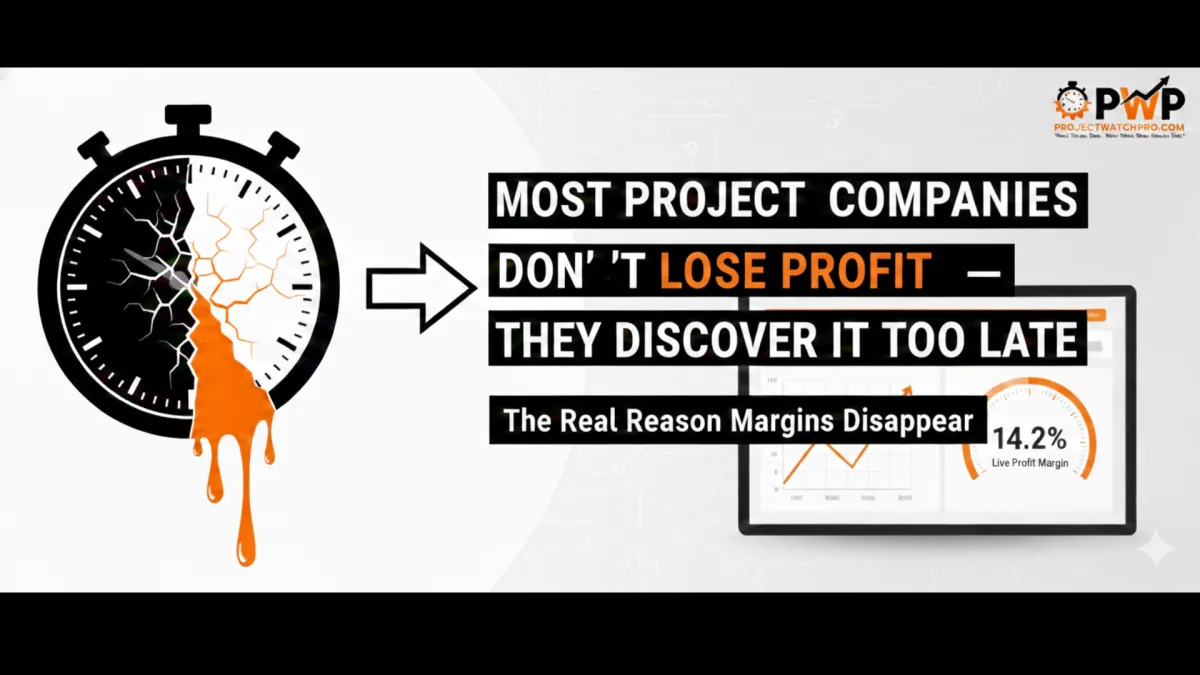
Most Project-Driven Companies Don’t Lose Profit — They Discover It Too Late
Most Project-Driven Companies Don’t Lose Profit — They Discover It Too Late
Project-driven companies — from electrical, plumbing, and HVAC businesses to fabrication shops, construction services, and field crews — often believe they know their numbers. Monthly reports, job costing systems, and accounting tools are supposed to provide that clarity.
But project profit isn’t usually lost in a single moment. It’s discovered after the job is finished, when the opportunity to fix it is already gone.
This article explains why project profit loss is rarely caused by incompetence — and why delay, not mismanagement, is the real reason margins disappear.
Table of Contents
Most Project-Driven Companies Don’t Lose Profit — They Discover It Too Late
Why Most Project-Driven Companies Believe They Know Their Costs
Monthly Reports Feel Like Control
Job Costing Exists — But Arrives Late
When Nothing Feels Broken (Yet)
When Project Profit Loss Only Shows Up at the End
Why Project Profit Is Usually Discovered Too Late
Profit Erosion Is Incremental, Not Dramatic
Why Month-End Reporting Explains Loss — But Can’t Prevent It
Labor Costs Drift While Work Is Happening
Event-Based Tracking Creates Invisible Gaps
Why Timing Matters More Than Accuracy in Profit Protection
What Real-Time Profit Protection Looks Like in Practice
Conclusion — Protecting Profit Before It’s Gone
Why do companies discover profit loss too late?
Isn’t job costing enough to prevent profit loss?
What’s the difference between real-time profit tracking and traditional reporting?
Why Most Project-Driven Companies Believe They Know Their Costs
Project-driven companies don’t operate in chaos. In fact, most feel reasonably confident about their cost visibility.
Jobs are quoted. Time is tracked. Expenses are coded. At the end of the month, reports arrive showing revenue, costs, and margins. That rhythm creates a sense of control.
Monthly Reports Feel Like Control
For many owners and operators, month-end reporting feels authoritative. The numbers are reviewed, variances are discussed, and lessons are noted for the next project.
From the outside, it looks like profit is being managed.
Job Costing Exists — But Arrives Late
Job costing systems do their job: they summarize what already happened. They explain performance after the fact. What they don’t do is protect margin while work is still underway.
When Nothing Feels Broken (Yet)
Projects are moving. Crews are busy. Cash is coming in. And because nothing is obviously on fire, there’s no reason to believe profit is at risk.
That assumption — often unspoken — is the comfort zone:
Knowing the numbers eventually is enough.
It isn’t.
When Project Profit Loss Only Shows Up at the End
The discomfort doesn’t usually arrive mid-project.
It arrives later.
A job wraps up. Final numbers come in. And a project that felt profitable doesn’t look the way it should. Margins are thinner than expected. Sometimes they’re gone entirely.
That’s when the familiar questions appear:
Where did it go?
Was it labor?
Was the estimate wrong?
The instinct is to look backward — through timesheets, cost codes, and reports — searching for a single point of failure.
But in most cases, there isn’t one.
What’s revealed instead is more unsettling:
The profit didn’t disappear at the end of the job.
It was discovered at the end of the job.
By the time the loss became visible, the work was already done. The hours were already spent. The decisions that mattered most had already passed.
Why Project Profit Is Usually Discovered Too Late
This is where most project-driven companies reach the same realization — often after the damage is irreversible.
Profit Erosion Is Incremental, Not Dramatic
Industry research consistently shows that margin erosion rarely comes from a single catastrophic event. It’s the accumulation of small, uncorrected variances:
Slight labor overruns
Minor productivity dips
Short delays that ripple forward
Small amounts of rework
Each issue feels manageable in isolation. Together, they quietly erode margin while work is in motion.
Sources:
https://contractorforeman.com/construction-profit-margins-explained-real-reason-youre-missing-goals/
https://www.clearstory.build/construction-blog/fee-erosion-0
Why Month-End Reporting Explains Loss — But Can’t Prevent It
Month-end reports are valuable. They close the books. They provide clarity. They explain outcomes.
But explanation is not protection.
Month-end reporting is delayed by design. It waits for work to finish, time to be submitted, costs to be coded, and periods to be closed. By the time the numbers are visible, the job is already over — or close enough that intervention no longer matters.
This is why so many post-project reviews end the same way:
“If we’d known sooner, we could have fixed it.”
Source:
Labor Costs Drift While Work Is Happening
Labor is the most volatile cost in project-based work. Productivity shifts throughout the day. Crew composition changes. Tasks take longer than expected.
Labor cost is not static. It moves continuously.
Yet many systems only update profitability when an event occurs:
An employee clocks out
A task is closed
A day ends
Between those events, cost drift continues — unseen.
Sources:
Event-Based Tracking Creates Invisible Gaps
Most job costing systems are event-based, not continuous. They are accurate — but late.
And late information removes leverage.
This is the core issue most companies don’t realize they’re facing:
Profit isn’t being lost because it isn’t tracked.
It’s being lost because it isn’t seen soon enough.
Why Timing Matters More Than Accuracy in Profit Protection
Most project-driven companies already measure costs accurately enough. The problem isn’t precision.
It’s timing.
Accuracy without speed creates hindsight. Speed creates control.
When cost movement is visible while a project is still live, small deviations can be corrected before they harden into permanent loss. Crews can be adjusted. Tasks re-sequenced. Productivity issues addressed early.
This is the difference between:
Managing outcomes, and
Managing momentum
Profit protection doesn’t require perfect data. It requires early data — early enough that decisions still matter.
Source:
What Real-Time Profit Protection Looks Like in Practice
For companies that reach this point, the goal is no longer better reports. It’s continuous awareness.
Real-time profit protection means understanding how labor and costs evolve as work is happening, not after shifts end or reports are finalized.
This is the environment ProjectWatchPRO was built for.
ProjectWatchPRO is a Real-Time Profit Defense System for project-driven companies. It continuously calculates true labor cost and updates project profitability every 60 seconds, instead of waiting for clock-out events or end-of-day summaries.
That cadence changes behavior.
When cost movement is visible in near real time:
Small adjustments replace large corrections
Decisions become proactive, not reactive
Profit becomes something you protect, not explain
That’s the better place.
Conclusion — Protecting Profit Before It’s Gone
Project-driven companies don’t lose profit because they lack experience or discipline. They lose it because delayed visibility removes their ability to act.
When costs are only visible after work is complete, profit becomes a historical fact. When costs are visible as they change, profit becomes something you can defend.
If you believe profit should be protected — not explained after the fact, the next step isn’t a sales pitch.
👉 Connect with us for a guided tour to see how real-time profit protection works on live projects.
FAQ
What is project profit loss?
Project profit loss occurs when the actual cost of delivering a project exceeds what was expected, reducing or eliminating margin. In most project-driven companies, this loss isn’t sudden — it accumulates gradually and is often only discovered after the work is complete.
Why do companies discover profit loss too late?
Because most systems report costs after work is finished. Monthly reporting, end-of-shift summaries, and clock-out-based job costing explain what happened, but they don’t provide visibility early enough to intervene while profit can still be protected.
Isn’t job costing enough to prevent profit loss?
Job costing is essential, but on its own it is retrospective. Without real-time visibility into how costs are changing during active work, job costing identifies losses after decisions are no longer reversible.
What’s the difference between real-time profit tracking and traditional reporting?
Traditional reporting updates profitability after tasks, shifts, or periods close. Real-time profit tracking continuously reflects cost movement while work is in progress, allowing teams to correct issues before margin erosion becomes permanent.


