
Real-Time Project Profitability: What Contractors Are Missing
Your Company Shouldn't Have to Run Projects Without Knowing If They're Making Money
You finished the job. The crew moved out. The invoice went out.
Then — 45 days later — the numbers came in.
And the job you thought made 14% made 3.1%.
You're not alone. According to CFMA's Financial Benchmarker, the average net margin for specialty contractors runs between 2.2% and 3.5% — a margin so thin that one unexpected cost variance can erase an entire month of work. Most contractors don't find out about that variance until the project is fully closed and the accounting team has finished reconciling.
That's not a math problem. That's a timing problem.
And here's what nobody in this industry says out loud: your company shouldn't have to run projects without knowing if they're profitable — in real time, while the work is still happening.
You're not the problem. The operating model is.
Most construction businesses were built on a close-then-look system — finish the job, run the report, discover the result. That model made sense when data moved slowly. It doesn't make sense now. And it's costing you between $10,000 and $50,000 per year in margin you could have defended — if you'd known about it while you still had time to act.
Here's what's actually happening — and what to do about it.
The 45-Day Blind Spot: The window of time between when a cost problem starts on a live job and when a contractor discovers it through standard month-end or closeout reporting. During this window, every decision that could have saved the margin — adjusting crew allocation, submitting a change order, catching a task running over — is unavailable because the data hasn't surfaced yet.

Real-Time Project Profitability: What Contractors Are Missing
Your Company Shouldn't Have to Run Projects Without Knowing If They're Making Money
Why Most Contractors Don't Know If a Job Is Profitable Until It's Too Late
Why You Find Out 45 Days After You Can Do Anything About It
This Isn't a You Problem — The Operating Model Was Built to Keep You Blind
The Three Points Where Profit Disappears Before You Can See It
What Real-Time Construction Project Profitability Actually Means in Practice
The Before and After — What Changes When You Can See It in Real Time
What to Do Right Now — Three Steps Before the Next Job Starts
Step 1 — Find Out What Your Labor Actually Costs
Step 2 — Set Up a Weekly Task Cost Comparison
Step 3 — Change the Question You Ask at Weekly Check-Ins
How do contractors track project profitability in real time?
Why do construction projects lose money even when they're billed correctly?
What is the 45-Day Blind Spot in construction?
What causes profit fade in construction?
What is real-time job costing for contractors?
How much can real-time project tracking improve contractor profit margins?
Why Most Contractors Don't Know If a Job Is Profitable Until It's Too Late
You finished a job last quarter. Do you know, right now, exactly which task cost you the most margin? Not the total — the task. The specific phase where the labor ran over. The week it started slipping.
Most contractors can't answer that question — not because they don't care, but because the system they're running wasn't built to surface it.
The default construction operating model works like this: costs accumulate in the field, get logged to payroll and accounts payable, flow into accounting, get reconciled at month-end, and appear in a job cost report somewhere between 30 and 60 days after the work happened.
By then, the crew has moved on. The GC's project is in closeout. Any change order that could have been submitted — with documentation, while the work was still ongoing — is now a memory exercise.
Real-time construction project profitability means seeing your actual job margin — by task, using your true loaded labor cost, against your estimate — while the job is still running. Not at closeout. Not at month-end. While the work is happening.
This is not a software problem. Every major construction PM platform generates job cost data. The gap isn't data collection. The gap is how fast that data surfaces, what rate it's calculated at, and whether anyone is comparing it to the estimate before the damage is permanent.
Why You Find Out 45 Days After You Can Do Anything About It
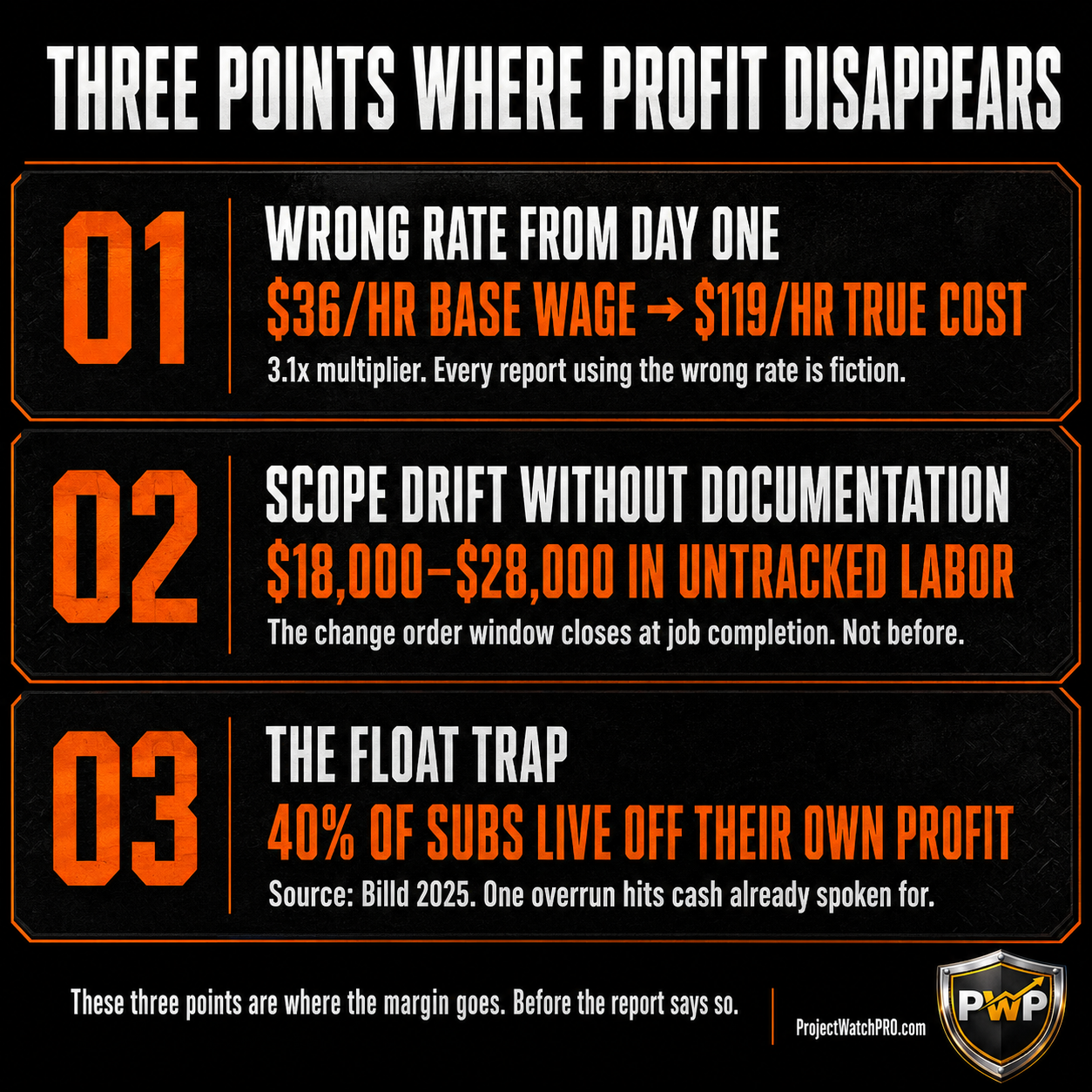
The problem compounds at three points:
Point 1 — The rate is wrong from day one. Most job cost reports calculate labor at base wage or charge-out rate. The true loaded rate — which includes labor burden, overhead allocation, task consumables, shift differential, and overtime exposure — is typically 2.7 to 3.1 times base wage. A contractor running $36/hr base wage has a true loaded cost closer to $119/hr. Every report using the wrong rate is producing fiction with real-looking numbers.
Point 2 — The data arrives too late. Even when the rate is right, month-end reporting means the comparison between actual and estimated cost happens after 30+ days of cost accumulation. A task that started running over in week two shows up in a report in week seven — by which time it has compounded across six more weeks of work.
Point 3 — The comparison never happens at the task level. Most job cost reviews look at the job total. The job total can look fine while one task is bleeding. Margin doesn't leak at the job level — it leaks inside tasks. If you're not comparing actual versus estimated at the task level, you're not seeing the leak. You're seeing the summary of the damage after it's done.
This Isn't a You Problem — The Operating Model Was Built to Keep You Blind
Here's the Kern Rule, and it applies here: you are not the problem.
Every contractor running the close-then-look model is running the industry default. Month-end reporting, closeout reconciliation, and job cost summaries at the total level — these aren't personal failures. They're the standard architecture of how construction businesses have been operated for forty years.
The architecture is wrong for the current environment.
When net margins run between 2% and 4%, a 1% variance on a $500,000 job is $5,000 — gone before you knew it was slipping. When labor costs are moving 9–11% per year in specialized trades, the rate you bid from last January may already be materially wrong. When 63% of contractors had jobs disrupted in the last six months (AGC 2026 Business Outlook), the operating model that assumes no surprises is the one getting crushed.
The question isn't whether you're paying attention. It's whether your system is built to surface the truth fast enough to act on it.
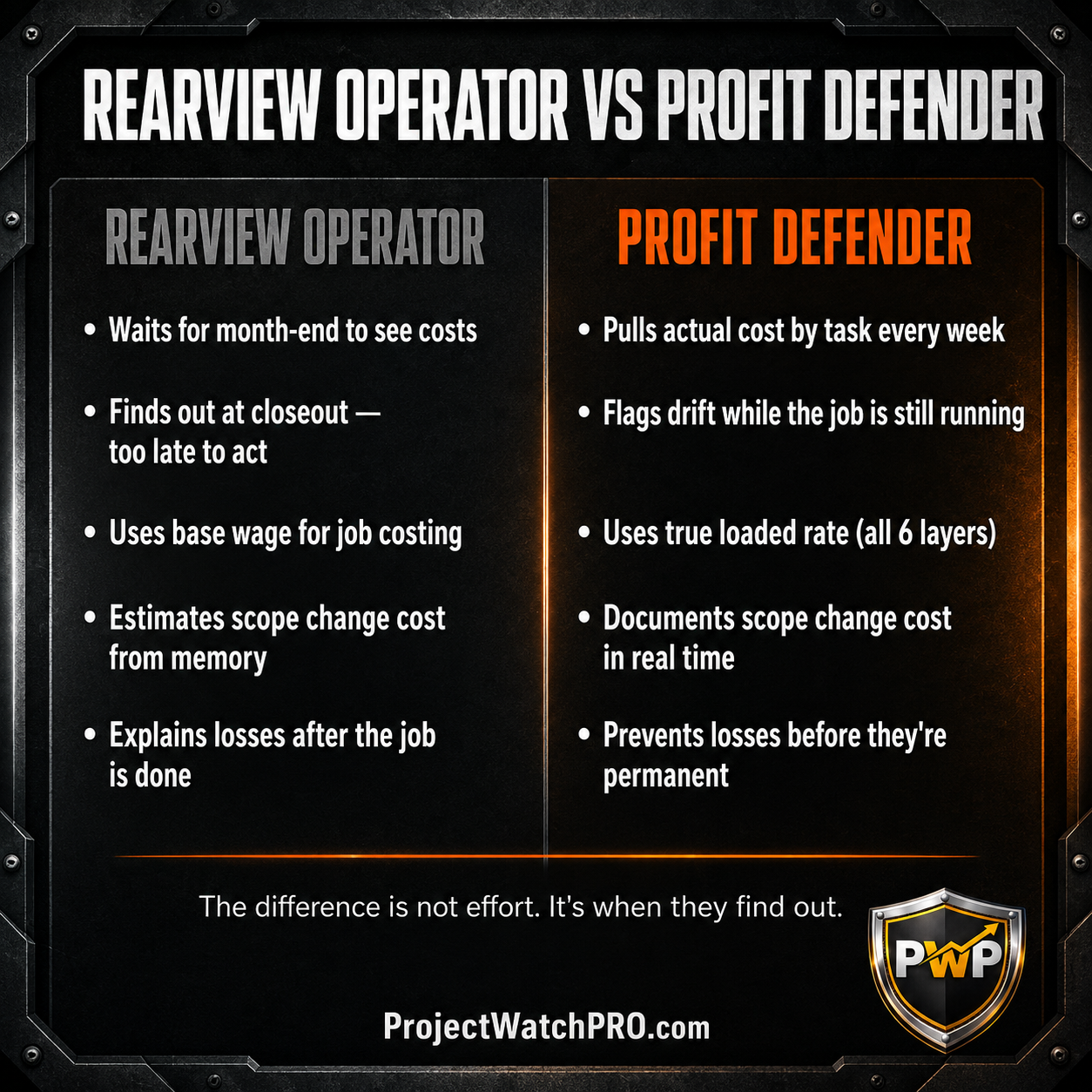
A Rearview Operator explains losses. A Profit Defender prevents them.
The difference isn't intelligence, effort, or experience. It's the operating model — and specifically, how quickly real-time project profitability data moves from the field to a decision-maker who can do something about it.
The Three Points Where Profit Disappears Before You Can See It
Labor cost miscalculation is the foundational layer. If the loaded rate used in your job cost system doesn't include all six cost layers — base wage, labor burden, overhead burden, task consumables, shift differential, and overtime premium — every estimate and every report is starting from a number that doesn't exist. Contractors using charge-out rate for job costing are systematically undervaluing their labor cost. The job looks profitable until it isn't.
Scope drift without documentation is the operational layer. A scope change happens in week four. The crew adapts. Nobody submits a change order immediately because the labor cost of the change hasn't been quantified. By week ten, the scope change has added $18,000 to $28,000 in untracked labor. It shows up at closeout. The change order window is closed.
The float trap is the structural layer. 40% of subcontractors retain half to all of their profits inside the business as working capital — not to invest, but to survive the payment timing gap (Billd 2025 National Subcontractor Market Report). When a job runs over, the overrun doesn't come from a reserve. It comes directly from the float being used to make payroll. A 6% cost overrun on a $600,000 job is $36,000 — and it hits cash that was already spoken for.
What Real-Time Construction Project Profitability Actually Means in Practice
Real-time project profitability is not a dashboard feature. It's an operating discipline.
Here's what it looks like when it's working:
Step 1 — True Cost Baseline. Before any job starts, the loaded labor rate is calculated using all six cost layers — not wage alone. This rate is rebuilt every 90 days, or whenever a major input changes (insurance renewal, wage increase, fuel escalation). Every estimate runs from the real number.
Step 2 — Task-Level Cost Visibility. During the job, actual costs are tracked at the task level — not the job total. Each task has an estimated cost and an actual cost, updated as labor hours flow in and materials are consumed. The rate applied is the true loaded rate, not the charge-out rate.
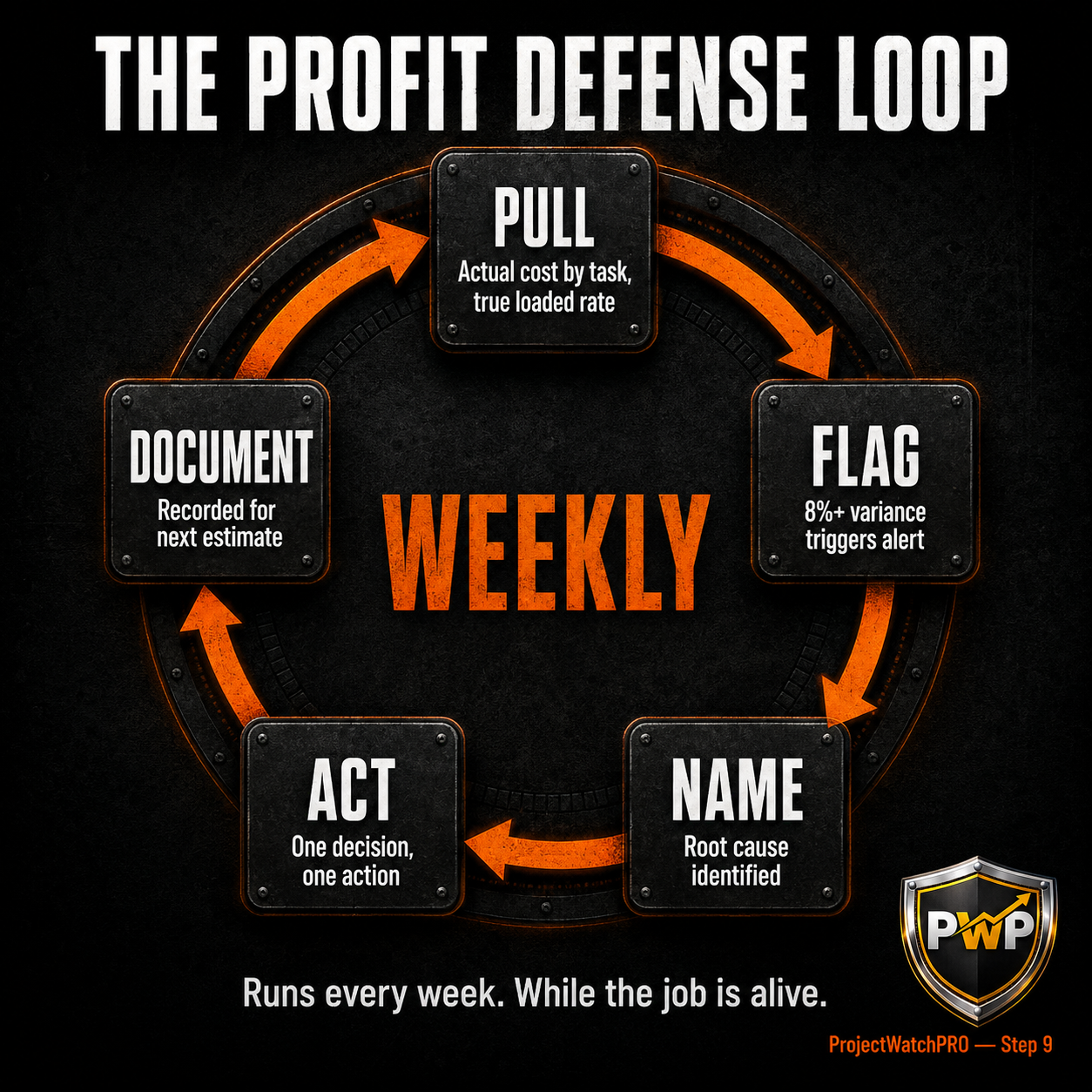
Step 3 — Weekly Comparison Cadence. Every week, actual cost by task is compared to estimated cost. Tasks running more than 8% over trigger a flag — not at closeout, not at month-end. That week.
Step 4 — Drift Detection and Action. When a task drifts, the root cause is named: scope change, crew efficiency, material variance, rework. The root cause determines the action — change order, resequencing, reassignment. The action is taken while the job is still running.
Step 5 — The Profit Defense Loop. Pull actual cost. Flag variance. Name cause. Take one action. Document. This loop runs every week. It turns visibility into control — and control into margin.
This is the operating model of a Profit Defender. Not because it requires more work — because it replaces a 45-day delay with a 7-day cadence.
The Before and After — What Changes When You Can See It in Real Time
Before — The Rearview Operator model:
A $420,000 HVAC retrofit. 12 weeks. Bid at 15% gross margin. Week six: a specification change requires a different equipment mounting method. The crew absorbs it. The PM estimates it's "probably $6,000 in extra labor." No change order is submitted while the work continues. At closeout: the actual extra labor was $22,400. The change order conversation with the GC, now 10 weeks after the work, goes nowhere. Final margin: 2.8%.
After — The Profit Defender model:
Same job. Same specification change in week six. The weekly task cost comparison fires a flag in week seven: equipment installation labor is running 31% over estimated cost, with the root cause identified as scope modification. A change order is quantified from actual data — $21,800 in additional labor hours at true loaded rate. Submitted week seven with documentation. Negotiated. Collected in full. Final margin: 13.4%.
Same disruption. Same crew. Same market. Different operating model.
Contractors who track real-time project profitability at the task level don't avoid disruption — they catch it while they can still do something about it. CFMA research shows contractors tracking in real time achieve 15–25% better margin outcomes relative to their own estimates, compared to contractors relying on closeout reporting.
What to Do Right Now — Three Steps Before the Next Job Starts
Step 1 — Find Out What Your Labor Actually Costs
Before anything else, you need the right number. Not base wage. Not charge-out rate. Your true loaded labor cost per hour, by trade category, including all six cost layers.
If that number hasn't been recalculated in the last 90 days — or if you've never calculated it — every job cost report you've looked at has been built on a fiction. The True Labor Cost Calculator at truelaborcost.site runs the full six-layer calculation in about two minutes. Start there.
Step 2 — Set Up a Weekly Task Cost Comparison
On the next job you start: identify the five highest-labor tasks in the estimate. Each week, pull actual labor cost for those tasks (using your true loaded rate) against the estimated cost. Don't wait for month-end. Don't wait for the PM's gut check. Run the actual number.
When a task hits 8% over estimate — flag it. Name the cause. Decide on one action.
Step 3 — Change the Question You Ask at Weekly Check-Ins
Most contractors ask their PM: "How is the job going?"
A Profit Defender asks: "Which tasks are running over — and by how much?"
The first question gets you a feeling. The second gets you a number. Numbers are actionable. Feelings are not.
This one question, asked every week, is the behavioral change that turns a Rearview Operator into a Profit Defender.
Key Takeaways
- Real-time construction project profitability means tracking actual job margin by task — using your true loaded labor rate — against your estimate, every week while the job is running.
- The 45-Day Blind Spot is not a personal failure. It's the industry default operating model — and it systematically prevents contractors from acting on cost problems before they become permanent losses.
- Your true loaded labor cost is typically 2.7 to 3.1 times your base wage. Every job cost system using base wage or charge-out rate is producing inaccurate results.
- Margin doesn't leak at the job level. It leaks inside tasks. Task-level visibility is the only way to catch it in time.
- A weekly task cost comparison — pulling actual versus estimated cost by task using true loaded rate — is the single operational change that closes the 45-day window.
- Contractors who run the Profit Defense Loop (Pull → Flag → Name → Act → Document) every week achieve 15–25% better margin outcomes than those relying on closeout reporting.
- The difference between a Rearview Operator and a Profit Defender is not intelligence or effort — it's whether the operating model surfaces the truth fast enough to act on it.
Frequently Asked Questions
How do contractors track project profitability in real time?
Real-time project profitability tracking requires three things: a true loaded labor rate (not base wage or charge-out rate), task-level cost tracking updated as labor hours and materials are consumed, and a weekly comparison of actual versus estimated cost by task. When actual cost exceeds estimated cost by more than 8% on any task, that flags a variance requiring a decision — while the job is still running.
Why do construction projects lose money even when they're billed correctly?
Construction projects lose margin even with correct billing because the cost problem happens before invoicing — during the job, at the task level, in the gap between what the estimate assumed and what the work actually cost. Scope changes absorb unsubmitted labor, crew efficiency variances compound over weeks, and burden rates applied to the wrong base rate systematically understate true cost. By the time billing is complete, the damage is already locked in.
What is the 45-Day Blind Spot in construction?
The 45-Day Blind Spot is the window between when a cost problem starts on a live construction job and when it surfaces in a standard month-end or closeout report — typically 30 to 60 days later. During this window, the margin is already eroding, but no decision-maker has the data to act. Every day of delay narrows the list of recoverable options. By the time the report arrives, the loss is confirmed — not preventable.
What causes profit fade in construction?
Profit fade in construction has three primary causes: labor cost miscalculation (using base wage instead of true loaded rate), scope drift without real-time change order documentation, and the absence of weekly task-level cost comparisons during the job. The result is a job that looked fine mid-project and arrived at closeout 5 to 12 margin points below estimate. Profit fade is not random — it's a predictable outcome of a delayed-data operating model.
What is real-time job costing for contractors?
Real-time job costing for contractors means tracking actual labor cost at the task level — using true loaded rates — against estimated cost, with the comparison running weekly during the job rather than at month-end or closeout. It requires a true cost baseline (all six labor cost layers), task-level time and material tracking, and a weekly review cadence that flags variances before they compound into permanent losses.
How much can real-time project tracking improve contractor profit margins?
CFMA research shows contractors tracking project costs in real time achieve 15 to 25% better margin outcomes relative to their own estimates compared to contractors relying on closeout reporting. On a $2M job portfolio at an average 5% estimated margin, that's a difference of $15,000 to $25,000 in actual profit — from the same jobs, the same crew, and the same volume.
Your company has been doing the hard part — winning jobs, keeping crews moving, delivering work that holds up.
The part that's been broken is when you find out whether it made money.
If you want to know what your labor is actually costing you — not the base rate, but the real number including burden, overtime risk, and true loaded cost across all six layers — the True Labor Cost Calculator does it in about two minutes.
No signup. No pitch. Just the number you need to stop underestimating.
That's the starting point. The rest of the Profit Defense System builds from there.