
The 60-Second Job Cost Test: Can You See Project Cost Right Now?
The 60-Second Job Cost Test
If Your Boss Calls at 9:30 AM on Day 3… Can You Answer?
Introduction
There’s a moment that happens in almost every project-based company.
The phone rings.
It’s the boss.
And he asks a question that sounds simple but exposes a massive operational blind spot.
“What’s the total cost of that job so far?”
Not the estimate.
Not the hours.
Not the spreadsheet you ran yesterday.
The actual cost right now.
And not just base wages.
He wants the real number:
• fully burdened labor
• payroll taxes and benefits
• overhead allocation
• shift differentials
• overtime premiums
• consumables used
• materials installed
• expenses
• third-party costs
The fully loaded cost of the job to this minute.
So the real question becomes:
Can you answer immediately?
Or would you need to wait until accounting runs the reports?

The 60-Second Job Cost Test: Can You See Project Cost Right Now?
If Your Boss Calls at 9:30 AM on Day 3… Can You Answer?
Quick Answer: Why Most Contractors Can’t See Job Cost in Real Time
The Reality Inside Most Project Businesses
Why Delayed Cost Visibility Destroys Profit
What Real-Time Job Costing Actually Means
What “True Job Cost” Actually Includes
The Difference Between Data and Insight
Common Mistakes That Hide Job Cost
Tracking Labor Hours but Not True Labor Cost
Waiting for Accounting Reports
Treating Consumables as Overhead
Disconnect Between Field and Accounting
How Contractors Fix This Problem
A Simple Test for Your Business
Why can’t most contractors see job cost in real time?
What is real-time job costing?
Quick Answer: Why Most Contractors Can’t See Job Cost in Real Time
Most construction and project-based businesses cannot provide real-time job costs because the financial data needed to calculate it lives in different systems.
Typical delays happen because:
time tracking updates daily or weekly
payroll calculates labor burden later
material usage is entered after the job
vendor invoices arrive weeks later
accounting reconciles costs at month end
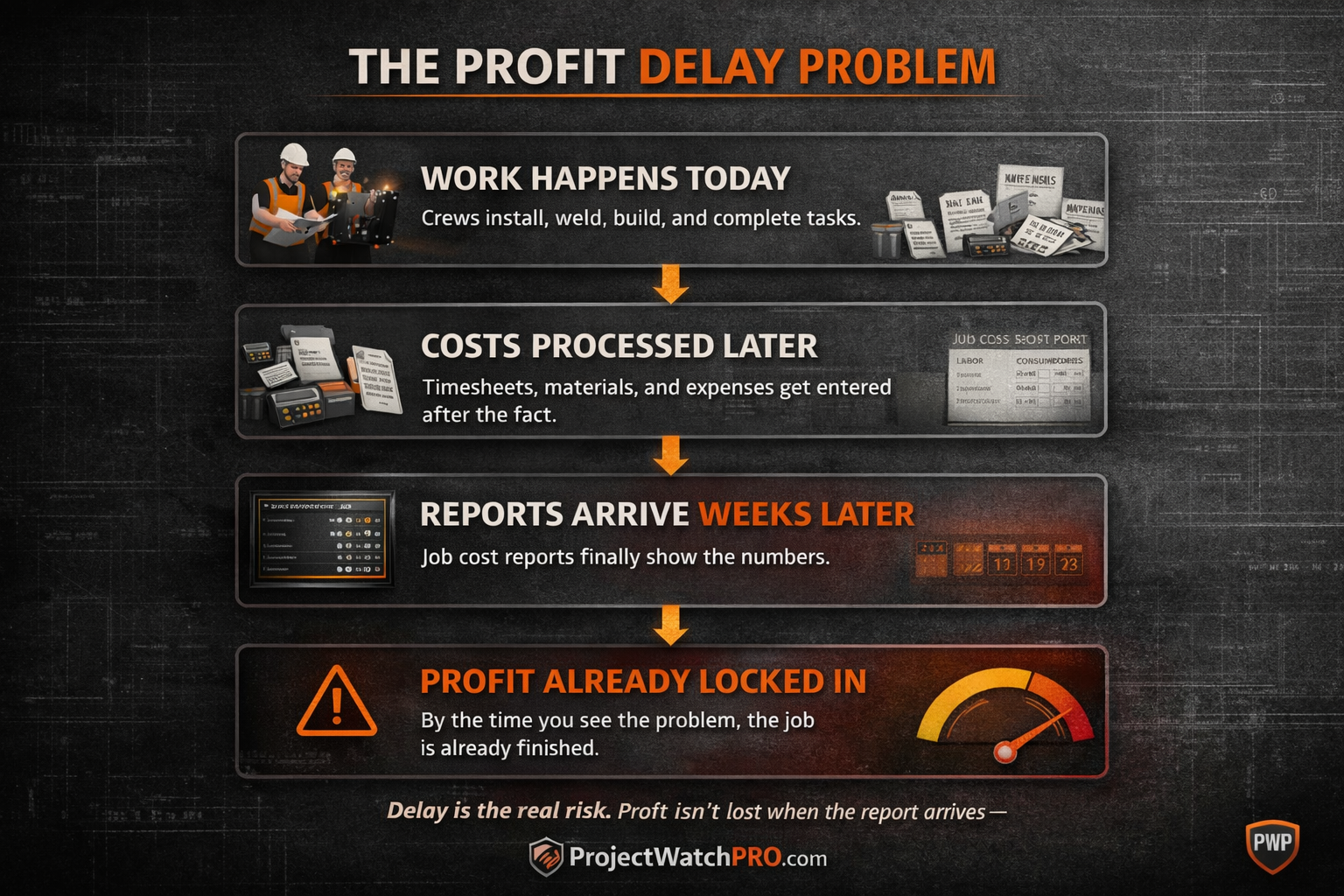
Because of these delays, job cost reports often reflect financial reality that is 30–45 days behind the job itself.
By the time management sees the real cost of the project, the work is already finished.
The Reality Inside Most Project Businesses
In most companies, the honest answer to the boss’s question is:
“I can’t tell you right now.”
You might know:
• hours worked
• rough labor cost
• some materials used
But the true cost of the job usually isn’t visible until:
• timesheets are processed
• payroll calculates burden rates
• expenses are entered
• vendor invoices arrive
• accounting closes the books
That means the real job cost is often weeks behind reality.
By the time the report shows the truth…
the project is already finished.
Why Delayed Cost Visibility Destroys Profit
Cost overruns rarely appear suddenly at the end of a project.
They accumulate quietly during the job.
A little extra labor here.
Unexpected consumables there.
Overtime creeping in slowly.
Small issues compound hour by hour until the margin disappears.
Without real-time visibility, companies are essentially flying blind while the job is happening.
When the report finally arrives, the job is over.
Which means the only thing left is explanation.
Not correction.
What Real-Time Job Costing Actually Means
Real-time job costing means you can answer the boss’s question immediately.
At 9:30 AM on day three, you can see:
• labor hours worked
• fully burdened labor cost
• materials installed
• consumables used
• subcontractor costs
• expenses recorded
• total cost to date
• remaining budget
• projected final margin
And those numbers reflect what has happened up to the last minute.
Not yesterday.
Not last week.
Right now.
What “True Job Cost” Actually Includes
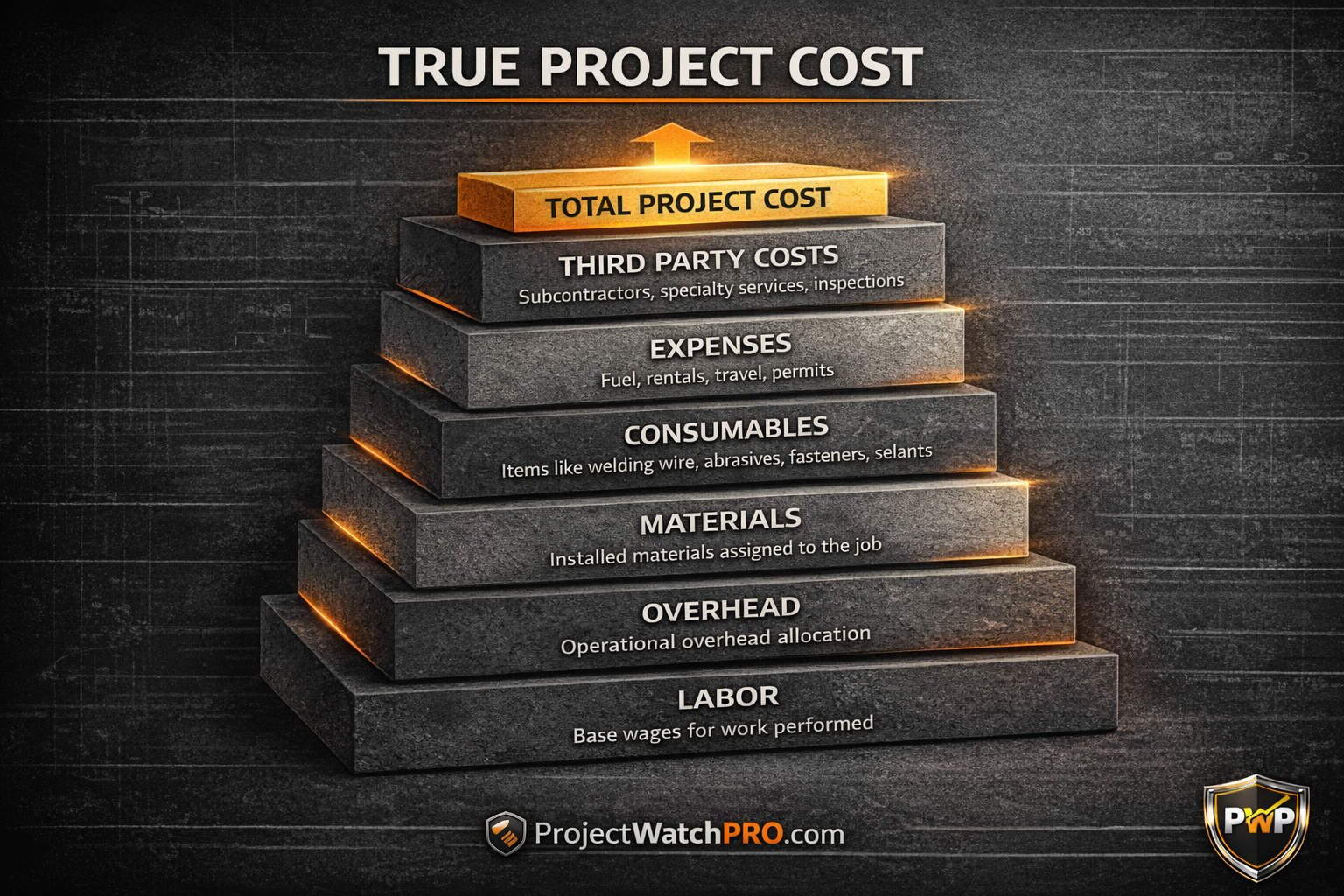
True job cost goes far beyond wages.
Labor Cost
• base wage
• labor burden rate
• overhead burden allocation
• shift differentials
• overtime premiums
Consumables
• abrasives
• welding wire
• fasteners
• sealants
• cutting discs
Materials
• installed materials tied to the job
Expenses
• fuel
• travel
• rentals
• permits
Third-Party Costs
• subcontractors
• inspections
• specialty services
Only when these components update continuously can you see the real cost of the job.
The Difference Between Data and Insight
Many systems capture data.
But capturing hours worked is not the same as knowing job cost.
True job cost requires automatically calculating:
• labor burden
• payroll taxes
• benefits
• overhead allocation
• overtime premiums
• shift differentials
• task-specific burdens
Only when those calculations happen automatically can managers see the financial reality of the project.
Common Mistakes That Hide Job Cost
Most companies struggle with cost visibility because of a few common operational habits.
Tracking Labor Hours but Not True Labor Cost
Base wages rarely reflect the real cost of labor.
Waiting for Accounting Reports
By the time accounting reports appear, the job is already finished.
Treating Consumables as Overhead
Consumables often represent a large hidden cost.
Disconnect Between Field and Accounting
Field activity and financial reporting rarely update at the same speed.
How Contractors Fix This Problem
Companies that solve this problem focus on visibility and decision speed.
The process usually includes:
Step 1
Calculate true labor cost, including burden and overhead.
Step 2
Track labor and task progress daily.
Step 3
Connect materials and consumables to the job.
Step 4
Update job cost continuously instead of waiting for accounting.
Step 5
Monitor margin while the job is still in progress.
When managers can see cost drift early, they can correct problems before margins collapse.
External Reference
Research from the Lean Construction Institute shows that construction crews may spend 40–60% of time waiting or reworking tasks due to coordination issues.
Source
https://www.leanconstruction.org
A Simple Test for Your Business
Ask yourself one question.
If the boss calls at 9:30 AM on day three of a five-day job, can you immediately provide the fully loaded cost of the project to that minute?
Including:
• burdens
• overhead
• shift differentials
• overtime
• consumables
• task-specific costs
If the answer is no, you’re not alone.
But it also means your company is operating with delayed financial visibility.
And delayed visibility almost always leads to eroded margins.
Key Takeaways
• Most companies cannot answer the 60-second job cost question
• Job cost reports often arrive weeks after the work happens
• True job cost includes labor burden, materials, consumables, and expenses
• Real-time visibility allows managers to detect cost problems early
• Faster financial visibility leads to stronger project margins
Final Thought
Let’s go back to the original moment.
It’s 9:30 AM on day three.
The boss calls.
He asks:
“What has this job cost us so far?”
If your company can’t answer that question with numbers accurate to the last 60 seconds, the problem isn’t your crew.
The problem is visibility.
And visibility is what protects profit.
FAQ
Why can’t most contractors see job cost in real time?
Because labor, materials, and expenses are processed in different systems that update at different speeds.
What is real-time job costing?
Real-time job costing continuously updates project cost as labor hours, materials, and operational conditions change.
Why does real-time visibility matter?
Because cost problems can only be corrected while the project is still in progress.
About the Author
John McCabe is the founder of ProjectWatchPRO, a real-time profit defense system used by construction, trades, fabrication, and field service companies to monitor job profitability as work happens.
He is the author of Profit Defended and works with contractors across North America to eliminate the operational blind spots that cause projects to lose money.


