True Labor Cost in Construction: The Wage Cost Trap (And Why Project-Driven Companies Get It Wrong)
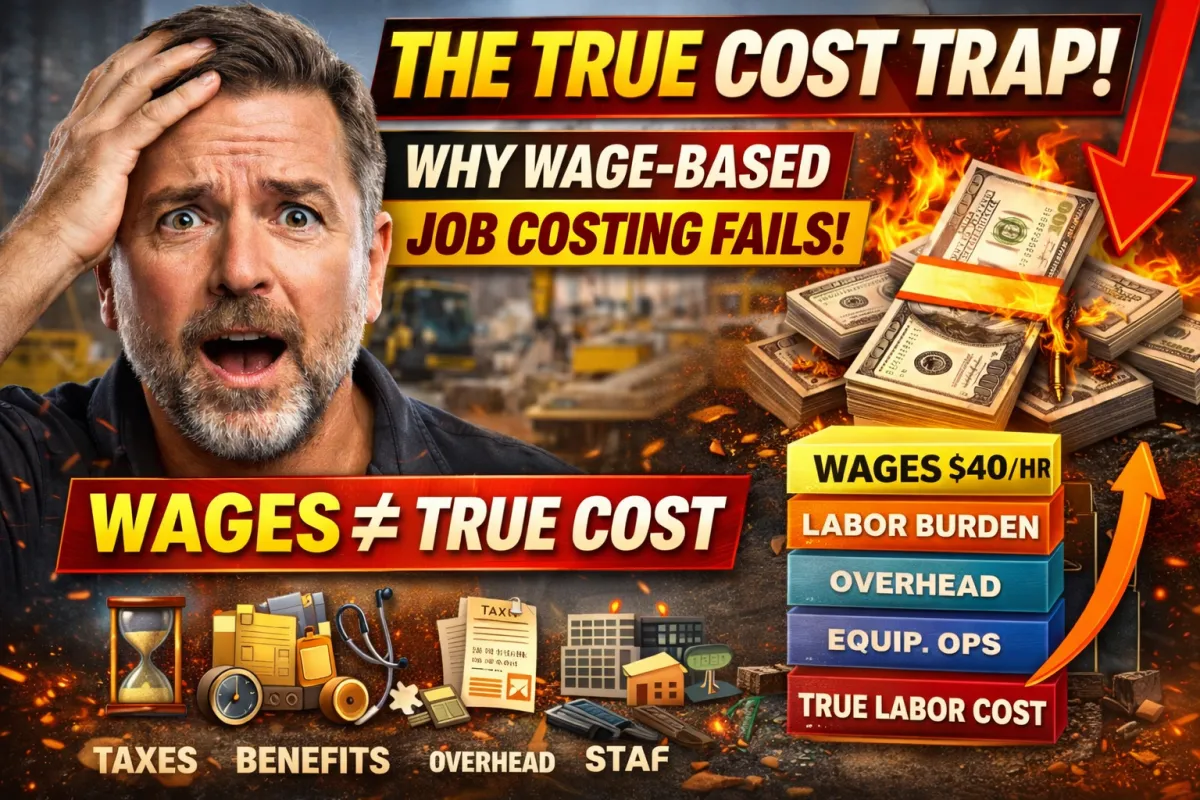
The True Cost Trap: Why Wage-Based Job Costing Makes Contractors and Project-Driven Companies Fly Blind
Most contractors and project-driven companies believe they understand their labor costs.
This includes construction companies, trades, fabrication shops, sandblasting and coating companies, and field service businesses — any operation where labor drives revenue and projects determine profit.
They track hours.
They know what they pay their employees.
They estimate jobs based on those numbers.
But in reality, most companies are making project decisions using less than half of their actual labor cost data..
That’s because wages are only one layer of the real cost structure required to run a construction company.
The rest of the costs — taxes, benefits, overhead, equipment, and operational expenses — are often invisible during the project.
This is what we call The True Cost Trap.
It affects nearly every project-driven business where labor, not materials, is the primary driver of cost and profit.
When companies estimate and track projects using only wage rates, they unknowingly build every estimate on incomplete financial data.
The result?
Jobs that appear profitable on paper slowly drift toward break-even — or loss — before anyone realizes what happened.
True Labor Cost in Construction: The Wage Cost Trap (And Why Project-Driven Companies Get It Wrong)
What Contractors Track vs What They Miss
The 6 Layers of True Labor Cost
Layer 2 — Labor Burden Rate (LBR)
Layer 3 — Overhead Burden Rate (OBR)
The Real Cost of Labor: A Simple Example
How This Impacts Fabrication, Coating, and Field Service Companies
Why Wage-Based Job Costing Fails
Mistake 1 — Confusing Wages with Labor Cost
Mistake 2 — Ignoring Overhead Allocation
Mistake 3 — Waiting for Accounting Reports
Mistake 4 — Estimating with Incomplete Data
From Historical Job Costing to Real-Time Cost Visibility
Why This Matters for Contractors
Free Contractor Cost Intelligence Toolkit
What is labor burden rate in construction?
Why do construction projects lose money?
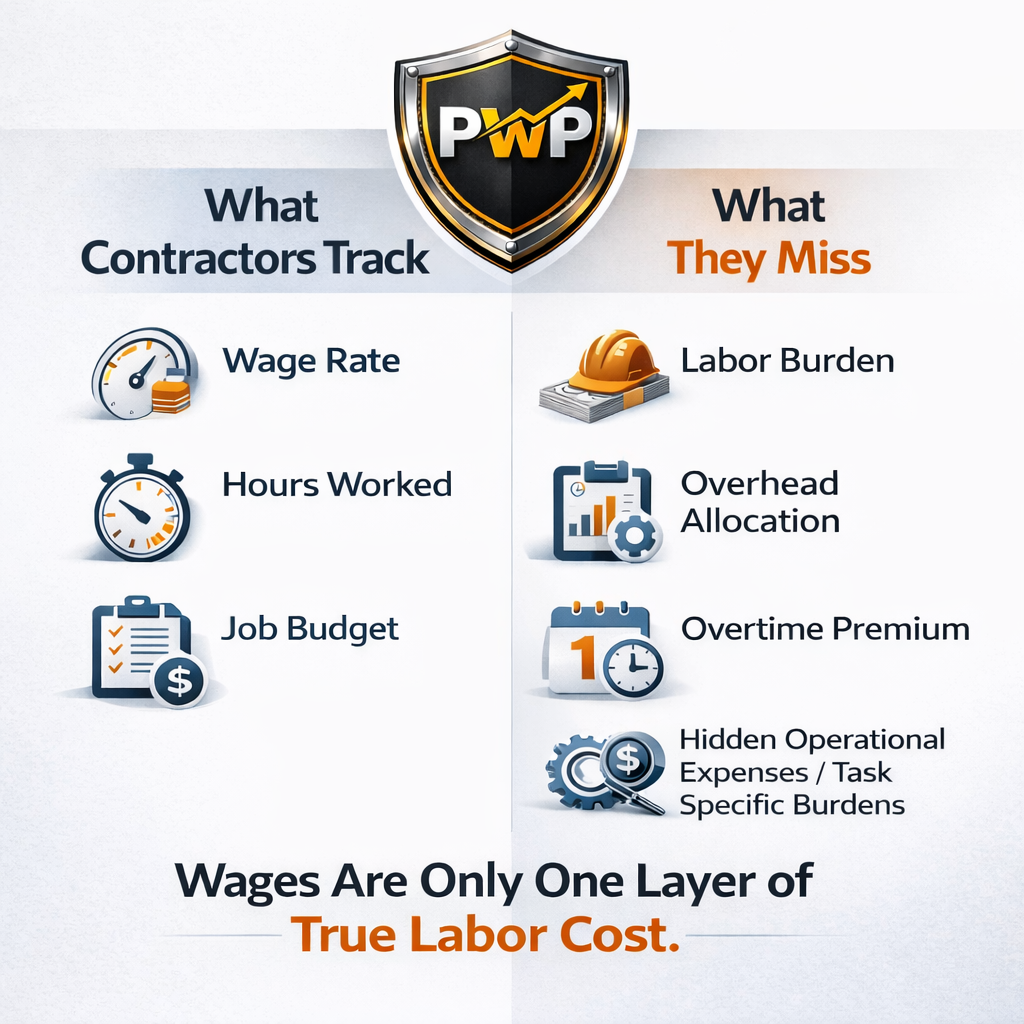
What Contractors Track vs What They Miss
Most job costing systems focus on three numbers:
• wage rate
• hours worked
• job budget
Those numbers are useful — but they only represent a fraction of the real cost of labor.
What many companies fail to include are the additional cost layers required to employ and support field workers:
• payroll taxes
• workers compensation
• benefits
• paid time off
• company overhead
• vehicles and equipment
• operational support staff
• overtime premiums
When these costs are excluded from project calculations, job costing becomes dangerously misleading.
Wage-based costing creates a false sense of profitability.
The True Cost Trap
Definition
The True Cost Trap occurs when companies estimate and track projects using wage rates instead of fully burdened labor costs.
Because wages represent only a portion of real labor cost, every estimate and job cost report built on wages alone contains hidden financial gaps.
Over time those gaps compound across projects.
Margins shrink.
Profit disappears.
And management often doesn't understand why.
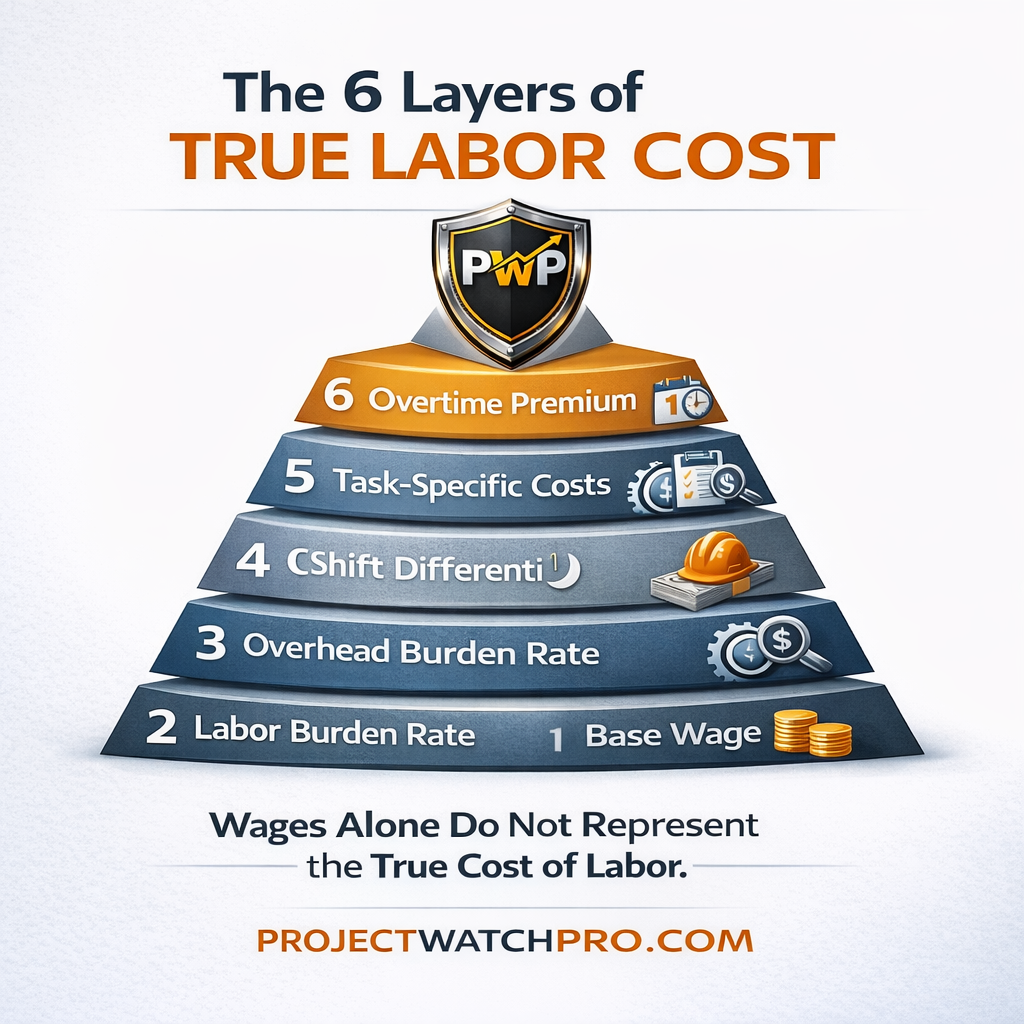
The 6 Layers of True Labor Cost
To understand the True Cost Trap, you need to understand how labor cost actually works.
The real cost of employing someone in construction is not a single number.
It is built from multiple cost layers that accumulate every hour an employee works.
Layer 1 — Base Wage
The base wage is the hourly rate paid directly to the employee.
Example:
$40 per hour.
This is the number most job costing systems use as the labor cost.
But the wage alone represents only the starting point of the cost stack.
Layer 2 — Labor Burden Rate (LBR)
Labor burden represents the additional costs required to employ someone beyond their wage.
These typically include:
• payroll taxes
• workers compensation
• health benefits
• retirement contributions
• paid vacation and sick days
• safety training
• paid breaks
In construction industries, labor burden typically ranges between:
30% – 50% of base wage
Example:
$40 wage
40% labor burden
= $16 additional cost per hour.
Running total:
$56 per hour.
Even at this point, the real cost of labor is still not fully visible.
Layer 3 — Overhead Burden Rate (OBR)
Every field employee relies on company infrastructure to perform their job.
These operational expenses must be allocated across productive labor hours.
Overhead often includes:
• office staff
• project managers
• rent and utilities
• vehicles and fuel
• insurance
• marketing and sales
• accounting and legal services
• software systems
• training and safety programs
When these costs are distributed across productive labor hours, they produce the Overhead Burden Rate.
In many companies, overhead allocation can add $30–$60 per labor hour.
Layer 4 — Shift Differential
Some jobs require premium pay for non-standard schedules.
Examples include:
• night shifts
• weekend work
• remote site premiums
These conditional costs increase the true cost of labor for specific projects.
Layer 5 — Task-Specific Costs
Certain tasks require additional equipment, materials, or consumables.
Examples include:
• specialized tools
• protective equipment
• consumables
• equipment wear and maintenance
These costs should be allocated when the task requires them rather than treated as general overhead.
Layer 6 — Overtime Premium
Overtime is one of the most common ways project margins are eroded.
In most jurisdictions overtime wages are paid at 1.5× the base rate.
This means the overtime premium alone equals 50% of the base wage.
Example:
$40 wage
Overtime premium = $20
Total overtime wage:
$60 per hour before additional burdens.
Once labor burden and overhead are added, overtime hours can cost dramatically more than standard hours.
The Real Cost of Labor: A Simple Example
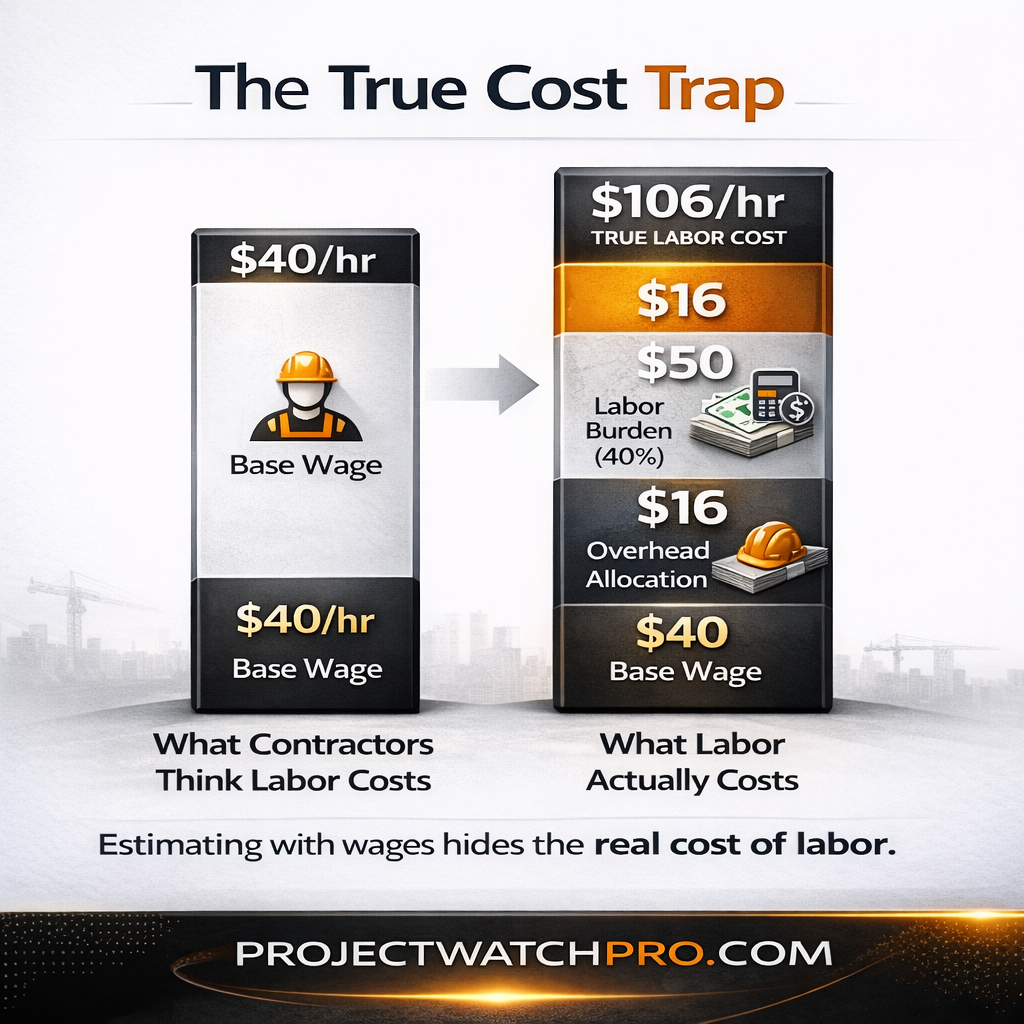
Let’s combine the first three layers — the costs that apply to almost every labor hour.
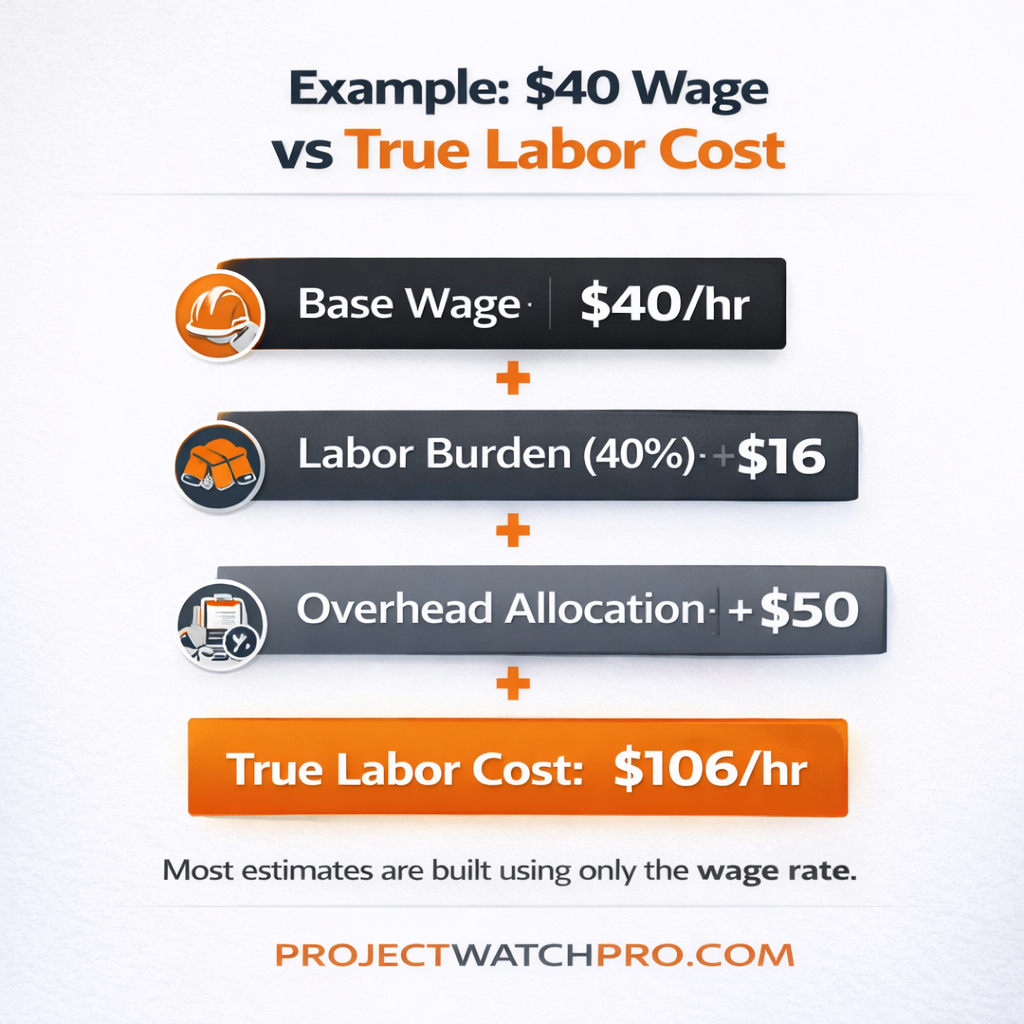
Example worker:
Base wage
$40/hr
Labor burden (40%)
+$16
Overhead allocation
+$50
True labor cost
$106 per hour
Yet many companies estimate and track jobs using only the $40 wage.
That means they are making decisions using less than 40% of the actual cost data.
This is the foundation of the True Cost Trap.
The Cost Visibility Gap
Another major issue in traditional job costing systems is timing.
Many companies assume they are tracking costs in real time.
But in reality, true labor cost often isn't calculated until accounting completes payroll and monthly financial reports.
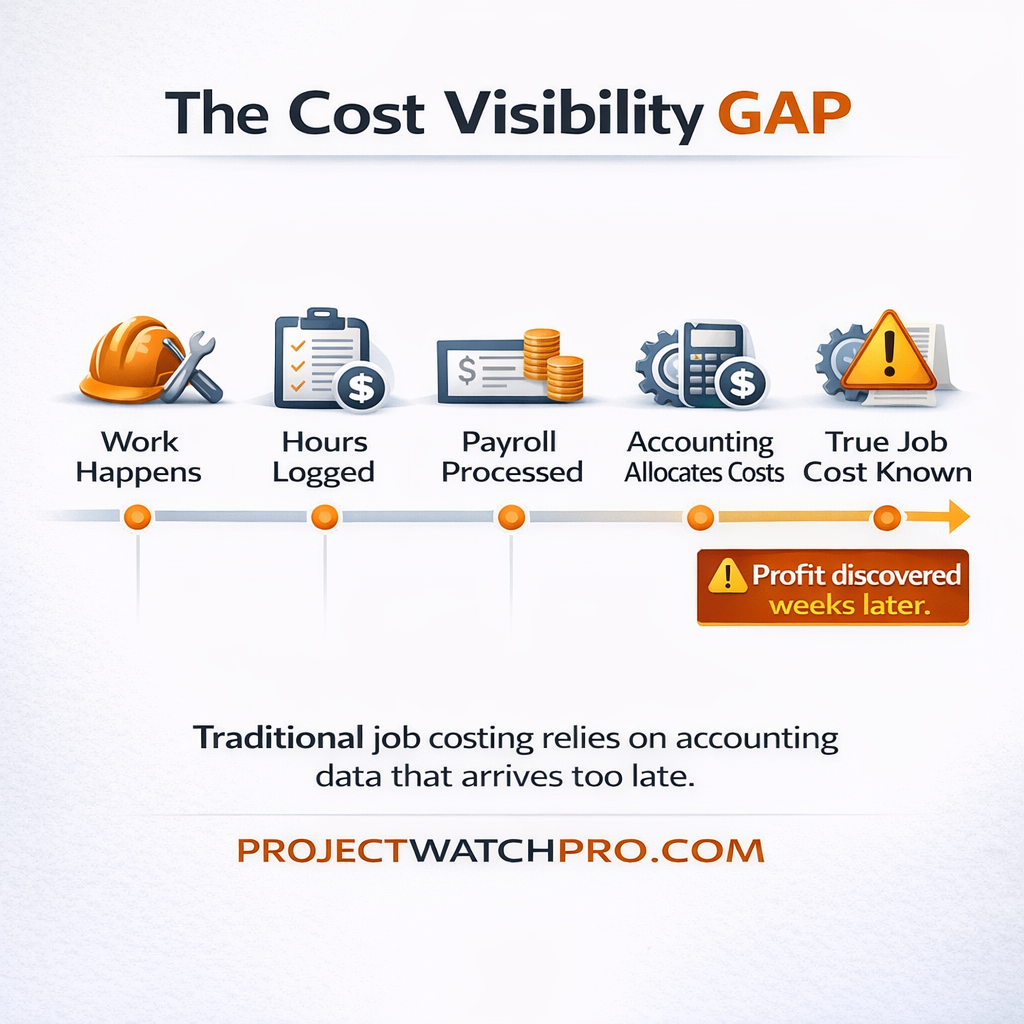
Typical cost timeline:
Work happens in the field.
Employees log their hours.
Payroll processes wages.
Accounting later calculates:
• payroll taxes
• benefits
• workers compensation
• overhead allocations
Only after those steps are completed can the company determine the true cost of labor.
By then the work is already finished.
The margin outcome is already locked in.
This delay creates a visibility gap between operations and accounting.
Project managers make decisions based on incomplete cost data.
How This Impacts Fabrication, Coating, and Field Service Companies
The True Cost Trap is not limited to construction contractors.
It affects any project-driven business where labor is the primary driver of cost and profit.
This includes:
• fabrication and welding shops
• sandblasting and coating companies
• mechanical and industrial service providers
• field service and repair businesses
Across these industries, the same pattern appears:
• labor burden is underestimated or excluded
• overhead is not properly allocated to jobs
• true costs are delayed until accounting closes the books
• margins drift without visibility during execution
While the work may look different, the cost structure is the same.
And so are the consequences.
Why Wage-Based Job Costing Fails
Several common mistakes cause contractors to fall into the True Cost Trap.
Mistake 1 — Confusing Wages with Labor Cost
Wages are the most visible labor expense, but they represent only part of the cost structure required to support a field employee.
Mistake 2 — Ignoring Overhead Allocation
Many companies track overhead at the company level but fail to allocate those costs properly to jobs.
This means project estimates are missing a major cost component.
Mistake 3 — Waiting for Accounting Reports
Financial reports often arrive weeks after the work occurs.
By the time true cost data appears, it is too late to adjust the project.
Mistake 4 — Estimating with Incomplete Data
When estimating systems rely only on wages, every bid is built on flawed assumptions.
That makes accurate pricing extremely difficult.
From Historical Job Costing to Real-Time Cost Visibility
Traditional job costing focuses on historical accounting data.
It answers the question:
What did the project cost after it finished?
But modern construction companies need a different question answered:
What is the project costing right now?
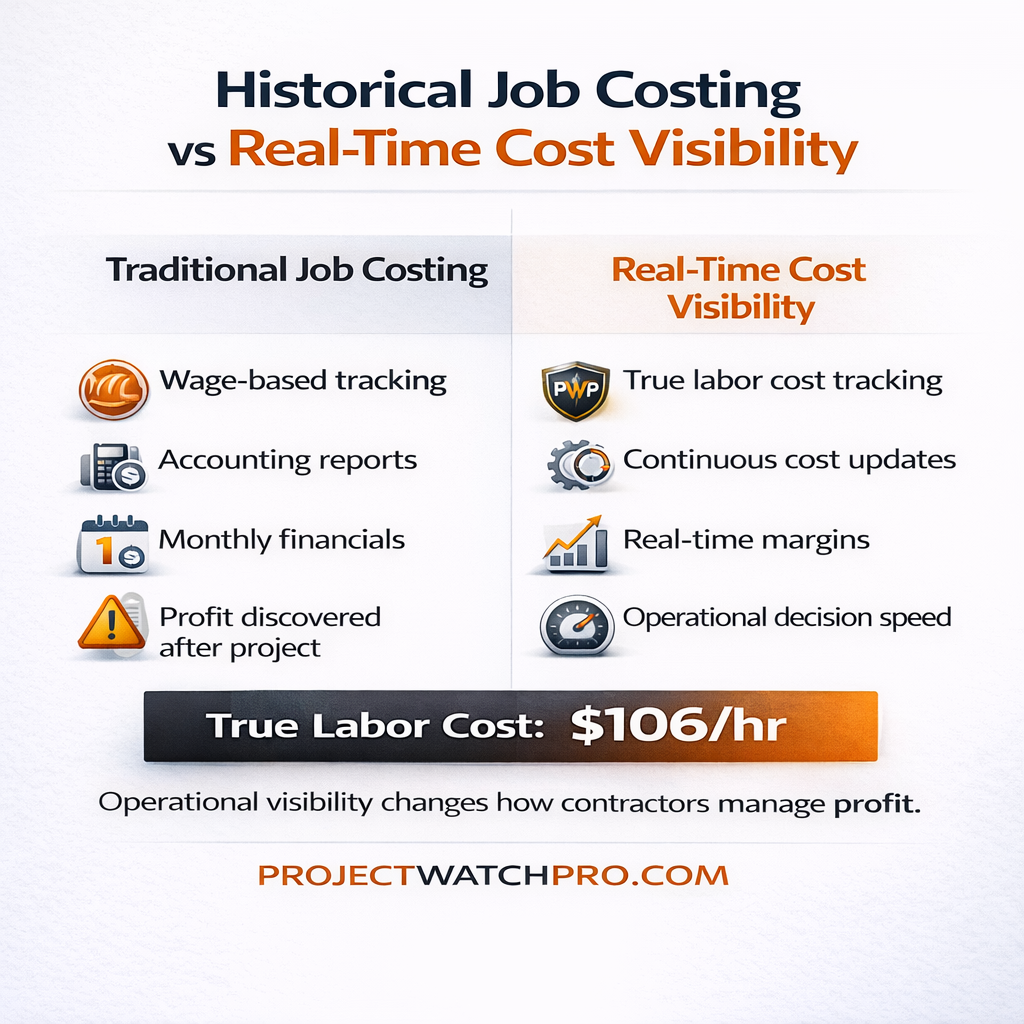
Real-time cost visibility allows managers to see:
• hours worked
• true labor cost
• charge-out value
• profit margin
continuously as work happens.
Instead of discovering profit after the project is complete, companies can see how labor activity affects margin during the job.
Operational visibility changes how projects are managed.
The Profit Defense Framework
Modern project-driven companies are shifting toward a new operational model built on three pillars.
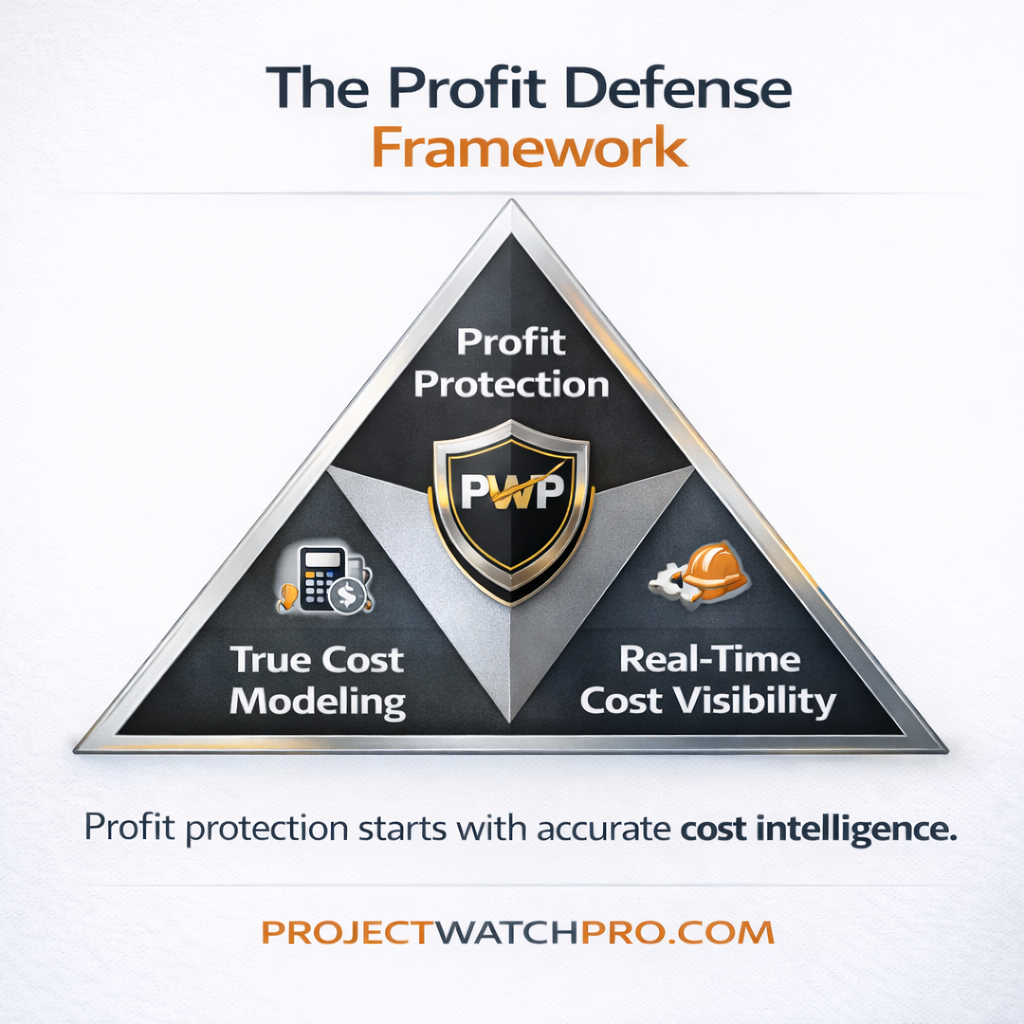
1. Cost Intelligence
Profit protection starts with understanding the true cost structure of labor.
Cost Intelligence means calculating the full cost of work — including labor burden, overhead allocation, and conditional costs — not just wages.
2. Real-Time Visibility
Operational decisions require live cost information.
Real-Time Visibility means managers can see labor costs, project margins, and cost trends while work is happening — not weeks later when accounting closes the books.
3. Profit Defense
When companies combine Cost Intelligence with Real-Time Visibility, they gain the ability to actively protect margins.
This is called Profit Defense — the ability to detect margin drift early and adjust operations before profit disappears.
Together these capabilities create what many companies are now pursuing:
profit protection systems for project-driven businesses.
Why This Matters for Contractors
When companies fall into the True Cost Trap, several problems emerge.
• estimates become inaccurate
• margins slowly drift
• overtime destroys profitability
• management loses financial visibility
• accounting reports become the only source of truth
Companies that calculate true labor cost correctly gain a powerful advantage.
They can:
• price projects accurately
• detect margin changes earlier
• make better operational decisions
• protect profitability across multiple jobs
Key Takeaways
• Wages are only one layer of true labor cost.
• Labor burden typically adds 30–50% to wages.
• Overhead allocation can add $30–$60 per hour in many companies.
• Overtime premiums increase labor cost by 50% of the base wage.
• Traditional job costing often relies on delayed accounting data.
• Real-time cost visibility dramatically improves decision-making.
Understanding the full cost structure of labor is the first step toward protecting margins in project-driven businesses.
Free Contractor Cost Intelligence Toolkit
To help contractors calculate their real labor cost, we created three practical worksheets.
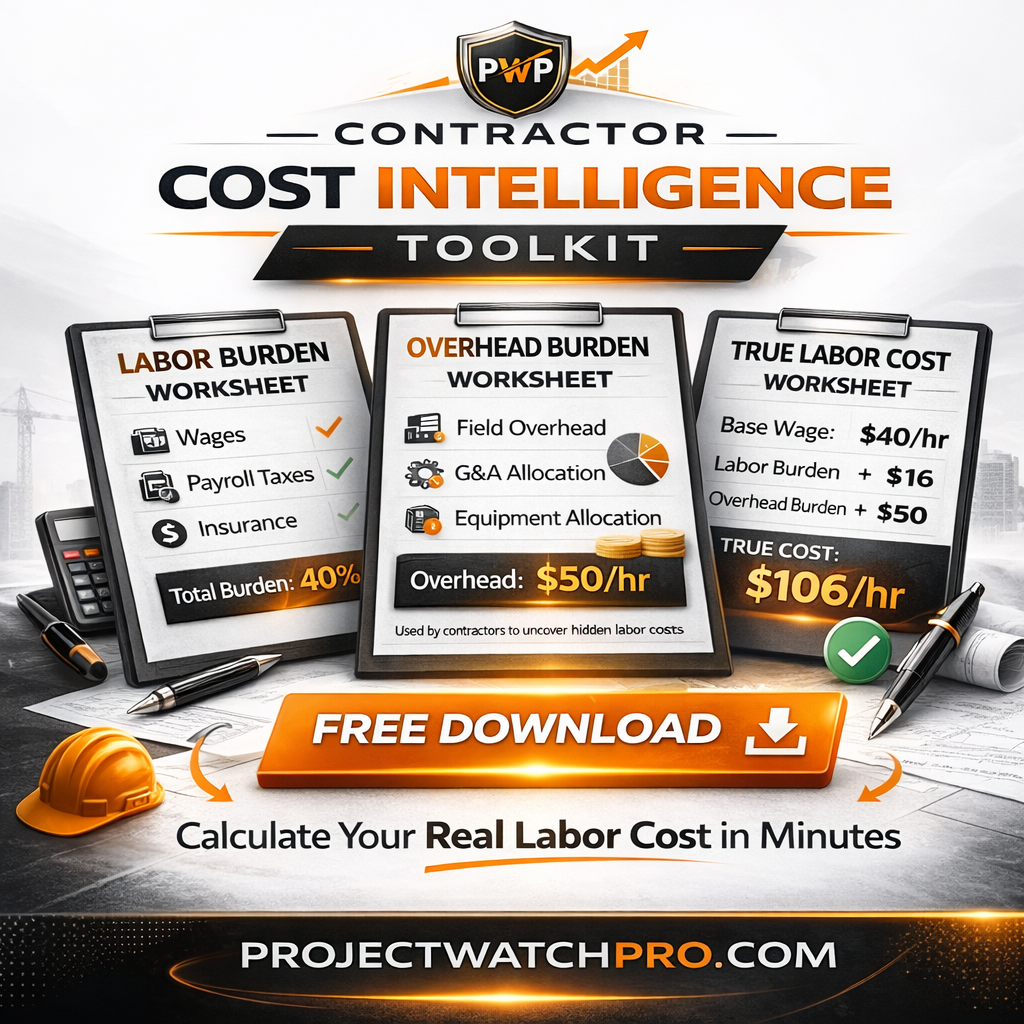
Download the toolkit to access:
• Labor Burden Calculator
• Overhead Burden Calculator
• True Labor Cost Worksheet
These tools make it easy to calculate the real hourly cost of your workforce.
Frequently Asked Questions
What is labor burden rate in construction?
Labor burden rate represents the additional cost of employing a worker beyond their wage. It includes payroll taxes, workers compensation, benefits, paid time off, and other employment costs. In construction industries it typically ranges between 30% and 50% of base wage.
What is overhead burden rate?
Overhead burden rate is the allocation of company overhead expenses across productive labor hours. These expenses include office staff, facilities, insurance, vehicles, software, and administrative costs required to operate the business.
Why do construction projects lose money?
Many projects lose money because estimates are built using incomplete cost data. When companies use wages instead of fully burdened labor cost, hidden expenses accumulate during the project and erode margins.
How do contractors calculate true labor cost?
True labor cost can be calculated using the formula:
True Labor Cost =
Base Wage
Labor Burden Rate
Overhead Burden Rate
Conditional Costs (overtime, shift premiums, task-specific expenses)
What percentage should labor burden be?
In construction industries, labor burden commonly ranges between 30% and 50% of base wage, depending on benefits, insurance rates, and local employment taxes.


