Profit Management Dies With Month-Old Data: Why Real-Time Visibility Is No Longer Optional
Why You Keep Losing Money on Projects (And Only Find Out Weeks Later)
Here's the question that keeps construction contractors up at night: Why does your bank account say one thing when your job estimates say another?
You bid the job right. Your crew worked hard. The project wrapped on time. But somehow, you lost $5,000—and you didn't find out until 45 days later when your bookkeeper finally closed the books.
By then? The crew's moved on. The client's paid. And there's absolutely nothing you can do about it.
If this sounds familiar, you're not alone. The construction industry operates on razor-thin margins where the slightest issue can mean the difference between profit and loss, and problems often remain hidden until after financial damage is done.
The real problem isn't that you're bad at construction. It's that you're managing your profitability with information that's 30-45 days old. And you can't fix what you can't see.
The Hidden Profit Killers Bleeding Your Business Dry
Let's be honest about what's actually happening on your projects right now.
1. You're Giving Clients Interest-Free Loans (Without Knowing It)
Projects have invoice submission deadlines, and if you miss them, you might wait until next month to submit and get paid—but your workers and vendors won't wait for their money.
Work gets completed. Your crew logs hours. Materials get delivered. But the invoice? It sits on someone's desk for three weeks because nobody knows it's billable yet.
Real example: One contractor discovered $180,000+ in outstanding accounts receivable simply because billing lagged behind work completion.
That's not a billing problem. That's a visibility problem. When you can't see what's billable in real-time, your cash is tied up funding someone else's project.
2. Your Data Lives in Five Different Places (And None of Them Talk)
Job costing in one system. Time tracking in another. Invoicing in a spreadsheet. Materials tracked on paper clipboards that may or may not make it back to the office.
There's no single source of truth. Just conflicting numbers, incomplete pictures, and gut-feeling decisions that feel right but cost you thousands.
The result? You're always reacting to problems that could've been prevented if you'd seen them coming.
3. Manual Processes Are Eating 17% of Your Profit
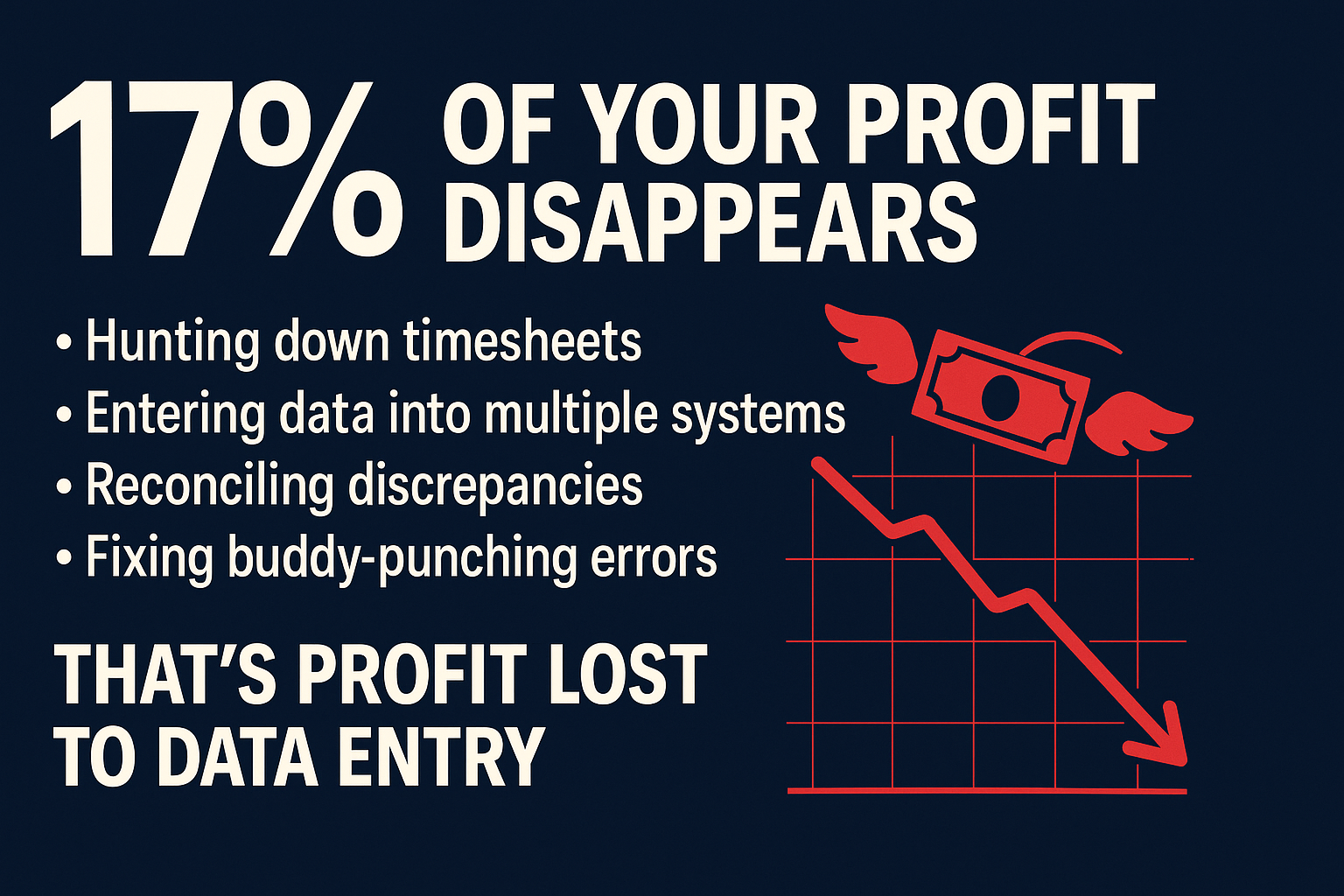
Think about the hours your team spends:
- Hunting down missing timesheets
- Entering data into multiple systems
- Reconciling discrepancies between what was tracked and what actually happened
- Fixing errors from buddy punching, missed punches, and "rounded" hours
Everyday field problems get fixed by throwing more labor at them, and overtime—even when authorized—can easily spiral out of control and eat up huge chunks of profitability.
Studies show manual processes can create up to 17% waste. That's 17% of your potential profit disappearing because you're stuck doing data entry instead of managing jobs.
4. The 45-Day Discovery Problem
Here's how traditional project management actually works:
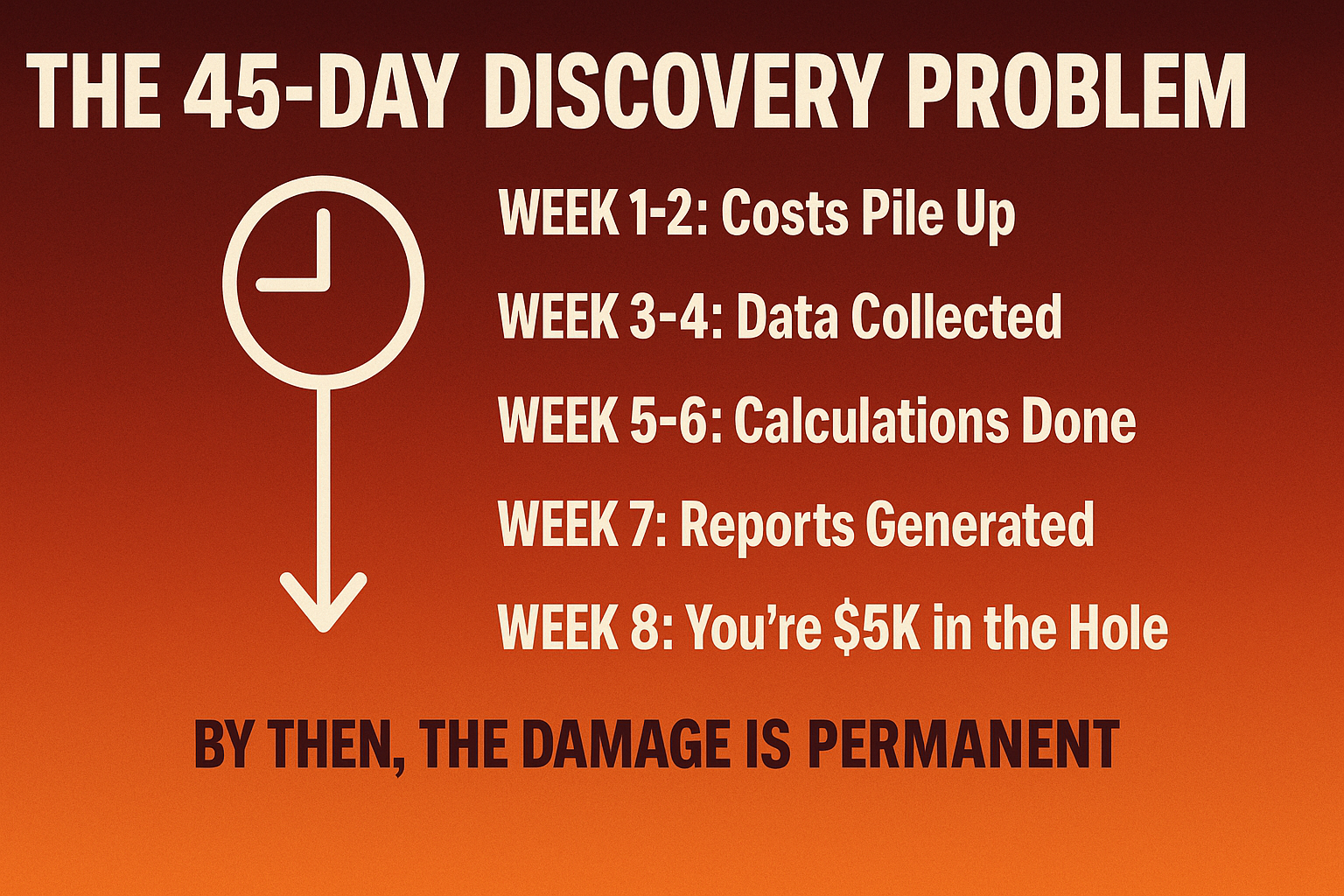
Week 1-2: Work happens (costs start piling up)
Week 3-4: Someone collects timesheets and receipts
Week 5-6: Data gets entered and calculations happen
Week 7: Reports finally get generated
Week 8: You discover you're $5K in the hole
Timeline: 45+ days from when the problem started to when you found out about it.
Opportunity to fix it: Zero. The project's done. The damage is permanent.
The critical questions: when did you realize the project was in trouble, and what actions did you take? Could you have reduced losses with timely interventions?
Why Projects Actually Lose Money (It's Not What You Think)
There are many reasons projects lose money, including poor supervision, low morale, poor management and planning, incorrect resource allocation, and production bottlenecks like poor logistics.
But here's what most contractors miss: It's not that these problems happen. It's that you don't see them happening until it's too late to fix them.
Inaccurate cost estimates are one of the top reasons contractors lose money, and carefully reviewing all contract requirements can help avoid missing key details.
If you delay a project, you lose money—not only from liquidated damages but also from overspent preliminary costs.
The pattern is always the same: Problem emerges → Problem grows → Problem gets discovered weeks later → Nothing can be done.
What Real-Time Profit Management Actually Looks Like
Imagine running your business like this instead:
Hour 1 of a project: Your crew clocks in via mobile app with GPS verification. No buddy punching. No "I forgot my timesheet."
Hour 3: You get an alert that labor costs are tracking 15% over estimate. You can see it happening right now.
Hour 4: You make a quick call. Adjust crew size. Reallocate resources. Fix the problem while the project is still running.
End of day: Invoicing happens automatically upon work verification. Your cash isn't tied up for weeks.
Every 60 seconds: Your dashboard updates with real margins, actual costs, and live productivity data.
This isn't fantasy. This is how modern construction companies operate.
The $12,000 Difference Speed Makes
Let's look at the same $50,000 project managed two different ways:
Traditional Method (45-day reporting delay)
- Cost overrun discovered after project completion
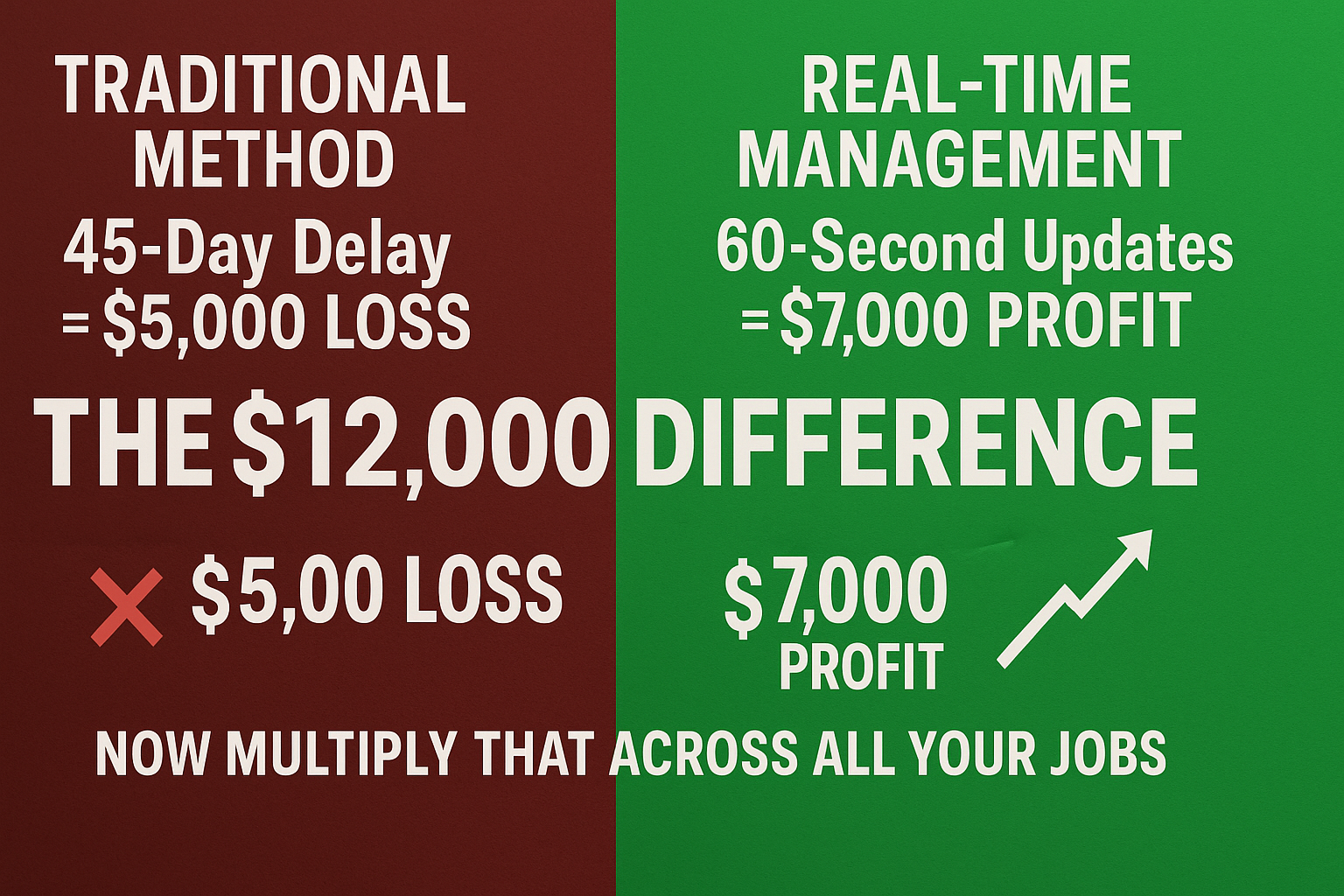
- Result: $5,000 loss
- Lesson maybe learned for next time
- Nothing can be recovered
Real-Time Management (60-second updates)
- Issue identified in Hour 1 of work
- Corrected immediately while project is active
- Result: $7,000 profit
- Lesson applied during the project
The difference: $12,000 swing on one project.
Now multiply that across 10 projects this year. 20 projects. 50 projects.
Specialized software with dynamic dashboards consolidates financial data into real-time insights, allowing quick strategy adjustments to keep projects on track and maximize ROI.
That's the difference between barely surviving and actually building a profitable business.
Stop Doing Autopsies. Start Managing Profit.
The construction industry has relatively low net profit margins of 3-7%, leaving very little room for error—even small cost increases can quickly erode profits, underscoring the importance of reviewing margins at least monthly.
You wouldn't drive your truck by only looking in the rearview mirror. You'd crash.
So why are you running your business that way?
The tools exist. The technology is proven. The question is whether you're going to keep discovering losses after they happen, or start preventing them while you still can.
Real profit management requires real-time visibility. Everything else is just expensive archaeology—examining what already died with no power to bring it back.
How to Actually Track Project Profitability in Real-Time
Want to stop bleeding profit? Here's what you need:
✓ Automated time tracking with GPS verification (no more buddy punching or "forgotten" timesheets)
✓ Same-day billing upon work verification (stop giving interest-free loans to clients)
✓ Centralized dashboards updating every 60 seconds (one source of truth, not five conflicting spreadsheets)
✓ Live cost alerts when jobs drift off estimate (catch problems in Hour 1, not Week 8)
✓ Mobile access for field teams (data captured where work happens, not transcribed later)
Modern construction management software lets you monitor budget variances, track labor and material costs in real-time, and receive automated alerts when profit margins fall below target thresholds.
The contractors who implement these systems don't just survive. They thrive. Because they're making decisions based on what's happening now, not what happened six weeks ago.
Frequently Asked Questions
Q: How quickly can I actually see ROI from real-time profit tracking?
Most contractors identify their first correctable cost overrun within the first week—often recovering the software investment on a single project. Regular financial data analysis allows companies to identify challenges like cost overruns or cash flow shortages early and take proactive measures.
Q: What if my team isn't tech-savvy enough for this?
If your crew can use a smartphone, they can track time with GPS verification. Modern tools are designed for field teams, not accountants. No manual entry, no complicated processes—just clock in and the system does the rest.
Q: Don't I need expensive software to get real-time data?
Not anymore. Cloud-based construction management platforms have made real-time tracking affordable for companies of all sizes. The question isn't whether you can afford it—it's whether you can afford not to have it.
Q: How do I know which jobs are actually profitable right now?
The best systems let you create, track, and manage budgets in real-time and automatically forecast project costs, profitability, and cashflow. You should be able to pull up any active job and see live P&L in seconds.
---
Ready to stop discovering losses after it's too late? Experience 60-second profit updates with a free 30-day trial at [ProjectWatchPRO.com](https://projectwatchpro.com). See exactly where every project stands—before the damage is done.
---
Related Topics: construction profit management | real-time job costing | project profitability tracking | construction cost overruns | cashflow management | construction project management software | how to improve profit margins | why construction projects lose money
---
ProjectWatchPRO gives construction contractors, trades, fabrication companies 60-second visibility into every job's profitability—while there's still time to fix problems and protect margins. Stop managing with month-old data and start making decisions based on what's happening right now.


