
What Does One Employee Actually Cost Per Day in the Field?
You Pay the Wage. Here's What That Person Actually Costs You Each Day in the Field.
Your crew shows up at 7am. One person. You're paying $38 an hour.
You think: 8 hours, $304. That's your labor cost for the day.
But that person drove 45 minutes to the job in your truck. Workers' comp is ticking on every hour, billed or not. Vacation pay is accruing. The shop lease, the commercial vehicle insurance, the tool wear, the phone bill — all of it is running in the background while they work.
By the time you count everything that actually has to be paid for one person to show up and do a day's work, the number isn't $304. It's closer to $600. Sometimes $700 or more.
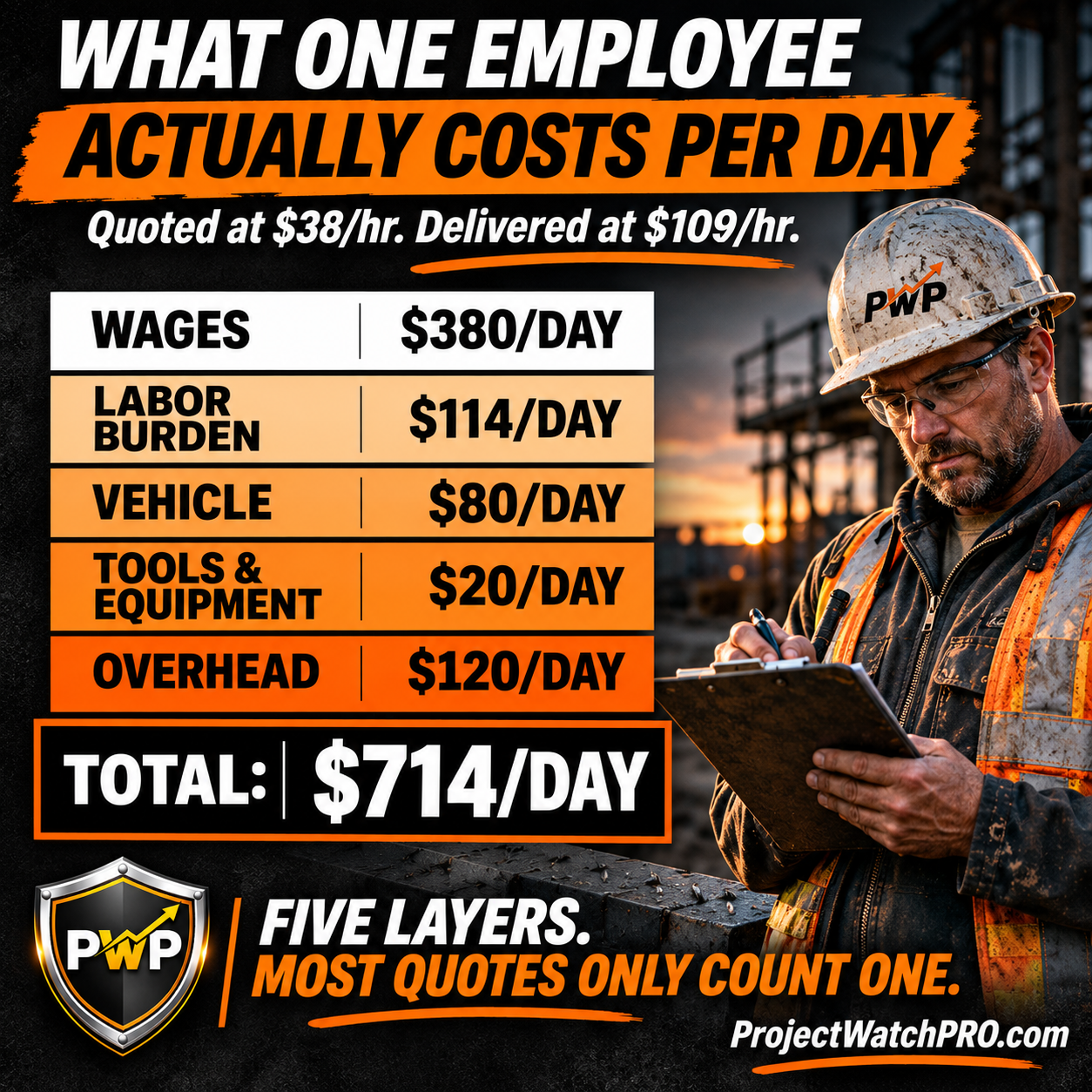
The true daily cost of one employee is the total amount it costs to put that person in the field for one day — wage, employer taxes, workers' comp, vacation, vehicle, tools, and your share of the overhead it takes to keep the company running. Most contractors only count the first line. The other layers are what eat the margin.
What You're Already Paying — Before the Day Even Starts
The wage is real. But the wage is not the total cost.
The moment you have someone on payroll, there are costs that exist whether they're billing to a job or not. The employer is on the hook for every one of them.
The Wage Is the Starting Number — Not the Full Number
If your person earns $38 an hour and works a 10-hour day, you're writing a check for $380 in wages. That's the number you see on the timesheet.
What doesn't show up as clearly:
- Employer payroll remittances — CPP and EI in Canada, Social Security and FUTA in the US. Employer-side CPP runs 5.95% of insurable earnings in 2026; employer EI is 1.4x the employee rate. In the US, FICA employer contribution is 7.65% before state taxes.
- Workers' compensation — varies by trade and jurisdiction but runs between $5 and $25 per $100 of insurable earnings for trade and industrial work. A roofer's rate is not the same as an office worker's. High-hazard coatings and industrial work sit at the high end of that range.
- Vacation pay — in most Canadian provinces, minimum 4% of gross wages, accrued from day one. US operations budget differently by state, but most trade contractors see 5–8% once PTO, sick time, and stat holiday accruals are counted.
- Benefits — group health, dental, and life insurance, where the shop provides them. Where they don't, the burden is lighter — but it still shows up in recruiting costs and turnover.
Add those four lines to a $38/hr wage and you're at $45–$55 per paid hour before the person starts the truck. That's just what it costs to have them on payroll.
According to Bureau of Labor Statistics Employer Costs for Employee Compensation data, employer-paid benefits and legally required contributions add an average of 30–40% above wages across the US construction industry. Canada's numbers run similar, with WCB and CPP contributions pushing it higher for trade and industrial work.
Here's what most people get wrong: they know the wage and they think that's the labor cost. The wage is what you pay the employee. The labor burden is what it costs the business to employ them. Those are two different numbers, and the gap between them runs 25–45% in most trade businesses. Almost none of that gap shows up in a quote built from the wage alone.
The Costs That Don't Come Out of Payroll — But Still Come Out of Your Pocket
Labor burden covers what flows through payroll. There's a second set of costs that come out of the business separately — but they're just as real, and they belong in the daily cost too.
The Vehicle Doesn't Drive Itself
A service truck or work van costs money every day it's on the road. Fuel is the obvious one. But the full daily vehicle cost includes:
- Fuel — a half-ton truck running 100–150km per day can easily hit $20–$35/day depending on diesel prices.
- Insurance — commercial vehicle coverage for a trades truck runs $2,000–$5,000+/year. Spread across 250 working days, that's $8–$20/day per truck.
- Maintenance — tires, brakes, oil changes, unplanned repairs. Most trades operations budget $4,000–$8,000/year per work truck in maintenance costs.
- Depreciation — a $60,000 work truck with a 5-year useful life is costing $12,000/year before it needs replacing.
Spread across 250 working days, one work truck costs $60–$100+ per day in real operating cost. Some operations run higher.
That cost exists whether the job gets billed or not. If your quotes don't have a vehicle line — or if that line is based on a rough estimate from three years ago — the cost is coming out of margin every day.
Tools and Equipment Have a Daily Cost Too
Every piece of gear your team uses has a purchase price, a maintenance schedule, and a useful life. A compressor, a welder, a grinder, a drill set — all of it needs to be replaced eventually.
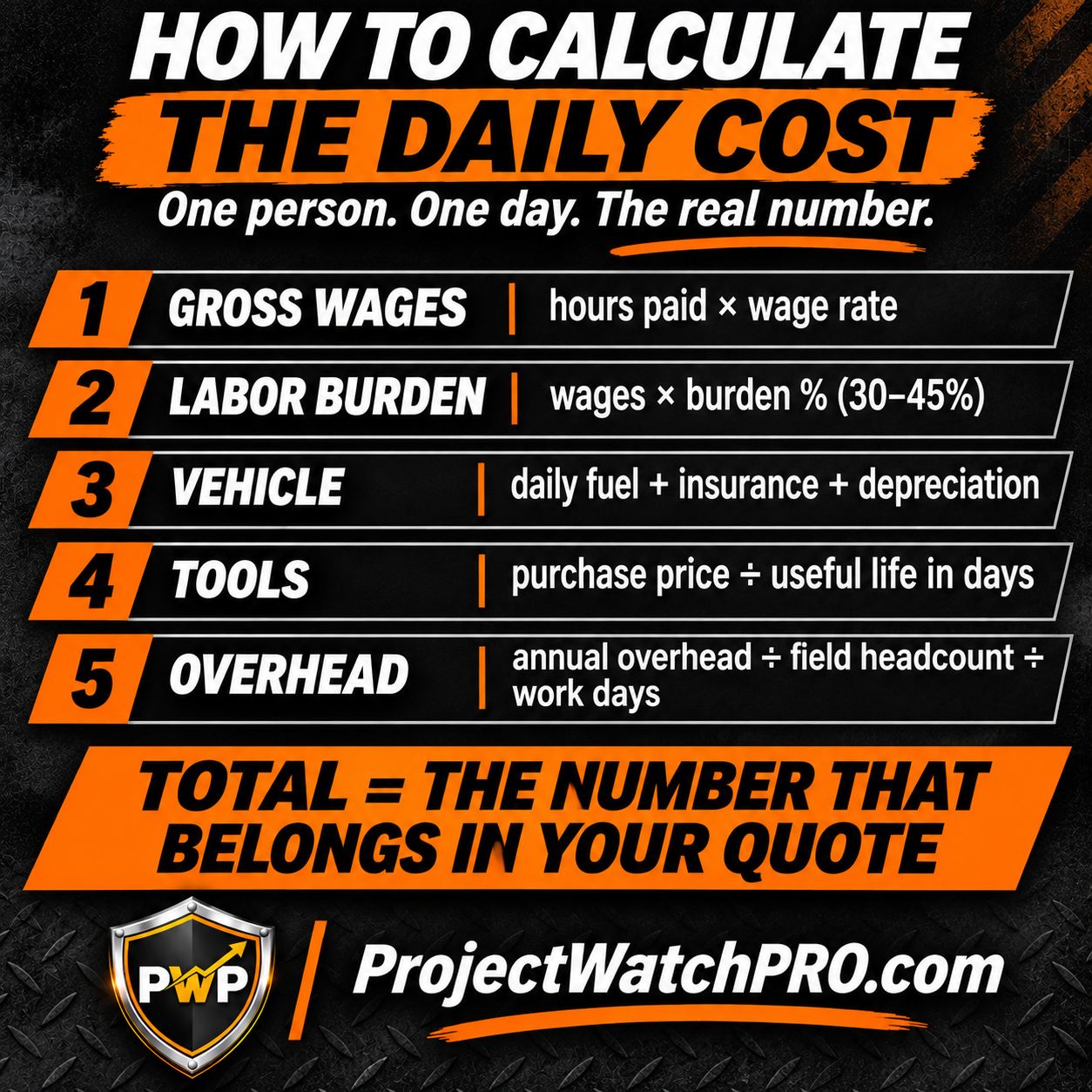
The right way to think about it: total purchase price ÷ useful life in days = daily cost. A $4,000 tool that lasts 1,000 working days costs $4/day. A $20,000 piece of equipment with 5 years of productive life costs $16/day, plus maintenance and calibration.
According to ACC4T's labor cost research, consumable and equipment costs are among the most consistently underloaded layers in a trade contractor's quote — typically recovered in overhead as a lump sum rather than priced per job and per task. The result: jobs that use heavy equipment recover less than their fair share; lighter jobs subsidize them.
Most contractors treat a big tool purchase as a one-time hit in the year they bought it, then stop counting. But the jobs that use that equipment are the ones that need to recover it.
Overhead Is a Daily Expense for Every Person in the Field
Overhead — the cost of keeping the doors open whether you have a job today or not — includes shop rent, office expenses, insurance, software, management salaries, and everything else that runs in the background. It doesn't pause when the crew ships out.
If your annual overhead is $240,000 and you have 4 people in the field, each person is carrying $60,000/year of overhead just by showing up. Divided by 250 working days, that's $240/day per person — just to cover what's behind them at the office.
This is the step most quotes miss entirely. Labor and materials go in. Overhead shows up as a guessed percentage at the end, if it shows up at all. The construction overhead rate calculation that actually works is overhead ÷ billable hours — not a percentage added to the job total at the finish line.
The Full Daily Cost — Run the Math Once
Take one person. $38/hr. 10-hour paid day. 6.5 of those hours land on a customer invoice.
You are quoting $38/hr. The job is costing $109.85 to deliver each billable hour.
That's not a small discrepancy. That's a quoting problem built into every job from line one of the estimate.
Why This Number Is Higher Than You'd Expect
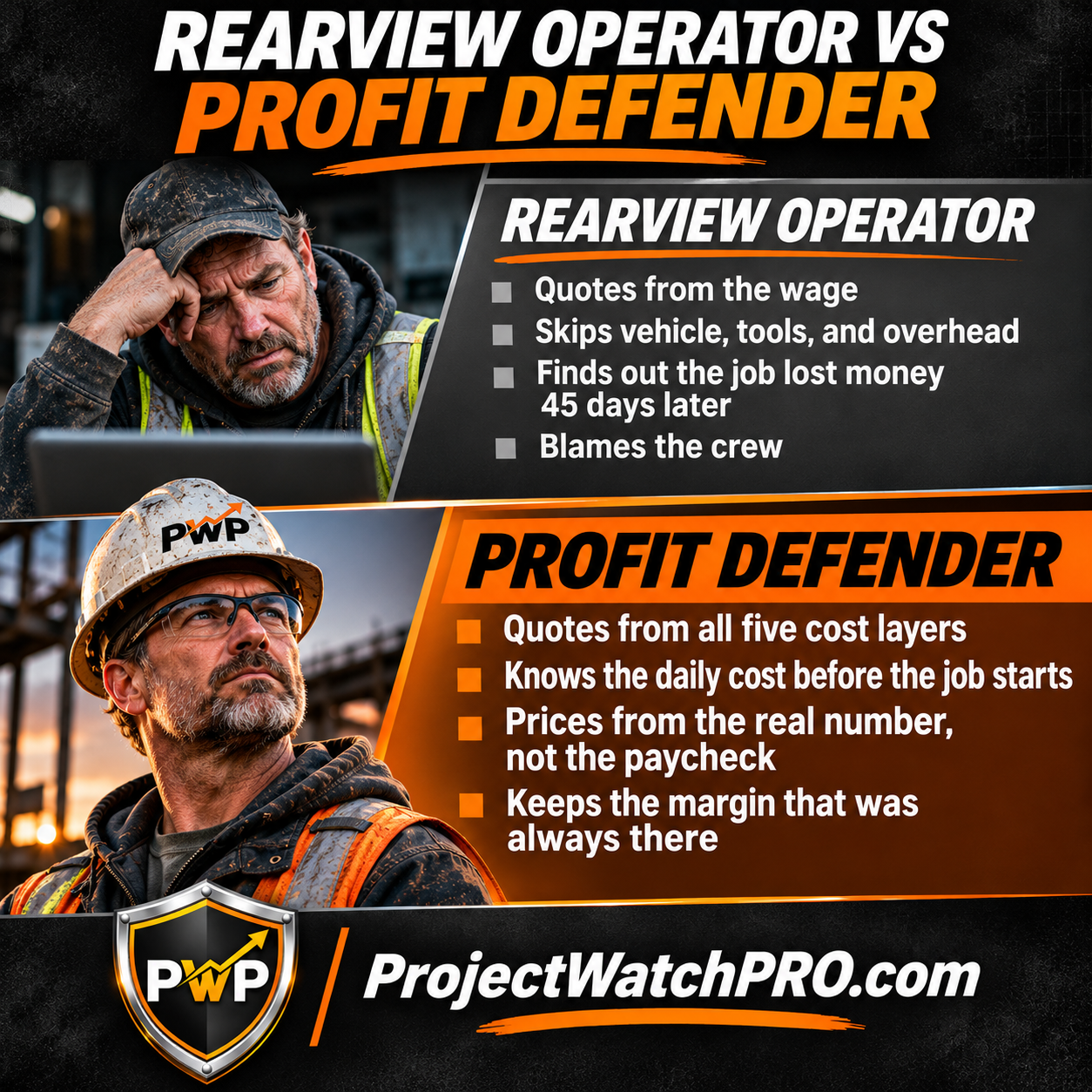
The gap isn't any one layer. It's all five at once.
The wage is the most visible. The burden is semi-visible — it shows up on the payroll remittance, but rarely in the quote. The vehicle, tools, and overhead are almost completely invisible in most trade businesses — they exist in the accounting, but they're not being loaded into the rate being used to price jobs.
That's why a contractor can run the right number of jobs, invoice every one of them, and still find the bank account thin at year-end. The revenue was there. The costs were there too — they just weren't in the quote.
John McCabe has seen this pattern in Profit Recovery Reviews across trades and revenue levels. Owners who think their labor cost is $45/hr are actually running $80–$110/hr when non-billable time, labor burden, vehicle, and overhead are properly loaded. At $3M in revenue, that gap typically accounts for around $150,000 per year in margin that was earned on paper and never kept. At $5M, closer to $200,000.

Swap in your trade — electrical, plumbing, HVAC, fabrication, painting. The layers are the same. The numbers change. The gap between what you quote and what it costs to deliver is the same problem every time. Whether you're running blast trucks in Alberta or service vans in Ontario, your crews are burning through the same five cost layers every day, and most of them only make it onto one line of the estimate.
This is a methodology problem, not a people problem. The crew is not the reason. The number the quote was built on is the reason. ProjectWatchPRO's approach — before the software ever enters the picture — is to get the right cost number built first. The Profit Pulse System starts there: a True Cost Baseline built from real payroll data, real vehicle costs, and real overhead, before anything gets quoted, scheduled, or tracked. The software makes it easier to hold that number consistent across every job. But the first step is always the number, and the True Labor Cost Blueprint is where you build it.
Key Takeaways
- Wage is one line in the true daily cost — employer payroll remittances, workers' comp, and vacation pay add another 25–45% before the person leaves the shop, per BLS Employer Cost data
- Vehicle cost — fuel, insurance, maintenance, and depreciation — runs $60–$100+ per day per truck; if that's not in the quote, it comes out of margin
- Tools and equipment cost money every day they're in use; daily amortization (purchase price ÷ useful life in days) is how to allocate it properly, not a one-time expense year
- Overhead per person per day — annual overhead ÷ field headcount ÷ working days — means every person carries a fixed daily overhead cost whether the quote accounts for it or not
- All five layers together: a $38/hr employee running 6.5 billable hours out of a 10-hour day, with vehicle, tools, and overhead loaded, typically costs over $100 per billable hour delivered
- At $3M revenue, closing a $20–$30/hr gap in the daily cost calculation typically recovers around $150,000 per year in [margin that shows up on paper but doesn't reach the bank](/profit-fade-construction)
- The True Labor Cost Blueprint at truelaborcostblueprint.com walks through every layer of this calculation — burden, vehicle, overhead — in one sequence
Frequently Asked Questions
What does it really cost to have one employee in the field per day?
The all-in daily cost of one field employee includes gross wages, employer payroll remittances (payroll taxes), workers' comp, vacation accrual, vehicle costs (fuel, insurance, depreciation), tools and equipment, and their daily share of company overhead. For a $38/hr employee on a 10-hour day, the total typically runs $600–$800 or more before any profit margin is built in.
How do I calculate the true cost of one employee per hour?
Add up everything that has to be paid for one person to show up and do a day's work — wages, labor burden, vehicle, tools, overhead — then divide by the number of billable hours that land on a customer invoice. If total daily cost is $714 and billable hours are 6.5, the true cost per billable hour is $109.85. That's the number the quote should be built from, not the wage. The True Labor Cost Blueprint walks through this calculation step by step.
Does vehicle cost belong in the labor rate for a construction quote?
Yes. Vehicle cost is a real, daily operating expense tied directly to field labor — if the truck doesn't roll, the job doesn't happen. It can be loaded into the daily labor rate as part of overhead allocation, or quoted as a separate daily line, but it must be recovered somewhere in the price. Most contractors who don't see it as a "labor cost" are still paying it. It's just not in the quote, so it comes out of margin.
What is a labor burden rate and what does it include?
A labor burden rate is the percentage by which employer costs exceed the base wage. It includes employer payroll remittances (CPP/EI in Canada, Social Security/FUTA in the US), workers' compensation premiums, vacation pay accrual, stat holiday pay, and any employer-paid benefits. In trade and construction work, the burden rate typically runs 25–45% above the wage — meaning a $38/hr employee has a fully burdened wage cost of $47–$55/hr before vehicle, tools, or overhead are added.
Why do my labor costs keep coming out higher than my quotes?
Because the quote was built on the wage and the actual cost is the wage plus four other layers. If you're using $38/hr in the estimate and the job is costing $80–$110/hr to deliver each billable hour, the quote is off from the start — no matter how accurately you count the hours. The fix is a loaded labor rate that includes burden, vehicle, overhead, and the non-billable time ratio before the number goes into an estimate.