How to Detect Construction Cost Drift Before the Job Closes
How to Detect Construction Cost Drift Before the Job Closes
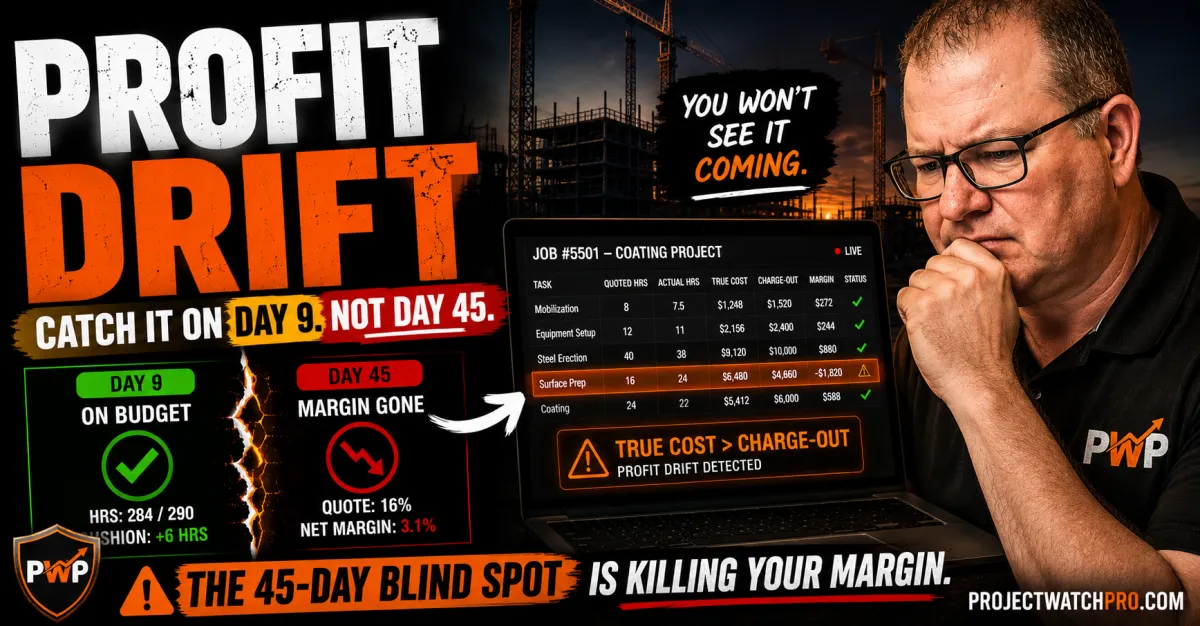
Marcus checked the timesheet on day nine of a twelve-day coatings job. Hours tracked: 284. Budget: 290. Six hours of cushion left. He closed the laptop satisfied — the job was running clean.
Thirty-eight days later, the job cost report landed. Net margin: 3.1%. He'd quoted 16%.
Nobody on the team could explain where the other thirteen points went. The hours looked fine. The schedule held. The client signed off. And yet somewhere in those twelve days, the margin quietly left the building — and nobody saw it happen.
According to a study published by GlobeNewswire on August 5, 2026, fewer than 41% of contractors can identify potential overruns while they are still manageable on at least half of their projects. The rest find out too late — after the job closes, after the invoice is sent, after the decision window is permanently shut.
You're not the problem. The tracking method is.
Construction profit drift is the gradual erosion of job margin that occurs when labor costs shift — through overtime, task-level inefficiencies, or an unverified charge-out rate — without any real-time signal that the shift is happening. It's invisible to hours-based tracking because hours are a count, not a cost.
How to Detect Construction Cost Drift Before the Job Closes
How to Detect Construction Cost Drift Before the Job Closes
Why Hours That Look On Budget Can Still Be Losing Money
Why Overtime Is the Most Common Trigger Nobody Catches in Time
The Decision Window You Don't Know You're Losing
Why Month-End Job Costing Guarantees You Find Out Too Late
What Profit Clarity Looks Like While a Job Is Still Running
True Cost vs. Charge-Out by Task — The Comparison That Breaks the Blind Spot
How the Drift Detector Stops the Same Job From Closing at 3%
Q: What is profit drift in construction?
Q: How do I detect cost overruns before a construction job closes?
Q: Why do construction jobs lose money even when hours look on budget?
Q: How does overtime affect construction job profitability?
Q: What is real-time job cost tracking for contractors?
Q: How much earlier does real-time tracking catch overruns compared to month-end reporting?
Find Out Where Your Margin Is Going Before the Next Job Closes
Why Hours That Look On Budget Can Still Be Losing Money
Here is the thing most contractors don't know until they've been burned by it: a timesheet is a count. It is not a cost.
Your crew clocks 47 hours on task 3. Your budget was 50 hours. That looks like a win — three hours under. What the timesheet does not tell you is whether six of those 47 hours were overtime. It does not tell you that overtime shifts the true labor cost of every hour above the charge-out rate you quoted from. And it does not tell you that your charge-out rate was built on straight-time costs to begin with, which means every overtime hour is now running at a cost your quote never accounted for.
That's not a minor adjustment. According to SmartBarrel's 2026 construction labor cost tracking report, labor represents 40–70% of total project cost depending on trade, and the indirect costs — overtime premiums, burden, task-specific costs — account for 20–30% of actual labor spend that never shows up in a standard time log.
When labor is 60% of your job and 25% of that is invisible to your tracking method, you do not have a cost management system. You have a count management system. And counts don't protect margin — costs do.
Construction net margins average 3–7% across the industry, according to multiple 2026 benchmarking reports. At 5% net, a 10% labor cost overrun on a single job doesn't reduce your margin — it eliminates it entirely. The math has no mercy. And the timesheet has no alarm.

Why Overtime Is the Most Common Trigger Nobody Catches in Time
Overtime is the stealth drift trigger in most construction businesses. It does not announce itself. A crew runs long on a task — six hours over — and the timesheet shows six extra hours. The hours look close enough to budget. Nobody flags it.
What nobody sees: those six hours cost 1.5× the regular rate. The true labor cost of those hours exceeded the charge-out rate the moment the overtime began. And the charge-out rate — the number you quoted the client — was built on straight-time assumptions that are now wrong.
Construction labor growth has slowed to 0.6% in 2026 against a historical average of 2.7%, according to ABC Carolinas — meaning existing crews are being pushed harder, which drives unplanned overtime at precisely the moment when margins are thinnest. This is not an edge case. It is the standard operating condition of the 2026 construction market.
The Decision Window You Don't Know You're Losing
This is the part that should alarm every contractor reading it.
A labor cost overrun found in week two of a ten-week project has eight weeks of recovery opportunity. The same overrun found in week eight has two weeks — and at that point, the decisions available to you are dramatically fewer. You cannot undo the labor. You cannot renegotiate the scope that has already been performed. You are managing the damage, not preventing it.

The GlobeNewswire study from August 2026 is explicit on this: contractors who track costs in real time catch overruns three weeks earlier than those relying on periodic reporting. Three weeks earlier. On a six-week job, that is the difference between catching the drift on day nine and catching it on day thirty — after the margin has already bled out.
The 45-Day Blind Spot — the gap between when a cost problem starts and when it surfaces in a standard month-end or closeout report — is not a reporting frequency problem. It is a structural problem. Month-end job costing was designed to account for what happened, not to defend against what is happening.
Why Month-End Job Costing Guarantees You Find Out Too Late
When you rely on month-end job costing, the sequence looks like this: the job runs, costs accumulate, the timesheet logs hours, payroll closes, the accounting system catches up, the report gets compiled, and — somewhere between thirty and forty-five days after the last hour was clocked — the report lands on your desk.
You read it. You see 3.1% where you quoted 16%. You call the team. Nobody can explain it clearly because the decisions that determined the outcome were made six weeks ago on a job that has since been invoiced, paid, and forgotten.
That is not a reporting failure. That is a structural guarantee that you will always find out after there is nothing left to do. The report is perfectly accurate. It is just perfectly useless as a defense tool.
Input prices in construction moved at 12.6% annualized in 2026 according to ABC Carolinas mid-year forecast. At that pace of cost movement, a 30-day feedback lag is not just inconvenient — it is an active dollar loss on every job. Costs you incurred at last month's rates are being reported at this month's lag. The two numbers are not the same.
What Profit Clarity Looks Like While a Job Is Still Running
Step 8 of the Profit Pulse System is the Drift Detector. Its job is to turn time tracking data into profit clarity — in real time, while the job is still running, while there are still decisions left to make.
The mechanism is not complicated. It is, however, different from anything most contractors have ever seen their software do.
Here is what it tracks — by task, updated as hours are clocked:
1. True labor cost applied — not wage, not wage + basic burden, but the full six-layer true cost for every hour logged, including labor burden, overhead burden, task-specific burden, shift differential, and overtime premium
2. Charge-out rate comparison — the rate the job was quoted at, compared in real time to the true cost of the hours being delivered
3. Cumulative drift — the live gap between what the job is earning and what it is costing, updated on every clock-out
When true cost exceeds charge-out on a task, the Drift Detector fires. Not at month-end. Not at closeout. While the job is still alive.
That is not better reporting. That is the difference between an autopsy and a vital sign.

True Cost vs. Charge-Out by Task — The Comparison That Breaks the Blind Spot
The standard time tracking model captures one dimension: hours. The Drift Detector captures two: hours and what those hours actually cost. The comparison between true cost and charge-out rate — updated at the task level, in real time — is the signal that makes profit drift visible before it becomes a loss.
I worked with a coatings contractor in Alberta — the crew was nine days into a twelve-day job. Hours looked clean. When we ran true cost against charge-out on task 3, six overtime hours had pushed the true cost per hour above the charge-out rate. The task was earning less than it cost to perform — in real time, visible that day.
That information, on day nine, left three days of decisions available. The crew allocation shifted. The remaining task hours recovered. The job closed at margin. The same information, arriving thirty-eight days later as a closeout report, would have produced nothing but an explanation.
This is the difference between real-time job costing and post-job reporting. Both use the same underlying data. Only one uses it in time.
How the Drift Detector Stops the Same Job From Closing at 3%
A Rearview Operator runs this job: twelve days, three tasks, coatings. Hours logged daily. Report compiled at month-end. Thirty-eight days later: 3.1% net. Nobody knows why.
A Profit Defender runs the same job differently.
The charge-out rate was built from true labor cost — not the wage, but the full six-layer cost stack including overtime premium. Every clock-out on every task updates the true cost vs. charge-out comparison automatically. On day nine, task 3 flags. True cost has exceeded charge-out. The drift is visible with three days of decisions remaining.
The foreman shifts crew allocation. The remaining hours on task 3 run at a corrected pace. The job closes at 13.4% — not the 16% it was quoted at, because two tasks of real drift were absorbed. But not 3.1%, because one task was caught in time.
That is what the Drift Detector does. It does not guarantee a job closes exactly at quoted margin — real jobs have real variability. It guarantees that when drift happens, you know about it while you can still act.

According to Mobilization Funding's 2026 construction cash flow report, 90% of senior construction decision-makers have passed on profitable work due to cash flow timing — and 43% have done so multiple times. Cash flow problems are downstream of cost visibility problems. When you cannot see what a live job is actually costing, you cannot project cash needs, time draws correctly, or plan the next job with confidence. The Drift Detector is not just a margin protection tool. It is a cash position tool.
ProjectWatchPRO — awarded Top Construction Job Costing and Project Management Software in Canada for 2026 — is the platform that delivers the Drift Detector as part of the complete 9-step Profit Pulse System. The system runs from Step 1 (true cost baseline) through Step 9 (the weekly profit review loop) — and Step 8 is where real-time profit visibility becomes the standard operating condition, not an end-of-job surprise.
Key Takeaways
- Fewer than 41% of contractors can identify cost overruns while they are still manageable — GlobeNewswire, August 2026. The majority find out too late, when the decision window has already closed.
- Hours are a count, not a cost. An on-budget hour count is not an on-budget job. Overtime shifts true labor cost above the charge-out rate without changing the hour tally.
- The decision window is time-sensitive. A drift signal on day 9 of a 12-day job leaves decisions available. The same signal on day 11 does not. Real-time detection is the only form of detection that matters.
- Month-end job costing is structurally guaranteed to arrive too late. It is an accounting tool, not a defense tool. The 30–45 day lag is not a reporting failure — it is a design outcome.
- The Drift Detector (Step 8 of the Profit Pulse System) applies true labor cost at the task level and compares it to charge-out rate in real time — so drift is visible while the job is still running.
- True labor cost is not the wage. It is the six-layer stack: base wage, labor burden, overhead burden, task-specific burden, shift differential, and overtime premium. A charge-out rate built on anything less than the full stack guarantees drift on every overtime shift.
- Cash flow is downstream of cost visibility. 90% of construction leaders have passed on profitable work due to cash flow timing — a problem that begins with not knowing what live jobs are actually costing.
Frequently Asked Questions
Q: What is profit drift in construction?
Construction profit drift is the gradual erosion of job margin that occurs when labor costs shift — through overtime, task-level inefficiency, or a charge-out rate that was never built on true labor cost — without a real-time signal that the shift is happening. It is invisible to hours-based tracking because timesheets record counts, not costs. Most contractors discover it 30–45 days after the job closes.
Q: How do I detect cost overruns before a construction job closes?
Cost overrun detection requires comparing true labor cost — all six layers, including overhead burden, labor burden, task-specific burden, shift differential, and overtime premium — against your charge-out rate at the task level, updated in real time as hours are clocked. This is what Step 8 of the Profit Pulse System (the Drift Detector) does. Without this comparison, you are tracking hours, not money — and hours do not tell you when the job starts losing margin.
Q: Why do construction jobs lose money even when hours look on budget?
Because hours are a count and costs are a dollar figure — and the two can diverge sharply when overtime is involved. Six hours of overtime looks like six hours on the timesheet. But overtime adds a 50% premium to true labor cost, and if your charge-out rate was built on straight-time assumptions, every overtime hour is generating a cost your quote never covered. Real-time job costing catches this gap as it forms. Month-end reporting catches it after it has already compounded.
Q: How does overtime affect construction job profitability?
Overtime shifts the true labor cost of every hour above what a straight-time charge-out rate was designed to recover. If your crew works six hours of overtime on a task with a charge-out rate built on a $38/hr base wage, the true cost of those six hours may be $89/hr or more — but you are only recovering against the $38/hr baseline. The true labor cost gap widens every overtime hour, invisibly, until the job cost report arrives weeks later with an unexplained margin loss.
Q: What is real-time job cost tracking for contractors?
Real-time job cost tracking means applying true labor cost — not just hours — to every clock-out on every task, and comparing that cost to the charge-out rate in real time while the job is running. It is different from standard time tracking because it translates hours into dollars immediately, and it is different from job cost reporting because the data is available while decisions can still be made. ProjectWatchPRO delivers this through the Drift Detector step of the Profit Pulse System.
Q: How much earlier does real-time tracking catch overruns compared to month-end reporting?
According to industry data from 2026, contractors using real-time cost tracking catch overruns an average of three weeks earlier than those relying on periodic reporting. On a six-week job, three weeks earlier means catching the drift at the midpoint — when crew allocation, task sequencing, and scope decisions are still available — rather than at closeout, when they are not.
Find Out Where Your Margin Is Going Before the Next Job Closes
The contractors who stop finding out 45 days too late all make the same decision: they stop treating hours as a proxy for costs and start applying true labor cost to every task in real time.
That shift — from tracking counts to tracking money — is the one that makes profit drift visible while it is still fixable.
If you want to see exactly where your margin is going on live jobs and what a real-time tracking structure looks like for your specific operation, a Profit Recovery Review puts that picture in front of you in 45 minutes.


