
How Do I Know If a Construction Job Was Estimated Wrong?
Did We Price This Wrong, or Is the Problem in the Field?
The job closed. You got paid. Then the final numbers came back.
You quoted 18% margin. You kept 5%. On a $700,000 job, that's $91,000 in expected profit that isn't there.
Now you're sitting at your desk trying to figure out if you priced it wrong — or if your guys ran over. Because those are two different problems with two different fixes. And if you apply the wrong fix to the wrong problem, you'll do the same thing next job.
You're not the only one who has been here. And you're not the problem. But the way most contractors investigate a miss like this — looking at total cost after the invoice, without breaking it down — means the answer never gets clear. Here's how to actually find out.
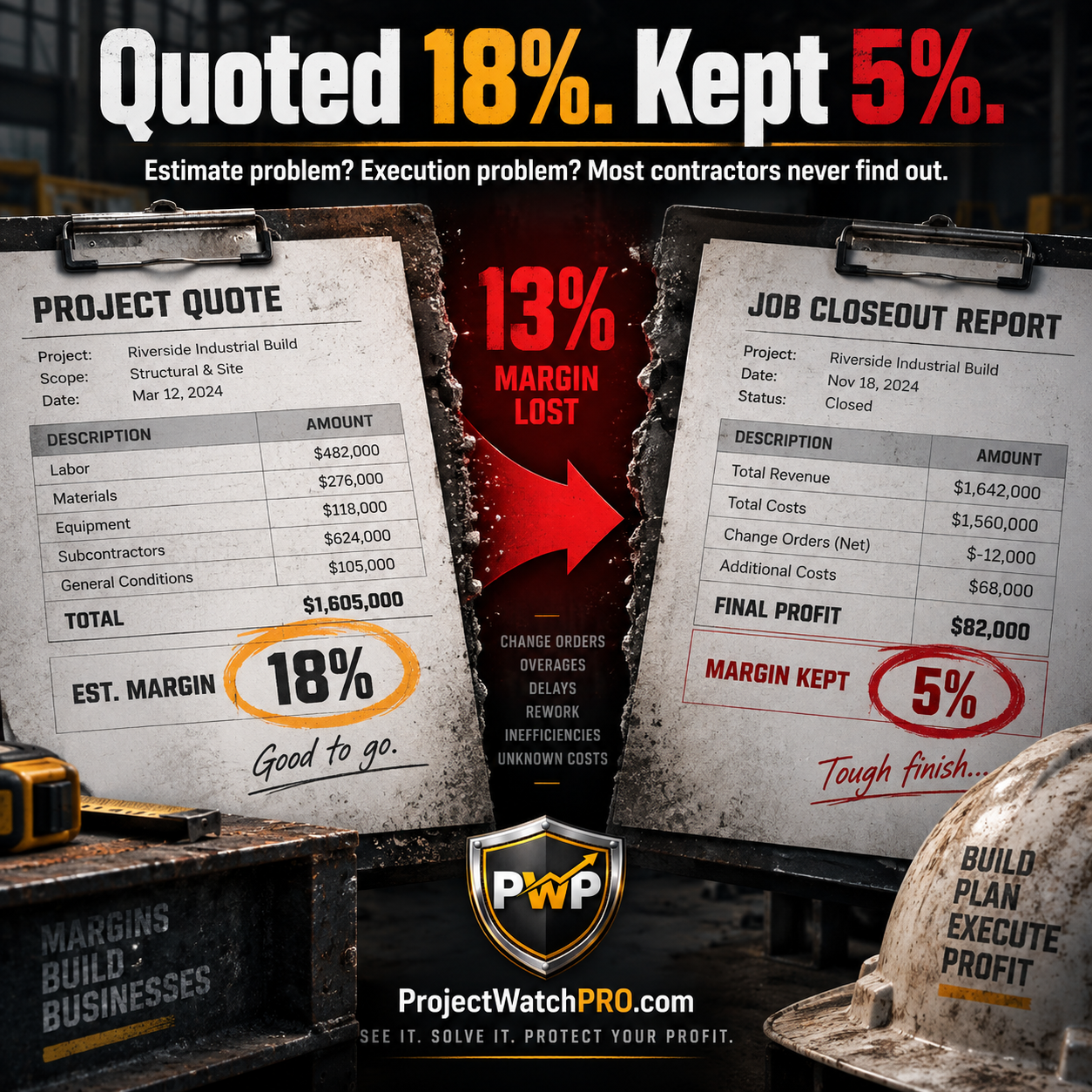
Comparing estimated labor cost to actual labor cost means taking the hours and rates you quoted for a job and setting them beside the hours your crew actually logged and what those hours truly cost. The gap between those two numbers — broken down by phase, task, or crew — shows you whether your pricing was off, your execution was off, or both.
What It Looks Like When You Can't Tell Which Problem You Have
John was brought in by a commercial painting and coating sub running about $4 million a year. They had just closed their biggest job to date — $1.2 million. They'd estimated 16% margin going in. Final result: 6.2%. About $117,000 short.
The owner thought they'd underpriced it. The project manager thought the crew ran over on prep time. The estimator thought the spec changed mid-job. Three different people. Three different theories. Nobody looking at the same set of numbers.
This plays out in electrical shops, framing crews, HVAC subs, fabrication houses, and general contractors the same way. The pain is the same — the job lost money and nobody agrees on why.
When John sat down with the data, here's what they actually found. The surface prep estimate was 440 hours at a loaded cost of $58 per hour. Actual came in at 412 hours — they ran under on prep. But blast booth time was estimated at 260 hours and came in at 391 hours. That's 131 hours over, at $71 per hour loaded, because two pieces of equipment were down for three days and work had to be redone.
So it wasn't an estimate problem. It was an execution problem — specifically, equipment downtime that wasn't in anyone's scope. The fix wasn't to requote surface prep lower. It was to build an equipment risk buffer and to catch equipment status earlier in the job. This is exactly how margin bleeding on specific phases hides inside a job that looks fine on the surface.
The owner was about to lower his surface prep rate on the next bid by $6 per hour. Surface prep had actually come in under estimate. The rate cut would have saved nothing and cost him margin on the next job. His problem wasn't the quote — it was the blast booth in week two. And without hours running over on a specific phase, the miss would never have happened.
Before you change a number on your next bid, you need to know which number was wrong — and where.
The Two-Step Check That Answers the Question
Here are the two questions you need to answer, and exactly how to get the answer to each.
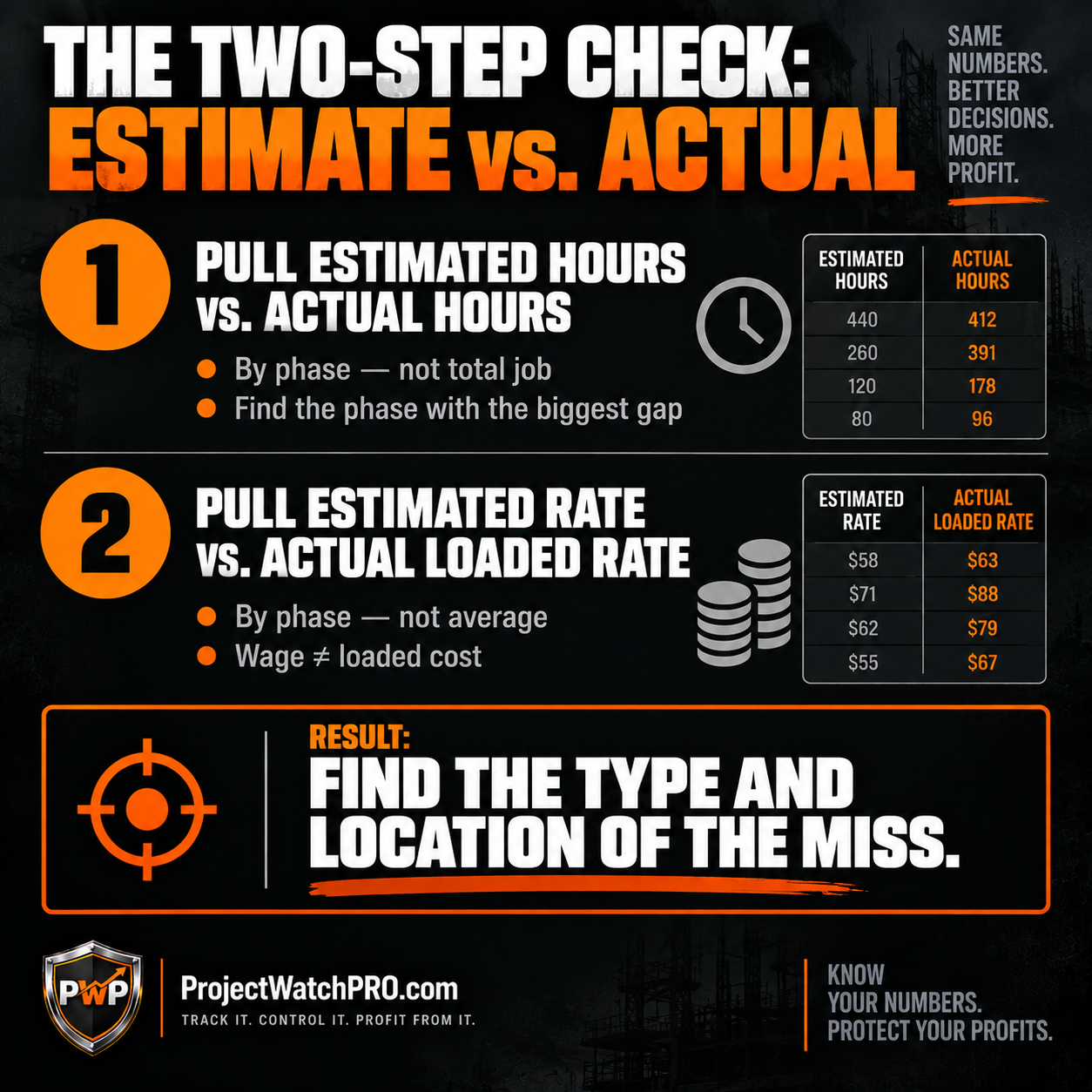
Did You Quote the Right Number for Each Phase?
For every major phase of the job — surface prep, application, equipment, site access, cleanup, or whatever your phases are — pull two numbers side by side:
1. Hours estimated
2. Hours actually logged
Then do the same for labor rate: the loaded cost per hour you used in the quote versus the loaded cost you actually paid. That means wage plus overhead burden plus labor burden plus overtime — all in. Not just the hourly wage on the timesheet.
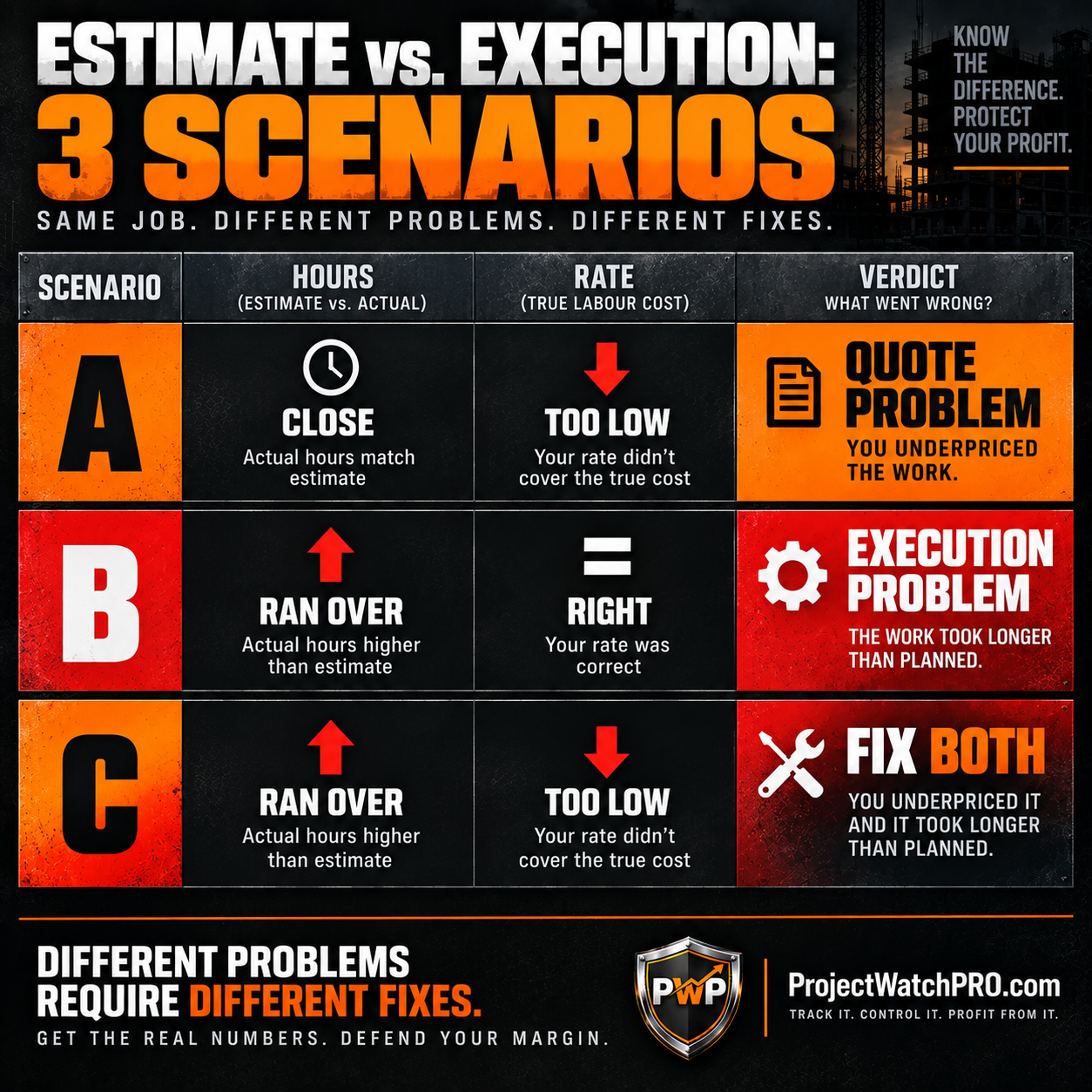
If your hours were close but your rate was too low — that's a quote problem. You underpriced what an hour actually costs.
If your rate was right but your hours ran over — that's an execution problem. The work took longer than the estimate said it would.
That table is the whole thing. If you can build that for each phase of a job, you'll know exactly what went wrong.
The loaded cost per hour is the number most contractors get wrong in their estimates. Learn how to build it correctly using the six-layer true labor cost calculation — and see why quoting off wage alone consistently underprices the work before anyone picks up a tool.
Which Phase Caused the Gap?
Once you know the type of problem — rate, hours, or both — you need to know where it happened. A $91,000 miss doesn't come from everything going wrong by 5%. It usually comes from one or two phases going badly wrong while the rest of the job ran close to plan.
Pull your hours and costs by phase. Find the phase with the biggest gap between estimate and actual. That's where you look.
If that phase ran over on hours: was it equipment issues, rework, crew speed, access problems, or scope additions? That's your execution question.
If that phase had the wrong rate: was the loaded cost per hour too low because you priced labor off wage instead of true cost? That's your quote question.
The fix is different depending on what you find:
- Quote problem: build your next bid from real loaded cost, not wage. See how the six-layer true labor cost calculation closes that gap.
- Execution problem: find out what happened in that phase — and address it in the field process or the schedule for the next job.
One more thing worth saying here. AGC guidance consistently identifies estimating accuracy and labor cost tracking gaps as leading contributors to construction losses — not materials, not subcontractors, not weather. If you're losing margin on labor, you're in the majority.
The Two Most Common Things People Get Wrong After a Miss
Lowering the Rate When the Problem Was the Hours
When a job loses money, the first instinct is often to lower the price. Cut the rate. Tighten up next time. But if the rate was right and the hours ran over — lowering the rate just makes the next quote worse.
The owner in the coating example above was about to cut $6 per hour off his surface prep rate. Surface prep hours came in under estimate. The problem was in the blast booth. The rate cut would have saved nothing and lost him margin on the next job.
Before you change the quote on the next bid, make sure you're fixing the right number.
Using Total Cost Instead of Phase Cost
A lot of contractors look at total job cost versus total job estimate and call it done. "We were $91,000 over." Okay — where? Which phase? Which crew? Which week?
Without phase-level or task-level comparison, you can't tell whether it was one bad week or a consistent pattern. You can't tell which part of your estimate needs work and which part was fine.
This is what task-level job costing is actually for. Not paperwork — the answer to "was it the quote or the crew, and specifically where?" That's the number that changes next quarter.
CFMA financial control guidance treats actual versus estimated cost comparison by cost category as a core financial control for contractors — not a nice-to-have report at closeout, but an active tracking tool used while the job runs.
The quote isn't just a price. It's the number you measure the job against. Without it broken into tasks, there's nothing to compare. ProjectWatchPRO makes that comparison visible while the job is still running — not in the post-mortem. Here's how real-time job costing changes what you can actually see and act on before the damage is done.
The Rearview Operator gets the $91,000 miss six weeks after closeout, lowers their rate on the next bid, and does it again. The Profit Defender sees the blast booth hours climbing at week two, asks the right question, finds the equipment issue, and prevents the same miss on the next job.
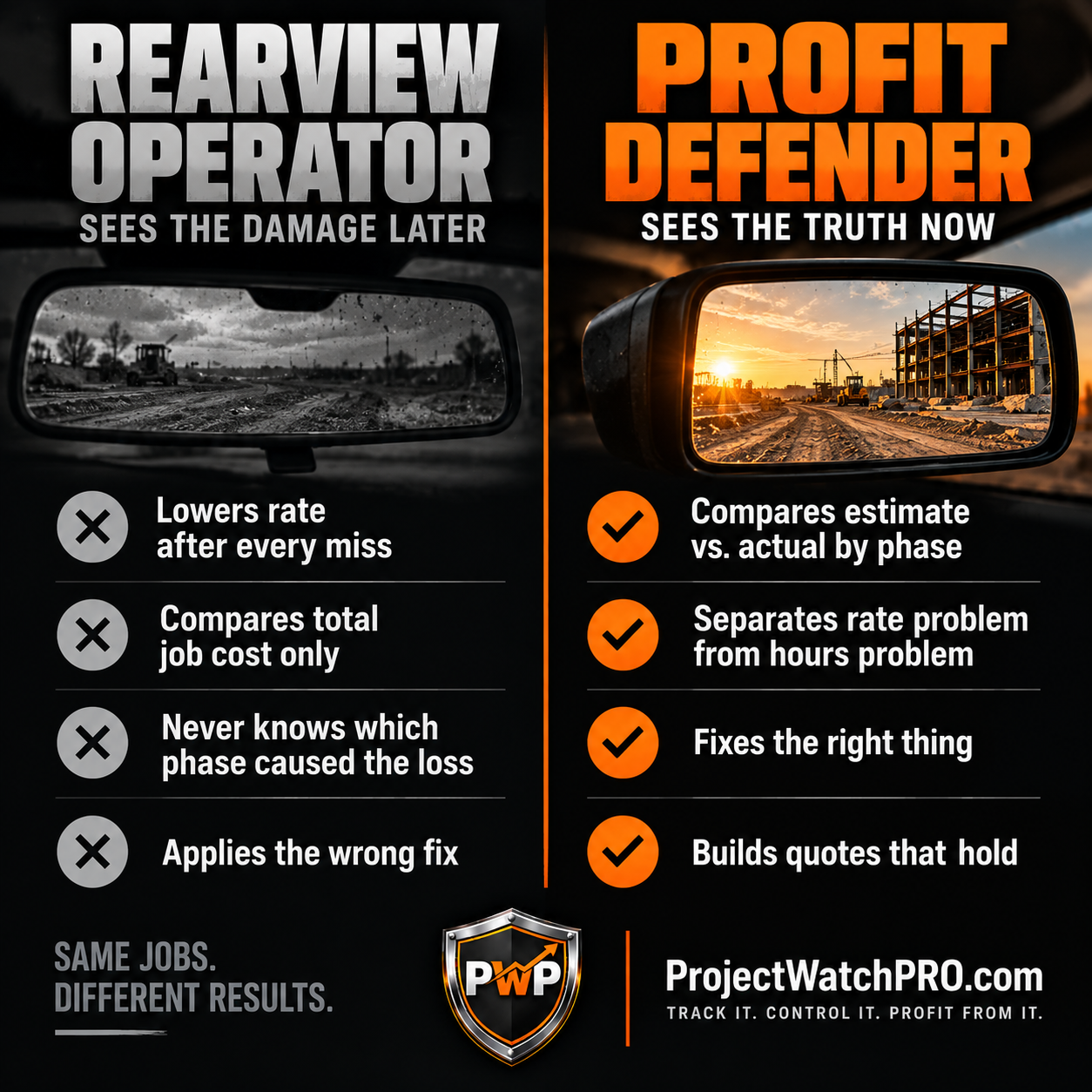
This is a method plus hands-on support — not just software. The Profit Defense Advisory Services team sits alongside contractors who've already seen the comparison. Software gives you the numbers. A person who's been through this with dozens of contractors tells you which number to act on and how to change the field process so it doesn't repeat next time.
Key Takeaways
- The two-part check: compare (1) estimated hours vs. actual hours and (2) estimated rate vs. actual loaded rate — by phase, not just total job. The combination tells you whether the miss was in pricing or execution.
- Scenario A (quote problem): hours came in close, but the rate was too low — the loaded cost per hour was higher than what you quoted. The fix is building your rate from all six cost layers, not from wage alone.
- Scenario B (execution problem): rate was right, but hours ran over — the work took longer than the estimate allowed. The fix is in the field process or schedule, not the next bid price.
- Scenario C (both): rate was too low AND hours ran over — this is the most common miss, and the reason a $700,000 job quoted at 18% closes at 5%.
- The most dangerous response to a miss: lowering the rate on the next quote when the problem was execution. You'd be making the estimate worse to solve a problem that was in the field.
- Phase-level vs. total-job cost: total cost comparison tells you how much you lost. Phase-level comparison tells you where — and that's the only number that changes anything. See how profit fade plays out when small phase overruns stack up across a job.
- The comparison only works if your estimate is broken into tasks: a lump-sum estimate can't be compared against anything. The quote has to be built by phase and task to be used as a measuring stick.
Frequently Asked Questions
How do I know if a construction job was estimated wrong?
Pull your estimated hours and loaded rate for each major phase side by side with actual hours and actual loaded cost. If hours were close but rate was low, the estimate was wrong. If the rate was right but hours ran over, the execution was off. You need both numbers to know. Total job cost alone will never give you a clear answer.
How do I compare estimated labor cost to actual labor cost?
Take your estimated hours per phase × estimated loaded rate. Compare that to actual hours per phase × actual loaded rate (wage + overhead burden + labor burden + overtime). The gap, broken down by phase, shows you where the miss happened. A lump-sum comparison won't give you enough to act on. Learn how to build that comparison using the six-layer true labor cost.
Why did my quoted margin disappear?
Almost always one of three things: your labor rate was too low (wage does not equal loaded cost), specific phases ran over in hours, or both. A $91,000 miss on a $700K job usually traces to one or two phases — not everything going wrong by the same amount. See how this plays out across a job in construction profit fade.
What is the difference between an estimate problem and an execution problem in construction?
An estimate problem means the cost in the quote was wrong before anyone touched a tool — usually because labor was priced off wage instead of fully loaded cost. An execution problem means the quote was right but the field ran over — more hours, equipment downtime, rework, scope additions. The fix is different for each. Running the two-step check tells you which one you're dealing with.
How do I tell if a job went over budget because of bad estimating or bad execution?
Compare by phase: estimated hours vs. actual hours, estimated rate vs. actual loaded rate. If the rate was low but hours tracked close — quote problem. If the rate was right but hours ran over — execution problem. If both are off — both problems need fixing. Most contractors find the rate problem is more common than they expected. Learn how real-time job costing catches the execution gap before the job closes.
How often is it actually an estimate problem vs. an execution problem?
Both are common — but the rate problem (underpricing what an employee actually costs per hour) is more widespread than most contractors realize. When wage is used instead of loaded cost, the estimate is underpriced before the crew shows up. The gap varies by business — a Profit Recovery Review will find yours specifically.