What Is a Shop Rate and How Do You Calculate It?
Your Shop Rate Should Be Built From Your Numbers — Not Borrowed From the Shop Down the Road
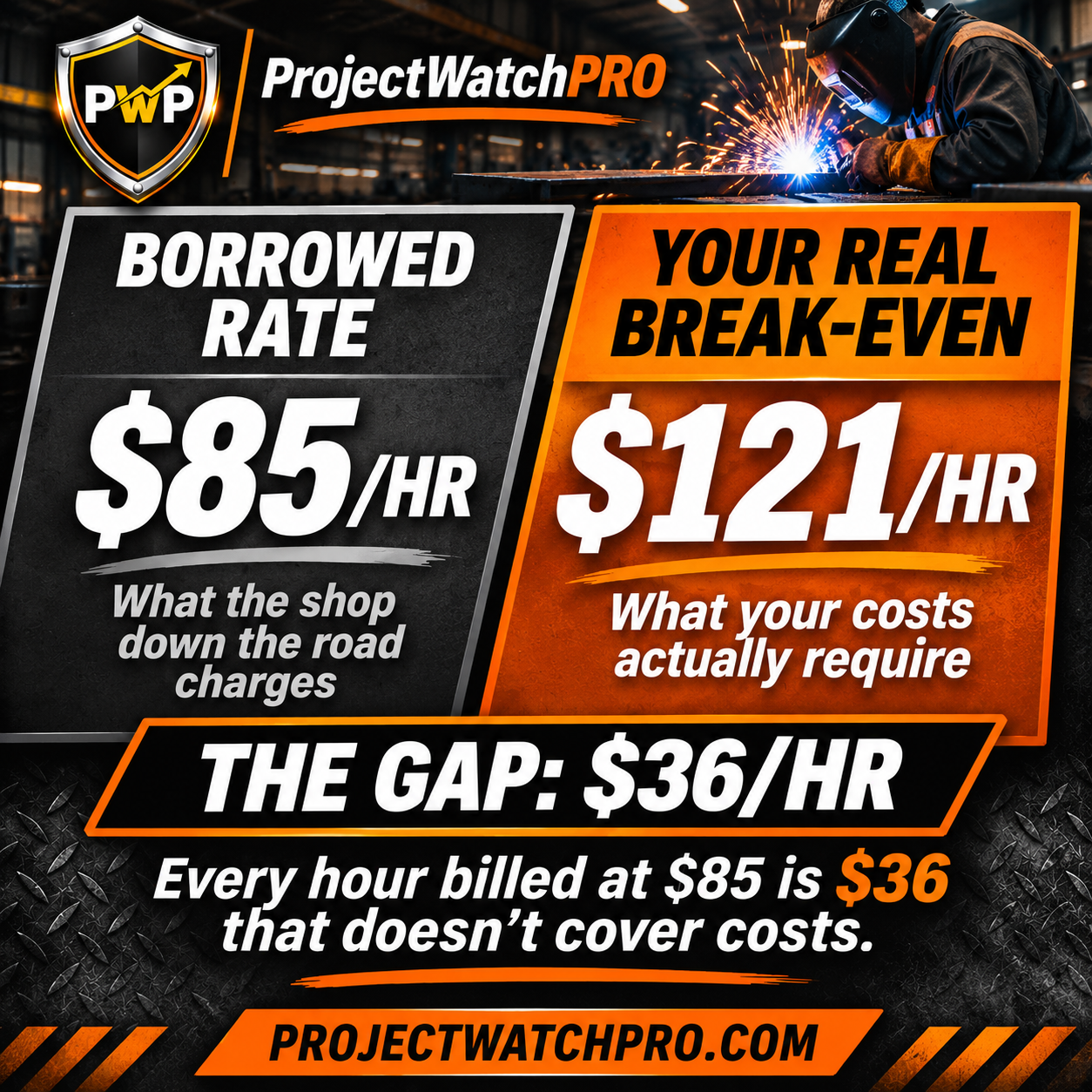
A welding shop owner in a Practical Machinist forum put it plainly: "Plenty of shops charge $85 an hour because that's what the shop down the road charges. Your costs aren't theirs."
He's right. And here's the thing — most shop owners know this. They've heard it. They've maybe even said it to someone else. But when it's time to actually set a rate, $85 is the number that feels safe because it's the number that keeps coming up.
The problem isn't that $85 is wrong for every shop. The problem is that it might be wrong for yours — too low or too high — and you have no way to know which one until you've run the jobs and found out 45 days later that the margin wasn't there.
A real shop rate doesn't start with what someone else charges. It starts with what it actually costs you to run your shop for one hour of billable work.
A shop rate is the minimum amount a job shop, fabricator, or trade contractor needs to charge per hour of billable work to cover all operating costs — overhead, labor burden, and direct wages — before any profit is added. It is calculated by dividing total annual operating costs by billable hours, not by total paid hours. The difference between those two denominators is where most shops get the number wrong.
What a Shop Rate Actually Covers
The name makes it sound simple. It isn't.
A shop rate is not just the wage you pay the person doing the work. It's the total cost of having that person in that shop doing that work — including every cost that has to be covered whether the job gets billed or not.
Here's what goes into it:
Wages — the base hourly pay for the people doing billable work. This is the number most shops start and stop at.
Labor burden — employer-side payroll costs: CPP and EI contributions in Canada, Social Security and FUTA in the US, plus workers' comp premiums, vacation pay, stat holiday accrual, and any employer-paid benefits. This adds 25–45% to the wage cost before the person picks up a tool. A machinist earning $32/hr costs the employer $40–$46/hr in direct employment costs, depending on the province or state and their workers' comp class. See the full breakdown in the labor burden rate calculation.
Overhead — everything it costs to keep the shop running that doesn't go directly into the job: rent or mortgage, utilities, equipment leases, insurance, software, management and admin salaries, shop supplies, maintenance contracts, and anything else that gets paid whether a job is running or not. This is the cost that most shop owners can list off the top of their heads in dollar figures but rarely convert into a rate. The conversion is what makes it useful: annual overhead ÷ annual billable hours = overhead per billable hour. That's the number that belongs in every quote.
Consumables — welding wire, gas, grinding discs, cutting tips, abrasives, coatings, lubricants. These get used up job by job and need to be recovered in the rate. Many fab shops track these as a separate line in the quote. Others fold them into overhead. Either way works as long as the number is in there — the mistake is assuming the job material covers it when it doesn't.
Together, those four layers are what make up a shop rate. The rate you need to charge per billable hour just to cover costs — before profit is added — is the total of all four divided by your annual billable hours.
The Calculation — And the One Step Most Shops Skip
The math is straightforward. The input most shops get wrong is the denominator.
Here's the full calculation:
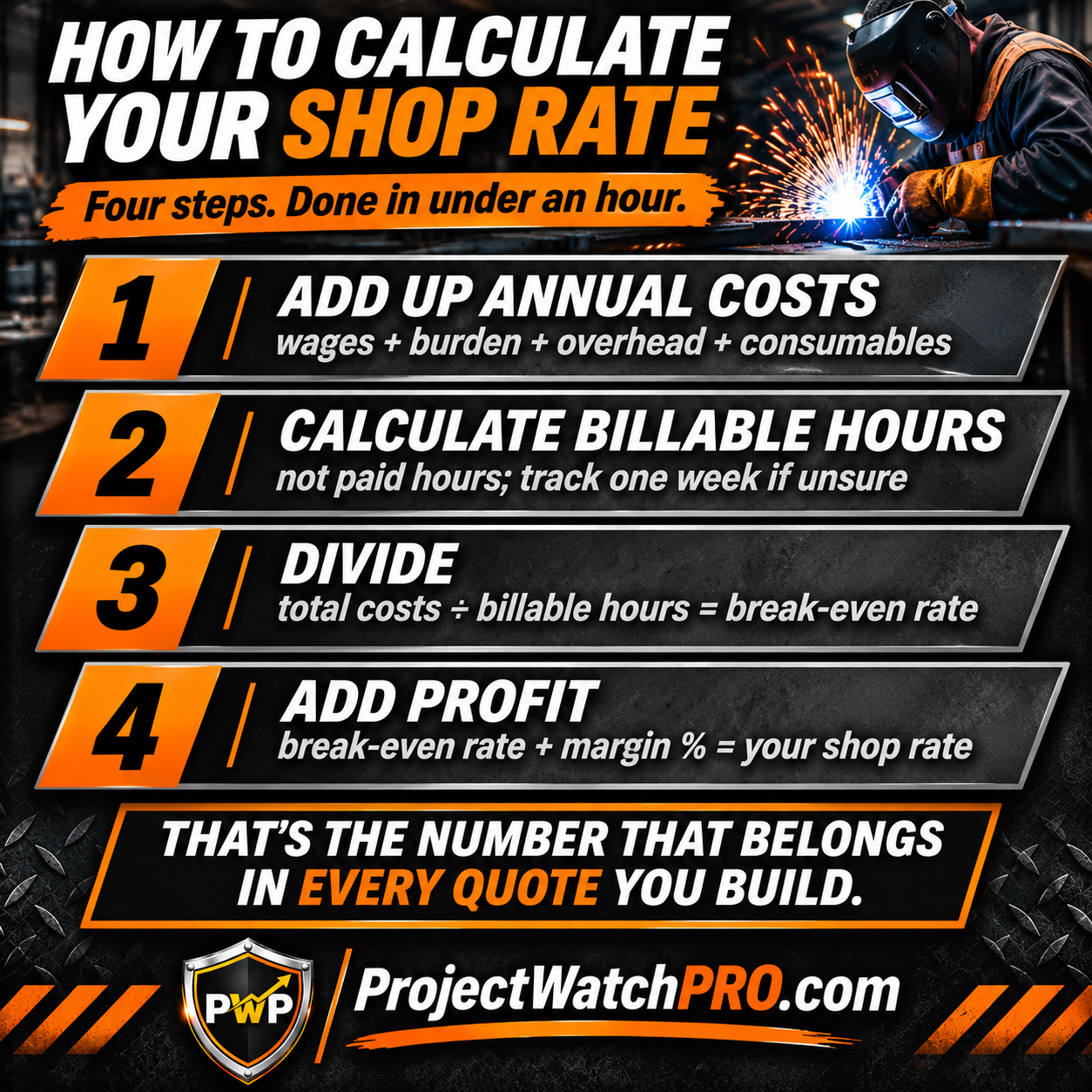
Step 1: Add up annual operating costs
Step 2: Calculate annual billable hours — not paid hours
This is where most shops get the number wrong. A 3-person shop with everyone working 2,080 paid hours per year does not have 6,240 billable hours. Some of those hours are:
- Drive time and transit between jobs
- Setup and breakdown that doesn't land on a job ticket
- Shop maintenance and cleaning
- Training and safety time
- Vacation, sick, and stat holidays
- Waiting on materials or inspection
In most fab and trade shops, billable hours run 65–80% of paid hours. A common reality for a service-heavy shop is 1,300–1,500 billable hours per person per year, not 2,080.
Three people at 1,400 billable hours each = 4,200 billable hours.
Step 3: Divide
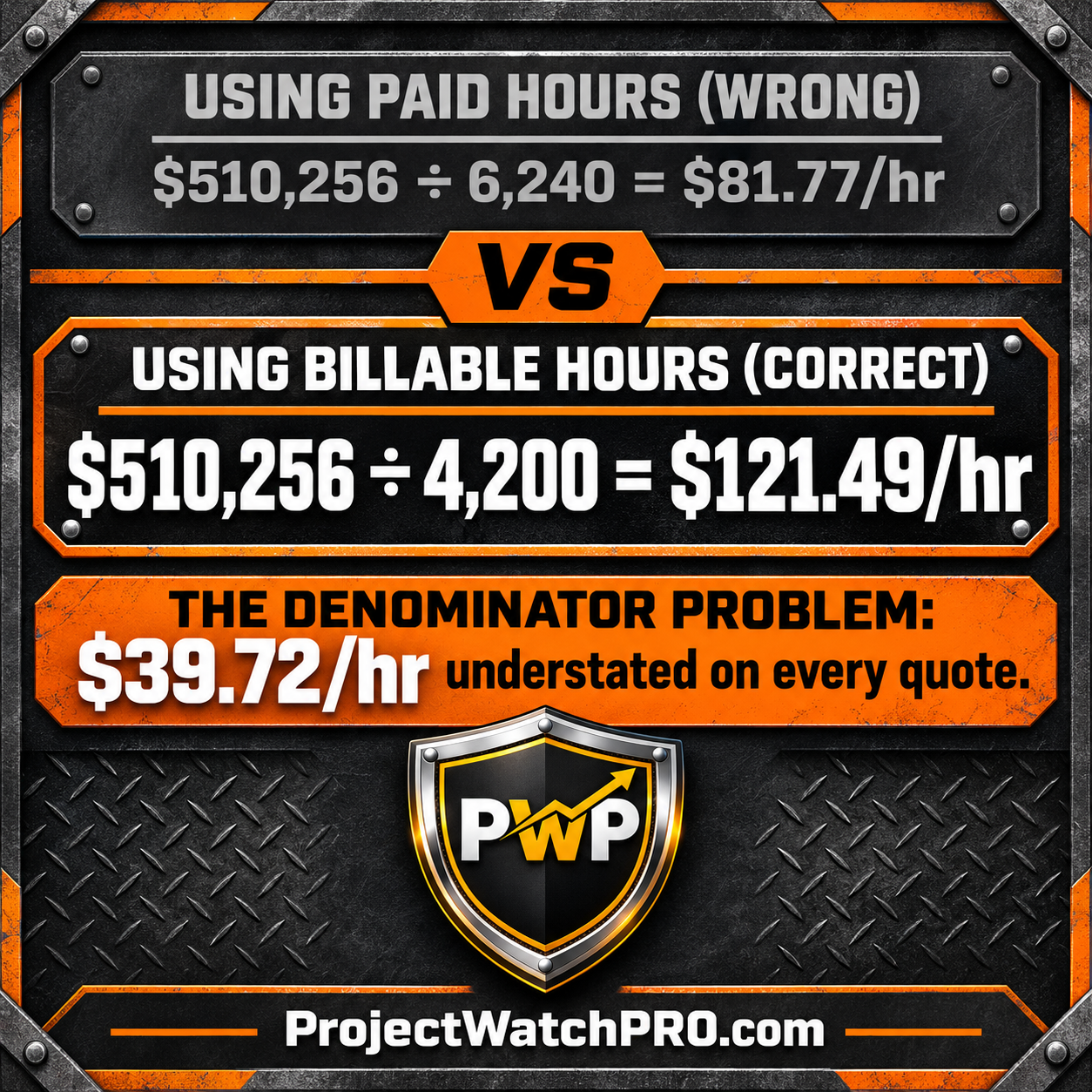
$510,256 ÷ 4,200 billable hours = $121.49 per billable hour
That's the break-even rate. Every hour billed at less than $121.49 is an hour that doesn't cover costs. Profit goes on top of that number, not inside it.
Compare that to the $85/hr the shop down the road is charging. If your costs produce a break-even of $121, you're not competitive at $85 — you're losing $36 on every hour you bill.
Here's what most shops get wrong: they divide total costs by paid hours instead of billable hours. With 6,240 paid hours in the denominator, the same $510,256 in costs produces a rate of $81.77 — a number that looks reasonable and is actually dangerous. It understates the break-even rate by $40/hr and guarantees the shop loses money on every job, every year, while the owner thinks the math is working.
Tailgate Office's 2026 overhead-rate explainer makes the rule clear: "The bottom of the fraction is billable hours. It is not paid hours, and it is never 2,080 per person."
Why the Rate You're Using Is Probably Wrong
There are three ways a shop rate ends up wrong. Most shops have at least one of them. Many have all three.
It Was Set Once and Never Updated
Costs change. Shop rent went up. Workers' comp rates shifted when you added a new trade class. Equipment lease payments changed. The rate that covered costs in 2021 may not cover the same costs in 2026 — but the quote template still has the old number in it.
Prism's construction cost management guide states it directly: "If you haven't recalculated in 12 months, you're probably pricing off a number that no longer reflects your business." A shop rate is not a one-time calculation. It needs to be updated when costs change materially — at minimum, annually.
It Was Borrowed From a Competitor or an Industry Average
Industry averages exist. For welding and fabrication, $80–$120/hr is a commonly cited range depending on the type of work and region. For industrial coatings and abrasive blasting, it varies by specialty and location. These are useful for sanity-checking a number. They're not useful for building one.
Your overhead per square foot of shop space is not the same as theirs. Your workers' comp rate depends on what your crew actually does and your claims history. Your equipment costs depend on what you bought, when, and what you owe on it. No competitor's rate accounts for any of that.
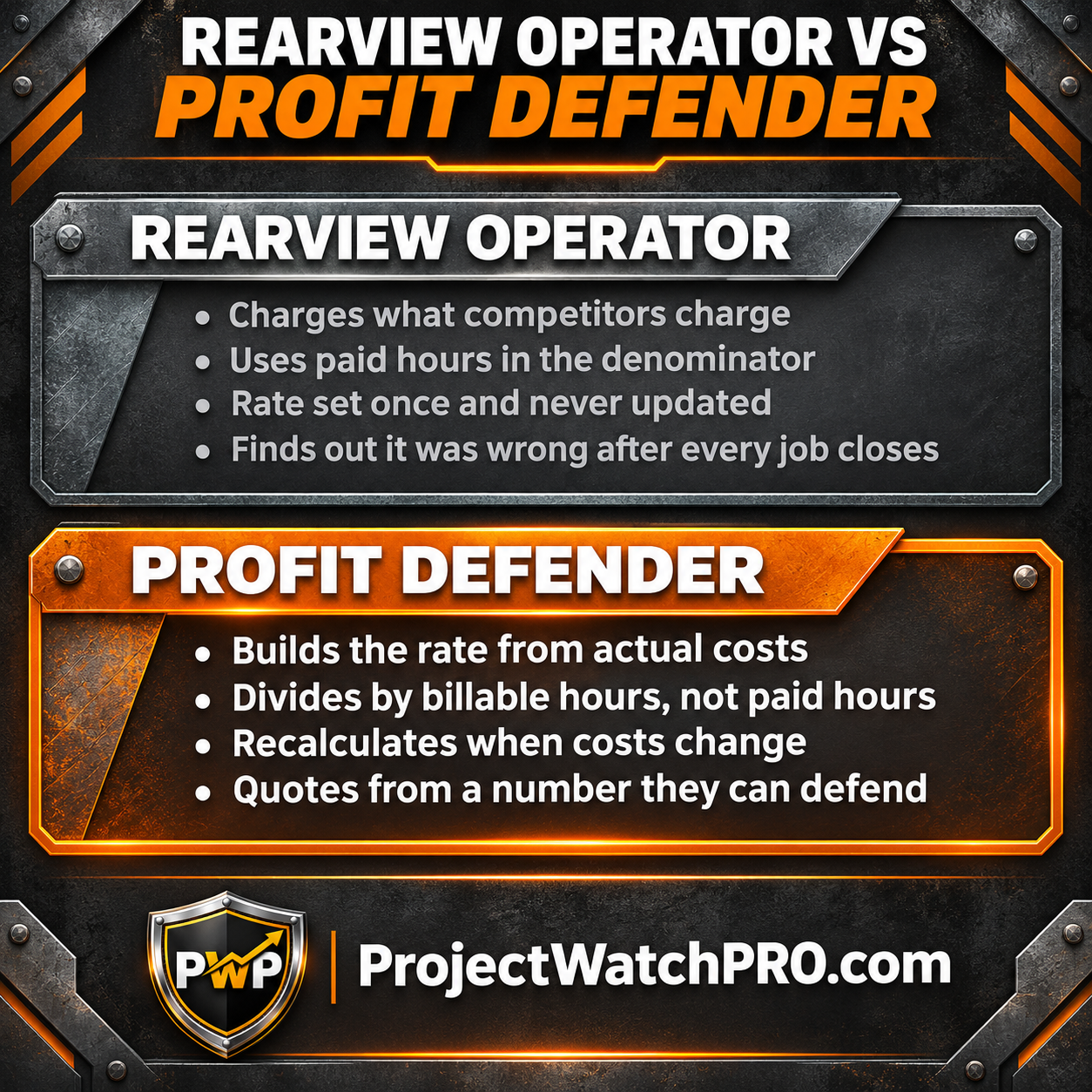
The Denominator Is Paid Hours, Not Billable Hours
This is the most common and most damaging error. Using paid hours in the denominator understates the break-even rate by 25–55% depending on how much non-billable time the shop carries. A shop with 70% billable hours that uses paid hours in its rate calculation is building a quote that covers 70 cents of every dollar it costs to run the shop. The other 30 cents comes from margin that isn't there.
Swap fabrication for whatever your trade is — service trades, industrial coatings, electrical, plumbing, general contracting. The non-billable time problem exists in every one of them. The hours you pay for and the hours that land on a customer invoice are two different pools. The rate is built from the second pool, not the first.
The all-in daily cost of a field employee shows the same gap from a different direction: when you add up wages, burden, vehicle, tools, and overhead for a single person per day, the number is typically $600–$800+. If you're billing 6.5 hours out of that day at $85/hr, you're recovering $552. The day cost you more than that before the truck left the lot.
What changes when you use the right number is not dramatic in terms of the work you do — the jobs run the same, the crew is the same, the customers are the same. The price changes by whatever it was underpriced by. Some jobs go up 15%. Some go up 30%. And the year-end numbers stop being a mystery.
John McCabe has seen this play out in Profit Recovery Reviews across industrial and trade businesses at every revenue level. The owners who discover their break-even rate is $40–$60/hr higher than what they've been charging don't have an execution problem. They have a rate problem — built on a denominator that was wrong from the start. At $3M in revenue, correcting a $30/hr gap in the shop rate typically recovers around $150,000 per year in margin that shows up in the books but not in the bank.
This isn't a job shop problem or a welding problem. Any business that quotes time — HVAC, plumbing, painting, concrete, coatings, GC work — runs the same calculation. The shop rate is just the name the machining and fab world uses for the number trade contractors call a loaded labor rate. Same math, same stakes, same consequences when the denominator is wrong. The True Labor Cost Blueprint builds the number correctly regardless of what your trade calls it — step by step, from your actual costs, in one calculation.
Key Takeaways
- A shop rate is the minimum hourly charge needed to cover all shop operating costs — wages, labor burden, overhead, and consumables — before any profit is added
- The calculation is total annual operating costs ÷ annual billable hours — not paid hours; using paid hours understates the break-even rate by 25–55% in most shops
- Labor burden adds 25–45% to the wage cost alone — employer payroll remittances, workers' comp, vacation, and benefits before the person touches a job
- Most shops set their rate by copying a competitor — which transfers someone else's cost structure into your quotes; your rent, your equipment, your comp rate are not theirs
- A rate that hasn't been recalculated in 12 months is probably wrong — costs change, billable-hour ratios shift, and a stale rate quietly bleeds margin on every job
- At $3M revenue, a $30/hr gap between the real break-even rate and the quoted rate accounts for around $150,000/year in unrecovered costs — the work was done, the invoice was paid, the money just never arrived
- The True Labor Cost Blueprint at truelaborcostblueprint.com builds your shop rate from your actual payroll, your actual overhead, and your actual billable hours — not an industry average
Frequently Asked Questions
What is a shop rate and how is it calculated?
A shop rate is the hourly cost to run a job shop for one hour of billable work — total annual operating costs (wages, labor burden, overhead, consumables) divided by annual billable hours. It's the minimum charge needed to cover costs before profit. Most shops calculate it incorrectly by dividing by paid hours instead of billable hours, which understates the real break-even rate by 25–55%.
What should I charge per hour for my fabrication or welding shop?
There's no single answer — the right rate is your costs divided by your billable hours, not an industry average. For a 3-person fab shop with $510,000 in annual costs and 4,200 billable hours, the break-even rate is $121/hr before profit. That's your floor. What you charge above it depends on your margin target. The True Labor Cost Blueprint runs this calculation from your actual numbers.
Why is my shop rate higher than what competitors charge?
It could mean your costs are higher — more equipment debt, higher rent, higher comp rates. It could also mean your competitors are quoting below their break-even rate without knowing it, which is a common situation in every trade. What your competitor charges should not determine what you charge. Your costs determine your floor. If your floor is higher than the market, that's information — it means the work you're quoting either needs to be priced at the real rate or the cost structure needs to change.
What is the difference between paid hours and billable hours in a shop rate calculation?
Paid hours are all the hours you pay your crew for. Billable hours are only the hours that land on a customer invoice — productive job work, not drive time, setup, breakdown, training, or waiting. In most trade and fab shops, billable hours run 65–80% of paid hours. Using paid hours in the denominator understates the rate because it spreads costs across a larger denominator than the jobs actually absorb. See non-billable hours in construction for the full breakdown.
How often should I recalculate my shop rate?
Any time costs change materially — a rent increase, a workers' comp audit, a new equipment lease, adding a person — the rate needs to be recalculated. As a minimum, once per year. A rate set two or three years ago and never touched is almost certainly wrong; costs in the construction and industrial trades have moved significantly since 2022. The fix is a one-time calculation that takes about an hour, not an ongoing system — the True Labor Cost Blueprint walks through it step by step.