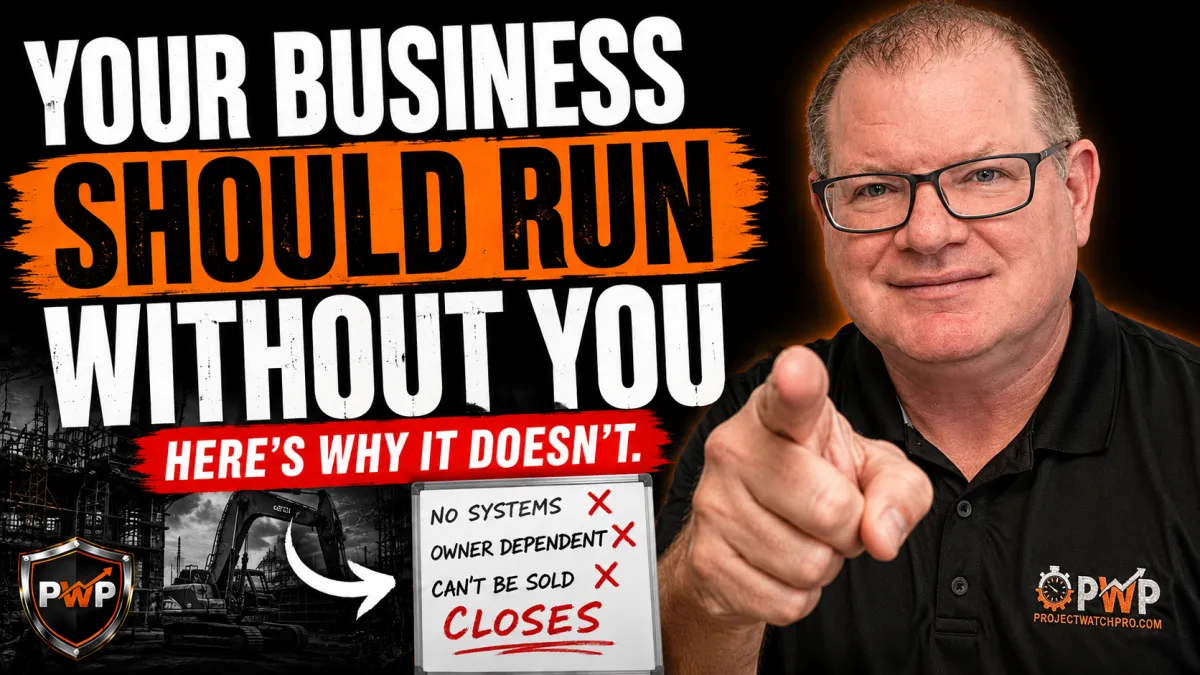
Construction Business Owner Independence: What It Actually Takes
Your Construction, Trades, or Job Shop Business Should Run Without You. Here's Why It Doesn't — And What to Do About It.
In May 2026, Forbes published a piece titled "The Clock No One Set: America's Small Business Succession Crisis." The headline stat: 70% of small businesses never find a buyer.
But there's a detail most people don't quote from the research behind that number. The primary obstacle cited for why businesses fail to transfer successfully is not price. It's not timing. It's not even family conflict.
It's owner dependency — and the absence of documented processes.
The business couldn't be sold because it wasn't really a business. It was the owner. And a team of people executing what the owner kept in their head.
This is the construction and trades industry's quiet crisis. Forbes reported in February 2026 that six million boomer-owned businesses are set to change hands over the next decade — a $5 trillion ownership transfer analysts are calling the "Great Ownership Transfer." A significant portion of the construction services, trades, and job shop operations in that number will not transfer.
They'll close.
Not because they weren't profitable. Because they couldn't operate without their founder physically present. If you've ever wondered why jobs that quote 20% margin keep closing at 4%, the Owner Trap is usually the root — and the exit problem compounds it.
If you're running a $2M–$15M construction services, trades, or job shop operation — and the business still calls your phone first, still needs you to sign off on the big decisions, still slows down when you're out of pocket — this post is about what changes that.
Trades business owner independence means the business operates, quotes, schedules, and tracks costs from documented systems and real-time data — not from the owner's presence, memory, or daily judgment. An owner-independent construction service, trades operation, or job shop generates predictable margin on every job, can be managed remotely, and retains its full value even when the founder steps back. This is what separates a business that supports the owner's life from one that consumes it.
Construction, Trades & Job Shop Owner Independence
What Makes a Construction, Trades, or Job Shop Business Owner-Independent — and Sellable
What the 2026 Succession Research Actually Shows
The Three-System Architecture That Removes the Owner
Phase 1 — The 90-Day Foundation (PPS + PWP)
Stage 1 — True Cost Foundation (Steps 1–3)
Stage 2 — Production Flow (Steps 4–6)
Stage 3 — Profit Defense (Steps 7–9)
Phase 2 — Profit Defense Advisory Services and the Profit Defense System™
What Twenty Years of System Ownership Looks Like
The Business That Supports Your Life — Not the Other Way Around
The Owner Trap — Why Most Construction, Trades, and Job Shop Businesses Can't Be Sold or Stepped Away From
The Owner Trap is the business model where the owner is the operating system.
Every quote goes through them. Every big materials call gets their approval. Every time a job runs long, the site foreman calls the owner — because the systems that should handle it don't exist, or nobody trusts them enough to act without asking. The owner is the hub. Everything else is a spoke.
This is not a character flaw. It's not because the owner failed to "delegate properly" or refused to "let go of control." It's a design problem. The business was built to run on one person's judgment, experience, and daily availability — and it was never rebuilt to run without them.
You're not the problem. The operating model is.

The consequence of the Owner Trap is not just that the owner is tired, overworked, and missing things that matter outside the business — although all of those things are usually true. The consequence is structural: the business itself becomes unsellable, unscalable, and irreplaceable.
A buyer — whether that's a private equity group, a strategic acquirer, a family member, or a key employee wanting to take over — is not buying the owner's reputation. They are buying a system. A set of documented processes, repeatable margins, and real-time financial data that prove the business will keep performing once the founder is no longer the center of every decision.
If the system is the founder, there is nothing to buy.
What Makes a Construction, Trades, or Job Shop Business Owner-Independent — and Sellable
An owner-independent construction or trades business has three things that most operations have never formally built.
Documented, verified cost foundations. The true overhead rate, the true labor cost per employee, the task-specific burden — all calculated from the actual P&L and real payroll data, not carried in the owner's head or approximated from what the last estimator used. When a buyer or their advisors run due diligence, these numbers exist, they're auditable, and they're defensible.
Jobs that run on systems, not supervision. Task-level scheduling, pre-job readiness, real-time tracking of cost against charge-out rate — all of it operating without the owner making daily calls about what happens next. The business has a rhythm. It doesn't require one person to hold that rhythm together.
Real-time financial visibility that replaces owner presence. Not the 30–45 day lag between when costs happen and when the bookkeeper reports them — live data that shows what each job is actually costing right now, by task, including overtime exposure, so any qualified party can see exactly where the business stands without calling the founder.
These are not philosophies. They are systems. And they can be built.
What the 2026 Succession Research Actually Shows
According to Forbes' January 2026 reporting on the Silver Tsunami, approximately 2.3 to 3 million boomer-owned small businesses are expected to transition over the next decade, with the 2026 State of Main Street report documenting that 70% of small business owners have no formal succession plan. The research behind that number points to two root causes above all others: owner dependency — the business cannot function without a specific individual — and the absence of documented operational processes.

In the construction and trades sector, this is compounded by demographics. The median age of the construction labor force in Canada is rising. The ownership cohort is older still. And the buyers who could step into these businesses — younger operators, private equity, strategic acquirers, family members — are increasingly citing "operational complexity" and "owner reliance" as the reason they walk away from otherwise profitable acquisitions.
The businesses successfully transferring are the ones where financial data is clean and accessible, operations run on documented systems, and margin is demonstrably repeatable — not historically present, but structurally built in.
The businesses closing are the ones where the knowledge, the relationships, and the judgment all walk out the door with the founder.
---
The Three-System Architecture That Removes the Owner
Three systems work together to produce a business that runs without its founder — and understanding what each one does matters, because this is not simply a software implementation.
The Profit Pulse System™ (PPS) is the Engine. A 9-step foundational operating system built specifically for construction services, trades, and job shop operations doing $1M–$20M. Every quote, every schedule, every cost-tracking process runs on this foundation. Before any software is activated, the PPS gets built first. It is the operating system the business runs on.
ProjectWatchPRO is the Automation — the software platform awarded Top Construction Job Costing and Project Management Software in Canada for 2026 — built to run on top of the PPS. It automates what the PPS defines: cost calculations, real-time job tracking, margin drift alerts, invoice cadence. Without the PPS foundation, there is nothing for the software to automate. With it, the automation runs the business while the owner watches.
The Profit Defense System™ (PDS) is how the business runs. Not the operating foundation, and not the software — the management methodology that removes the owner from day-to-day decisions without sacrificing profit margin, financial visibility, or control over the business.
The implementation is structured in two phases. Phase 1 — the 90-day engagement — installs the Profit Pulse System and activates ProjectWatchPRO. The business gets its foundational operating system built, and the software that automates it deployed. Phase 2 is where Profit Defense Advisory Services comes in: a structured advisory engagement that builds out and deploys the Profit Defense System — the operational methodology, management cadence, and decision rhythms that make owner removal structural rather than personal.
The businesses that fail to find a buyer or can't step back are not simply missing software. They are missing the foundational operating system the software needs to run on, and the management methodology that makes the transition permanent.
Phase 1 builds the foundation. The PPS transition runs through three stages. Each is executable in sequence. None require the business to pause.
Phase 1 — The 90-Day Foundation (PPS + PWP)
Stage 1 — True Cost Foundation (Steps 1–3)
The first stage gets the numbers out of the owner's head and into a verified, documented system that any party can read and trust.

Step 1 — Overhead Guru calculates the true overhead burden rate from the actual P&L — every operating dollar (rent, insurance, admin, vehicles, software, management time) divided by real productive field hours, not paid hours. Not an industry average. Not the number carried over from the last estimator. The real number, from the real financials, recalculated on a rolling twelve-month basis so it stays current. When this number is wrong, every quote is wrong before anyone picks up a tool.
Step 2 — Labor Analyst calculates the true cost to employ each person on the crew — not just base wage, but every layer of labor burden: employer payroll taxes, workers' comp, benefits, vacation accrual. Built per employee, not as a company-wide average, because each person's burden is different. This is the number every labor hour on every quote should be built from.
Step 3 — Burden Builder prices specialized, high-cost tasks at what they actually consume. Blasting media. Welding wire and gas. Specialty PPE. Consumables that apply to one type of work and nothing else. Instead of burying those costs in overhead — where they get spread thin across every hour in the business — Burden Builder assigns them as task-specific hourly rates to the work that actually generates them.
When Stage 1 is complete, the business has auditable unit economics. The cost data buyers and their advisors want to see exists — and it's accurate. The owner is no longer the only person who knows what the business actually costs to run.
Stage 2 — Production Flow (Steps 4–6)
The second stage shifts jobs from running on the owner's judgment to running on documented structure and pre-built process.
Step 4 — Task Architect builds the master task list that every quote, every schedule, and every time entry in the business runs from. When a quote is built from one set of line items and the crew tracks time against different categories, there is no way to compare what was quoted against what was spent, task by task. Task Architect creates the common language that makes that comparison possible — and that every step in Stage 3 depends on.
Step 5 — Bulletproof Quote builds the Bulletproof Quote from the verified cost inputs established in Stage 1 — labor at true cost per employee, overhead at the real rate, task-specific burden applied where it actually belongs. The quote floor — the minimum that protects the profit on that specific job — is a calculated number, not a gut check. No owner presence required to know whether the quote is defensible before it goes out.
Step 6 — Schedule Master schedules at the task level, not just the job level — right crew, right task, right sequence, right timing — and enforces a readiness discipline: nothing goes on the calendar before materials are confirmed, crew is allocated, and the task sequence is clear. Idle hours on a job site are hours that were quoted as productive, paid regardless, and never recovered. Schedule Master eliminates them before the day starts.
When Stage 2 is complete, the business has production flow that doesn't need the founder to keep it moving. A general manager can run the operation. A buyer can observe it and understand it. The founder can be away for three weeks and the jobs still run.
Stage 3 — Profit Defense (Steps 7–9)
The third stage replaces owner presence with real-time job cost visibility. The owner stops needing to be on site — or on the phone — because the dashboard tells them everything the site visit used to.
Step 7 — Pulse Monitor breaks the 30–45 day Profit Lag — the gap between when profit gets lost on a job and when anyone finds out. Time is tracked by task and compared in real time against what was quoted for that work, while the job is still open. Not a month-end postmortem — a live view of what each job is actually costing, on a dashboard any qualified party can read without calling the owner.
Step 8 — Drift Detector reviews live job data against the quote, the schedule, and the target profit — on a defined rhythm — and catches drift before it becomes a budget overrun or a cash flow problem. A job total can look acceptable while a single task burns twice its budgeted hours underneath it. Drift Detector looks past the total — task by task — and assigns a named action with an owner when something is off.
Step 9 — Profit Pulse Loop establishes the weekly, monthly, and quarterly review rhythm that turns one-time fixes into permanent operating standards. Every fix that isn't documented and built into the system quietly reverts. Someone forgets. A new hire never learns the new way. The old habit creeps back. Profit Pulse Loop closes that gap: every lesson from every job gets embedded into how the business operates going forward — the same leak never costs twice.
When Stage 3 is complete, the owner has a dashboard instead of a phone that rings constantly. They manage by exception — seeing what drifts, acting on what matters — rather than being present for every decision that moves through the business.
Phase 2 — Profit Defense Advisory Services and the Profit Defense System™
Phase 1 installs what the business runs on. Phase 2 installs how the business is run.
Once the Profit Pulse System is operating and ProjectWatchPRO is live, the Profit Defense Advisory Services engagement begins. This is a structured advisory program — not additional software, not a course — where the Profit Defense System™ (PDS) is built into the business alongside its management layer.
The PDS is the operational methodology that makes owner removal structural. Where Phase 1 gives the business verified cost data, automated job tracking, and a Bulletproof Quote process, Phase 2 builds the management cadence, decision rhythm, and accountability structure that allows a general manager — or any qualified operator — to run the business at the standards the owner used to maintain personally.
This is the distinction that separates a business that can perform when the owner steps back from one that quietly degrades. The PPS and PWP provide the data and the automation. The PDS and the advisory engagement that deploys it provide the human operating structure that uses that data without the founder present.
The owner's involvement in Phase 2 shifts. They are no longer making daily decisions — they are reviewing exception reports, setting direction at the management level, and monitoring outcomes through the ProjectWatchPRO dashboard. The business has a management layer that is trained, cadenced, and accountable. The owner manages the system. The system manages the business.
For owners targeting a sale, a family transition, or simply the ability to take three weeks without their phone ringing — Phase 2 is where the business becomes genuinely independent. Phase 1 makes it possible. Phase 2 makes it permanent.
What Twenty Years of System Ownership Looks Like
Abrasive Blast and Paint Inc. has been running the Profit Pulse System™ since 2004. They came in operating a $1.5M industrial sandblasting and painting operation. The owners were doing what owners in that situation typically do: managing the quotes, reviewing every job, available by phone whenever something went sideways on site.
Twenty years later, the owners don't work in the business day-to-day anymore. The system runs it. The data flows. The jobs close. The margin is there.
That's not the result of luck or a particularly talented management team. It's what happens when a business is deliberately designed to run on documented systems rather than on the founder's daily availability.
If the system required the owners to stay involved to function — if the business was still dependent on their presence — they would have had to come back. In the past fifteen years or so, they haven't needed to.

The Business That Supports Your Life — Not the Other Way Around
The owner who runs a Hub business does not own a business. They have built themselves an expensive, demanding job — one they cannot easily leave, sell, or step away from without everything slowing down or stopping.
The System Owner is different. Monday morning looks different.
The dashboard shows what is happening on every active job — cost against charge-out rate, schedule adherence, overtime exposure — without a single phone call. The general manager has a decision rhythm. The crew has clear, sequenced work. The quote was built from verified numbers. The invoice goes out on schedule.
The owner's phone is quieter. Not because they have "let go of control" — because the system is doing what the owner used to do manually. The control is still there. It's just not exercised through constant availability.
This is what ninety days of disciplined implementation produces: a business that is not only more profitable on a per-job basis, but more valuable, more transferable, and genuinely capable of supporting the life its owner built it for in the first place.
Key Takeaways
- 70% of family-owned businesses fail to find a buyer — Forbes' 2026 succession research identifies owner dependency and absent documented processes as the primary cause
- A trades or job shop that requires the owner's daily presence is not a sellable asset — its value walks out the door with the founder
- Three systems drive the transition: the Profit Pulse System™ (PPS) is the Engine (the 9-step foundational operating system, built first across True Cost Foundation, Production Flow, and Profit Defense); ProjectWatchPRO is the Automation (software that runs on the PPS); the Profit Defense System™ (PDS) is the operational methodology installed in Phase 2 through Profit Defense Advisory Services
- Phase 1 (90 days) installs PPS + PWP — beginning with Overhead Guru, Labor Analyst, and Burden Builder in Stage 1, through Bulletproof Quote and Schedule Master in Stage 2, through real-time visibility in Stage 3 — while the business keeps running
- Phase 2 deploys PDS through Profit Defense Advisory Services: the management cadence, decision rhythms, and operational methodology that make owner removal structural, not temporary
- Documented, verified cost foundations — true labor cost per employee and real overhead rate — are the first step toward financial data that holds up under buyer due diligence
- Real-time job cost visibility replaces the owner's need to be physically present — the business runs from a dashboard, not from the owner's memory
- Abrasive Blast & Paint has operated without owner day-to-day involvement for over a decade, running on the same system since 2004
Frequently Asked Questions
What does it mean for a construction, trades, or job shop business to be owner-independent?
An owner-independent trades business has documented systems for quoting, scheduling, and cost tracking that operate without requiring the owner's daily presence or decisions. It has verified financial data that any qualified party can audit and trust, and it generates predictable, repeatable margins that exist because of the system — not because the owner is personally managing every detail on every job.
How long does it take to step back from day-to-day operations in a trades, construction, or job shop business?
Phase 1 — installing the Profit Pulse System™ and activating ProjectWatchPRO — takes 90 days. That phase establishes verified cost data, a Bulletproof Quote structure, and a production flow cadence. Phase 2, delivered through Profit Defense Advisory Services, builds out and deploys the Profit Defense System™: the management cadence, decision rhythms, and accountability structure that allow middle management to operate the business without the owner's daily input. Full internalization, where the owner manages by exception rather than by presence, typically develops over six to twelve months. The business does not need to pause during either phase.
What makes a construction, trades, or job shop business sellable to a buyer?
Buyers and their advisors look for three things: auditable unit economics (verified cost data, not estimates), operational independence from the founder (documented systems that continue running without specific individuals), and demonstrably repeatable margin. A business that has all three can command a premium. A business where the value is the founder's knowledge and judgment is difficult to sell and often impossible to transfer at a meaningful price.
Why do most trades and construction business owners struggle to step back from operations?
Most trades businesses were built by people who were excellent at the work — and who solved operational problems by being available, knowledgeable, and decisive. The business learned to depend on that. There are no documented systems because the owner was the system. Stepping back requires replacing the owner's presence with documented processes, verified financial data, and real-time visibility — not willpower or better time management.
What is the Owner Trap in construction, trades, and job shops?
The Owner Trap is the business model in which the owner is the operating system. Every significant decision, quote review, crew deployment, and problem escalation flows through one person. The business performs when the owner is present and slows or fails when they are not. It is a design problem — the business was built on the founder's availability and was never redesigned to run without it.
Can a $2M–$15M construction, trades, or job shop business become genuinely sellable without private equity involvement?
Yes. The factors that make a business attractive to any buyer — auditable financials, operational systems that run without specific people, and demonstrable margin — are built through process implementation, not deal structure. A trades or construction operation that installs verified cost systems, a Bulletproof Quote process, and real-time job cost visibility becomes demonstrably more transferable regardless of whether the eventual exit is to a family member, a key employee, a strategic buyer, or an institutional acquirer.
If your business still requires your daily presence to run — and if the thought of stepping back for a month makes your stomach tighten — the first step is not a management book or a delegation workshop. It's a clear picture of what the business actually costs to run, where the margin is going, and what it would take to make the business genuinely independent of you.
A Profit Recovery Review starts there. We pull your actual employment costs, calculate your real overhead rate, and run the diagnostic against your last three jobs. From that, we build a specific 90-day action plan: what Stage 1 looks like for your operation, what changes in Stage 2, and what it means for the business — and for your time — when Stage 3 is running.
It is $299. 45 minutes. You walk away with a specific number and a clear sequence of steps, whether we work together after that or not.
The business you built deserves to be worth something — and to run without you being the price of that.
→ Book a Profit Recovery Review ($299)


